

Among the main language certificates that students who want to apply for bachelor's, master's and doctoral programs in France or other countries where education is provided in French, the DELF and DALF diplomas occupy a special place. These diplomas confirm the candidate's reading, listening, writing and speaking skills in French in accordance with international standards. Both diplomas are official French language diplomas issued by the French Ministry of National Education. DELF covers levels A1, A2, B1 and B2, while DALF covers higher levels C1 and C2.
DELF and DALF are not just temporary certificates showing exam results. These diplomas are recognized worldwide and are valid for life. Once a candidate has obtained the certificate, he does not have to renew it after a certain period of time or take the same exam again.
In this article, "Hesabla.com" will explain in detail what the DELF and DALF exams are, the difference between them, what the levels mean, the exam structure, how the results are calculated, how universities approach these diplomas and what you should pay attention to during preparation.
# What are DELF and DALF and who needs them?
DELF is an official diploma that confirms the language skills of people learning French as a foreign language. DELF stands for “Diplôme d’études en langue française”, meaning “Diploma of studies in French”. This system consists of four levels: A1, A2, B1 and B2.
DALF is a diploma that confirms high and professional level skills in French. DALF stands for “Diplôme approfondi de langue française”, meaning “In-depth diploma in French”. This system consists of two levels: C1 and C2.
- DALF C1 shows that the candidate can use French independently in academic, professional and complex communication environments.
- DALF C2 confirms a very high level of language proficiency, the ability to analyze and synthesize complex information.
It should also be noted that, although each level has its own diploma, for example, it is not mandatory to have an A1, A2 or B1 diploma in order to take the DELF B2 exam. The candidate can register directly for the exam according to their language level.
So, for what purposes can DELF or DALF be used? So, you can use these diplomas when applying to universities, when applying to Master's and doctoral programs, when applying for jobs or when applying for scholarship programs.
DELF and DALF diplomas can also strengthen your CV in job applications and make it easier to find a job in companies where the French language is used. However, which diploma is required for university applications depends on the program. While some universities accept DELF B2, others may require DALF C1 or additional language documents.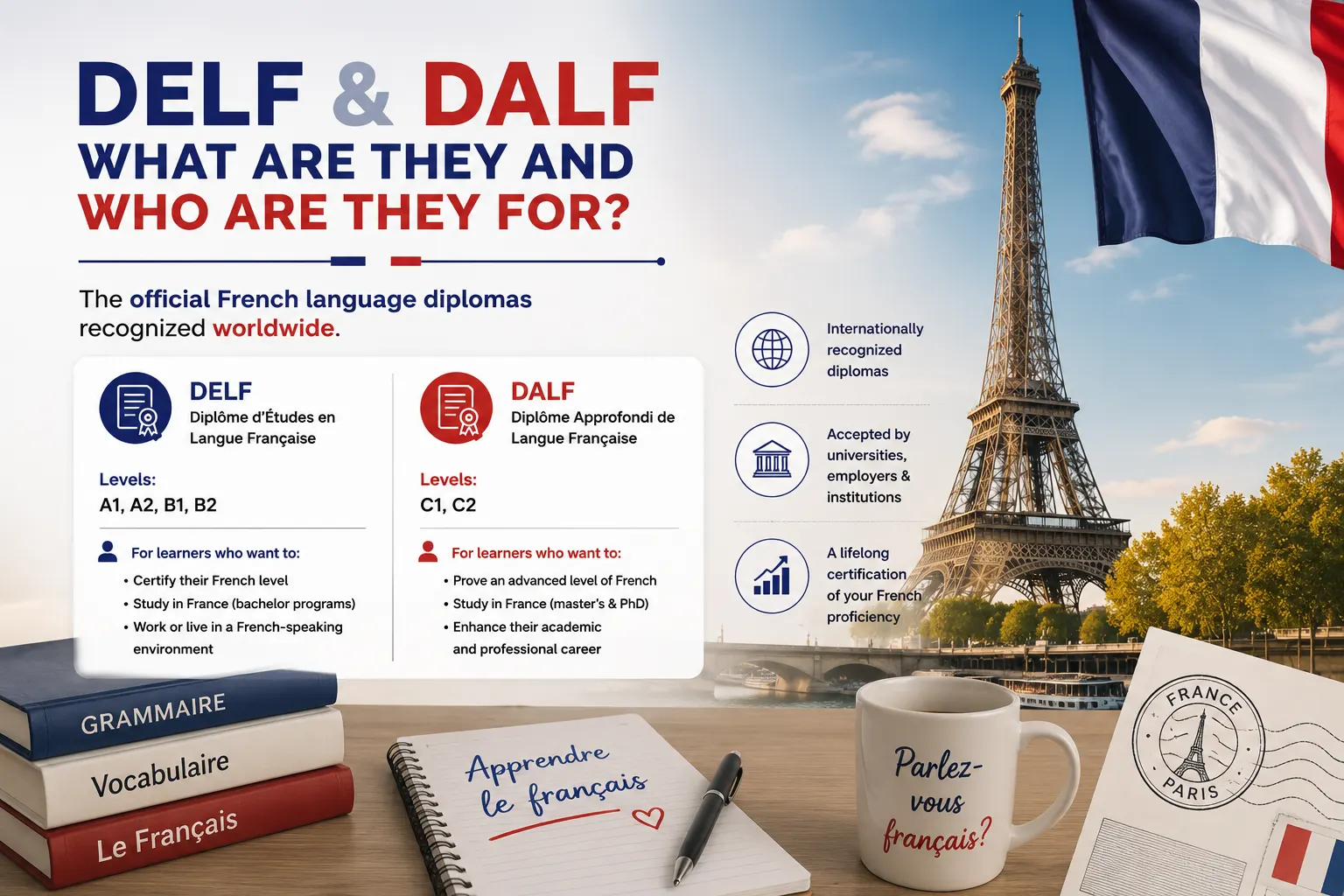
# What is the structure of the DELF and DALF exams?
The DELF and DALF exams assess four basic French language skills:
1. Compréhension de l’oral — listening comprehension (understanding spoken and audio materials in French)
2. Compréhension des écrits — reading comprehension (understanding the main idea and details of various texts)
3. Production écrite — written expression (producing written text appropriate to the purpose and level)
4. Production orale — oral expression (communicating ideas in French in a clear and appropriate way)
From DELF A1 to DALF C1, these four skills are assessed separately. In DALF C2, however, skills are tested within a broader and integrated set of tasks. The exact duration of the exams, the complexity of the texts, the number of tasks and the length of the required writing vary depending on the chosen level.
# What is the DELF and DALF scoring system and how is it calculated?
In the DELF A1, A2, B1, B2 and DALF C1 exams, each of the four basic skills is assessed with 25 points.
- Listening Comprehension = 25
- Reading Comprehension = 25
- Written Expression = 25
- Oral Expression = 25
- Total Score = 100
To obtain the diploma, the Overall Score must be at least 50/100 and the score in no section must be lower than 5/25. In other words, a high overall score alone does not guarantee obtaining the diploma.
In the DELF and DALF exams, the calculation of the score is mainly based on the sum of the scores obtained in the four language skills. That is, Overall Score = Listening + Reading + Writing + Speaking
- Listening = 14/25
- Reading = 16/25
- Writing = 13/25
- Speaking = 17/25
- Total Score = 60/100
This candidate obtains the diploma because:
* His overall score is higher than 50.
* He did not obtain a score lower than 5 in any section.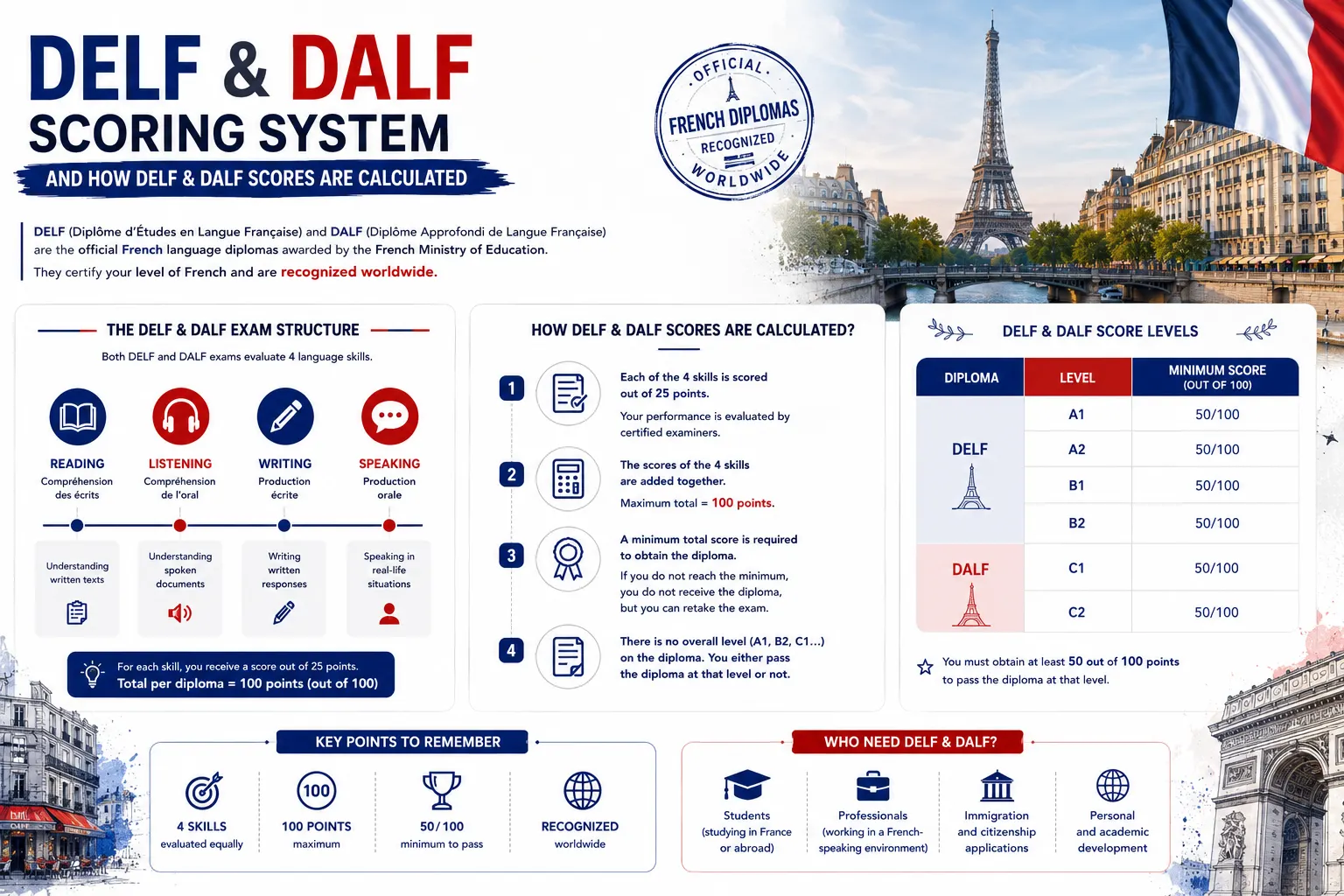
# How do universities view DELF and DALF results?
While universities consider DELF and DALF diplomas as proof of language proficiency that a candidate can study in French, DELF and DALF diplomas, like other exams, do not play a role in admissions alone. This means that academic results, certificates or diplomas, transcripts, motivation letters, CVs and other requirements of the program are also taken into account.
# How do universities view DELF and DALF results?
Although universities consider DELF and DALF diplomas as language proof that a candidate can study in French, DELF and DALF diplomas, like other exams, do not play a role in admission alone. This means that academic results, certificates or diplomas, transcripts, motivation letters, CVs and other requirements of the program are also taken into account.
# Our recommendations as "Hesabla.com" for those preparing for the DELF and DALF exams
If you have problems with the listening section, listen to daily audio materials in French, these materials do not always have to be materials specifically designed for listening. News, interviews and podcasts can also have a positive impact on your listening skills. Another mistake in this exam is trying to write out the whole sentence, instead try to note down the main words. When it comes to levels B2, C1 and C2, hearing only the words is not enough. You may also need to understand the speaker's position, tone, and logic of the argument.
In the Reading section, the texts become longer, more abstract, and more argumentative as the level increases. Therefore, read the title and the first few sentences of the text carefully. Identify the main idea and supporting examples. Pay attention to connecting words. Do not try to translate every word in the text. At higher levels, it is especially useful to read news articles, analytical articles, popular science texts, and opinion pieces.
In the Writing section, not only grammar is assessed, but also the correct execution of the task, the structure of the text, the sequence of ideas, vocabulary, and the appropriateness of the language to the situation. Therefore, always determine the type of Task (a letter, an opinion piece, a report, or a synthesis require a different structure), plan what you are going to write, and be sure to prepare an Introduction and Conclusion to help the text seem complete. Use connecting phrases to create a logical connection between ideas.
As for the speaking part, in order to achieve a good result in this part, create an introduction, main part and conclusion regarding the idea you will express. Clearly express your position regarding your idea. Support your opinion with examples. If you do not understand the question, do not get excited and ask for the question to be repeated. Express your answers naturally, not in a memorized form. Before the exam, record your voice and work on your mistakes. During the speaking part, as in other exams, not all sentences are expected to be grammatically perfect in the DELF and DALF exams. The main goal is to establish clear, logical and effective communication appropriate to the level.
# Frequently Asked Questions
- What is DELF?
DELF is an official diploma confirming the language skills of people learning French as a foreign language at levels A1, A2, B1 and B2. It is issued by the French Ministry of National Education.
- What is DALF?
DALF is a high-level official diploma confirming levels C1 and C2 in French.
- How many levels are there in DELF and DALF?
DELF has four levels — A1, A2, B1 and B2; DALF has two levels — C1 and C2.
- How many points are needed to pass the DELF–DALF exam?
A candidate must score at least 50/100 overall and not score lower than 5/25 in any section.
- How are DELF and DALF scores calculated?
Listening, reading, writing and speaking sections are worth 25 points each. Four scores are added together, giving a maximum score of 100.
- Can I pass if I get 4 points in one section, for a total of 60 points?
No. Even if the overall score is higher than 50, a score lower than 5/25 in any section is considered a failure.
- Is DELF B2 sufficient for university?
DELF B2 is acceptable for many French-language university programs. However, some universities, and especially more demanding programs in terms of language, may require DALF C1. The official requirements of the specific program should be checked.
- How long are DELF and DALF valid?
Both diplomas are valid for life.
- Is it possible to take the DELF B2 exam without having taken the DELF B1?
Yes. The levels are independent and the candidate can register directly for the exam of his choice without having the diploma of the previous level.
- Are DELF Junior and DELF Tout Public different?
Both confirm the same CEFR levels. The main difference is the adaptation of the topics and situations to the age group. DELF Junior is aimed at teenagers, while Tout Public is aimed at older teenagers and adults.
- Why is the DELF–DALF Calculator used?
The Calculator adds up the results of the four sections, shows whether the total score reaches 50 and whether each section meets the minimum score of 5.
- How many times can the exam be taken?
A candidate can take the exam several times until he/she receives his/her diploma. Before registering for a new session, the results of the previous exam must be declared.


How the United States calculates taxes for busin...

21 Jul
278