
One of the main international exams that students who want to apply for MBA, business master, management, finance, marketing, business analytics and other business-oriented master's programs abroad face is the GMAT exam. GMAT is used especially by business schools to measure the candidate's quantitative reasoning, verbal reasoning, data literacy, problem-solving and critical thinking skills.
GMAT is more associated with MBA and graduate business programs. Harvard Business School, Stanford GSB, Wharton, INSEAD, London Business School, HEC Paris, IE Business School and other prestigious business schools may accept or require GMAT results during the application process. However, the GMAT policy of each university and each program is not the same. Some programs make GMAT results mandatory, some accept them optionally, and some may grant test waivers under certain conditions.
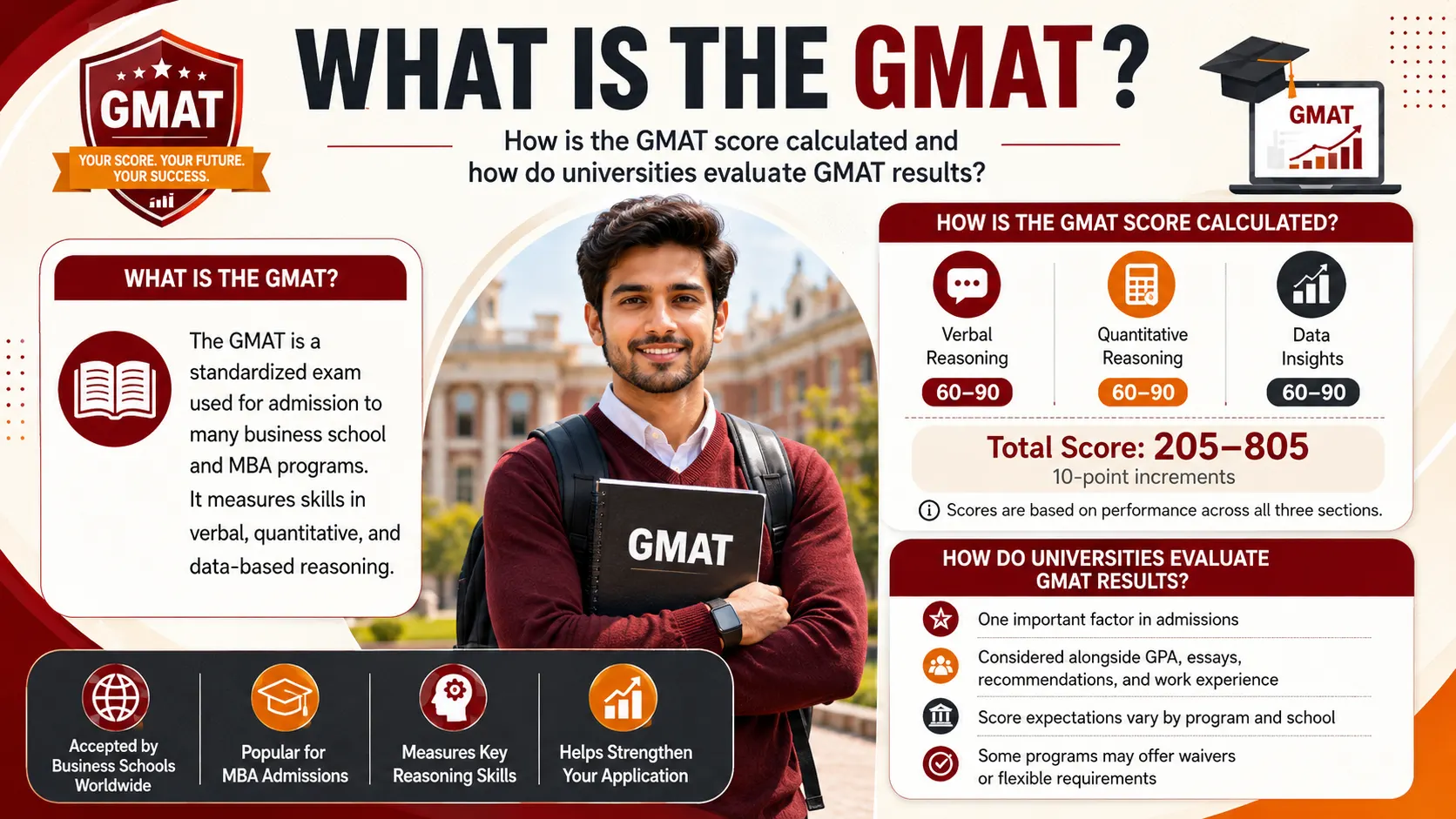
The current GMAT exam consists of 3 main sections: Quantitative Reasoning, Verbal Reasoning and Data Insights. According to the official mba.com, the GMAT exam lasts 2 hours and 15 minutes, consists of a total of 64 questions, and 45 minutes are allocated for each section. There is also an optional 10-minute break in the exam.
In this article, we will explain in detail what the GMAT exam is, who needs it, the current GMAT structure, the GMAT scoring system, how the score is calculated, how universities view GMAT results, how the GMAT Calculator can work, and what you should pay attention to when preparing for the GMAT.
# What is GMAT?
GMAT is an abbreviation for the phrase Graduate Management Admission Test. This exam is mainly used to measure the academic and analytical preparation of candidates applying to graduate business schools, namely MBA and business-oriented master's programs.
GMAT is not just a math or English exam. This test measures a student's thinking skills that are important in a business environment. This includes analyzing information, reading tables and graphs, evaluating arguments, drawing logical conclusions, solving mathematical problems, and understanding written information correctly.
Simply put, the GMAT is a standardized test that shows the problem-solving, data-processing, analytical thinking, and decision-making skills of a candidate applying to business schools.
# Who needs the GMAT?
The GMAT is primarily intended for students applying to MBA and business-oriented graduate programs. This exam can be especially useful for those who want to study in fields such as management, finance, consulting, entrepreneurship, business analytics, accounting, marketing, and strategy.
For example, your undergraduate education may be in engineering, law, economics, computer science, or another field. MBA programs often accept candidates with a variety of academic and professional backgrounds. In this case, your GMAT score can serve as additional evidence that you can succeed in business school.
However, the GMAT is not mandatory for every program. In recent years, many universities have adopted test-optional and test-waiver policies. Therefore, it is important to check the official admission requirements pages of the target universities before preparing for the GMAT.
# What programs is the GMAT used for?
The GMAT is most commonly known for MBA programs. However, its use is not limited to MBAs. Many business schools also accept GMAT scores for a variety of graduate business programs.
Some students think that the GMAT is only for MBA candidates with extensive work experience. This is not true. The GMAT can be used for both MBA and early-career business master's programs. The main thing is to check whether the program you are applying to requires the GMAT.
# The current GMAT exam consists of 3 sections:
1. Quantitative Reasoning
2. Verbal Reasoning
3. Data Insights
According to the official mba.com, the GMAT lasts 2 hours and 15 minutes and consists of 64 questions: 21 questions in the Quantitative Reasoning section, 23 questions in the Verbal Reasoning section, and 20 questions in the Data Insights section. Each section has 45 minutes.
Unlike the previous GMAT version, the current GMAT format does not have a separate Analytical Writing Assessment section. Data Insights, however, takes a more important place in the new format and is included in the total score.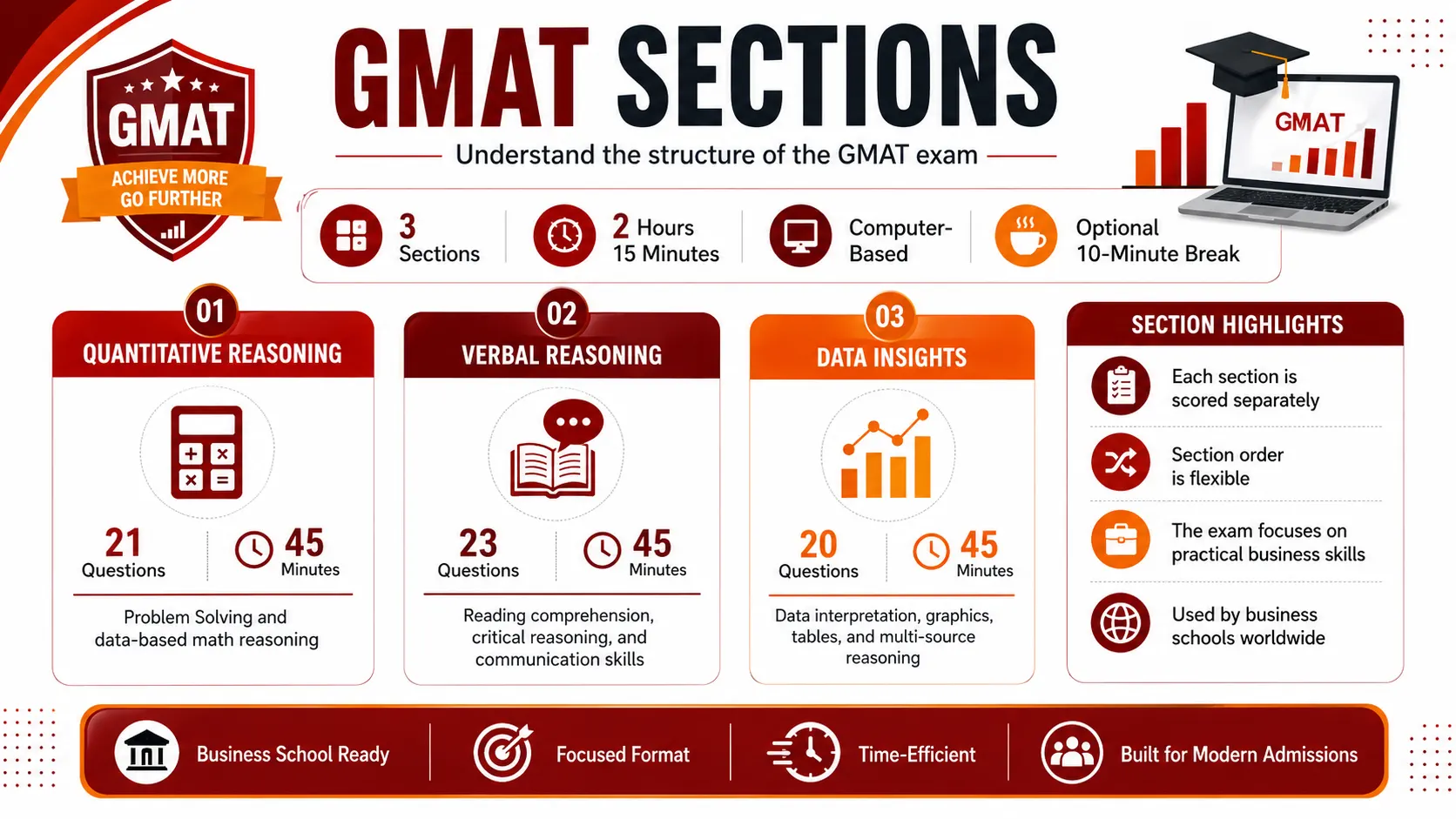
# What does the GMAT Quantitative Reasoning section measure?
The Quantitative Reasoning section measures a candidate’s mathematical reasoning, problem-solving, and quantitative reasoning skills. This section is not about high-level university mathematics, but rather about applying basic mathematical concepts in the context of business and analytical thinking.
The Quantitative Reasoning section is mostly about problem-solving. The candidate must read the information provided, understand the mathematical relationship, choose the correct method, and calculate the answer.
The GMAT Quant is not just a “calculation” section. The main issue here is mathematical reasoning. Sometimes a question may seem simple, but if the correct logic is not established, the answer may be wrong.
Quantitative Reasoning can be especially important for students applying to fields such as finance, business analytics, economics, consulting, and management science. A strong Quant score shows the university that the candidate has the ability to work with numbers and make analytical decisions.
# What does the GMAT Verbal Reasoning section measure?
The Verbal Reasoning section measures a candidate's ability to understand written English, analyze arguments, and draw logical conclusions. This section is not just a vocabulary test. GMAT Verbal is more about understanding the logic of the text, the author's point, and the strength of the argument.
To be successful on the GMAT Verbal, it is not enough to know English alone. The candidate must also be able to see the structure of the text, the author's purpose, and the subtle differences between answer options.
For example, in a question, you may be asked to find an answer that weakens the argument. In this case, you need to not only understand the topic, but also find the main claim of the argument and the assumption on which that claim is based.
Verbal may stand out more in humanities and social sciences programs, but Verbal score is also very important in MBA and business programs. Because reading case studies, conducting discussions, preparing written analysis, and justifying decisions are part of the daily academic process in business school.
# What is the GMAT Data Insights section?
Data Insights is one of the most important sections of the current GMAT format. This section measures the candidate's data literacy, data analysis, reading graphs and tables, integrating information from different sources, and decision-making skills.
The official mba.com page states that the three sections of the GMAT measure skills related to modern business challenges and opportunities. The Data Insights section is also designed to assess the ability to work with data in today's business world.
The Data Insights section is especially important for fields such as business analytics, finance, consulting, product management, operations, and strategy. Because modern business decisions are often made based on data.
To be successful in this section, you need both mathematical logic, verbal comprehension, and data interpretation skills. In other words, Data Insights can be thought of as a more practical section that combines Quant and Verbal skills.
# What is the GMAT score system?
The current GMAT score system differs from the previous 200–800 range. According to the official mba.com information, the GMAT Total Score is given in the range of 205–805 and all total scores end with 5. Section scores are in the range of 60–90.
The GMAT Total Score is based on the results of all three sections. The official information states that each of the Quantitative Reasoning, Verbal Reasoning and Data Insights sections has an equal impact on the total score.
This means that, as in the previous GMAT format, only Quant and Verbal do not create the total score. In the current GMAT, Data Insights is also included in the calculation of the total score.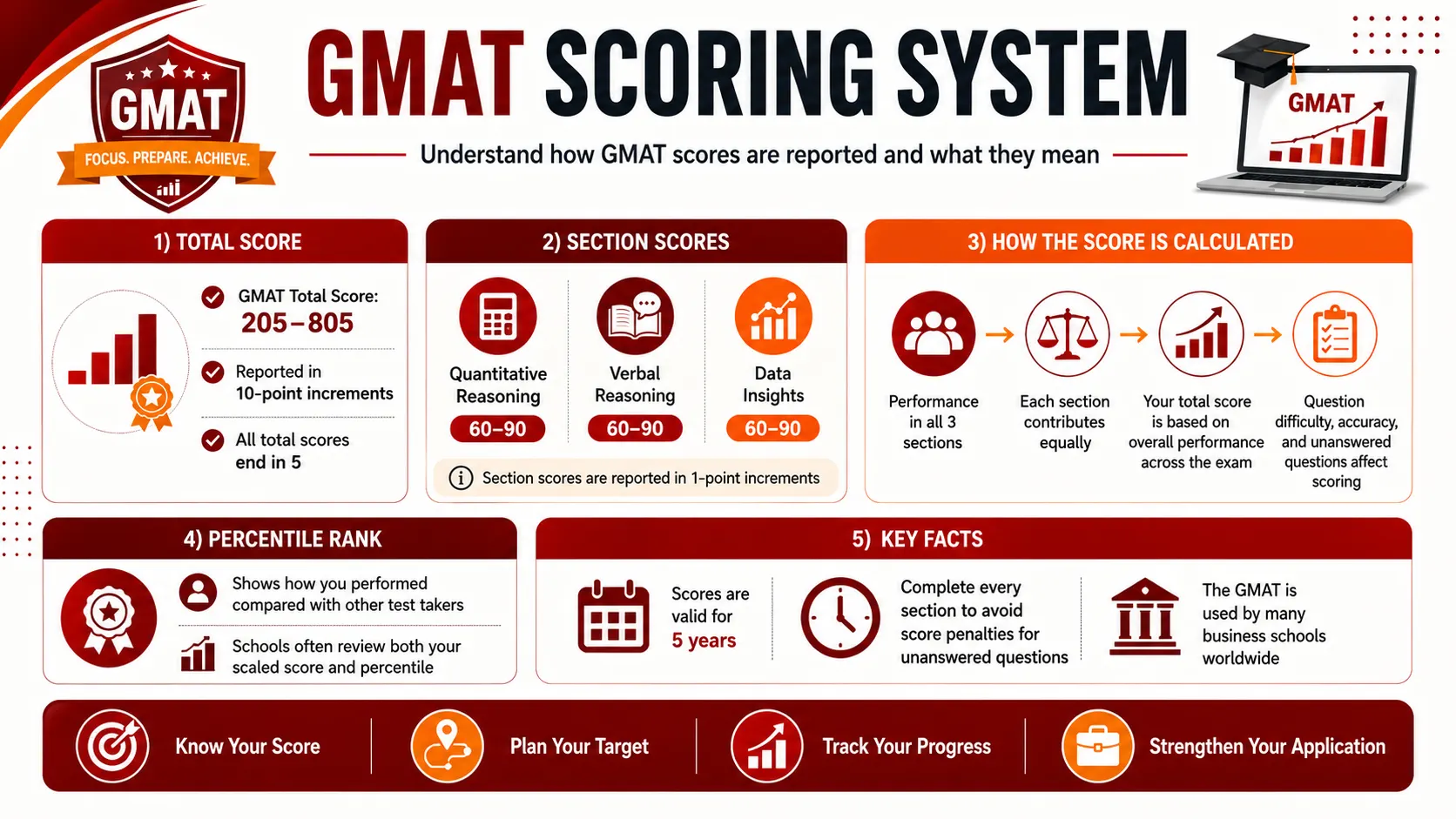
# How is the GMAT score calculated?
The GMAT score is not calculated simply by adding up the number of correct answers. This exam has a computer-based and adaptive logic. The final score is formed based on the correct answers to the questions, the difficulty level of the questions and the scoring algorithm of the test.
The general logic is as follows:
1. The candidate answers the questions in each section.
2. The system records the correct and incorrect answers.
3. The difficulty level of the questions and the answer pattern are taken into account.
4. A section score is calculated for each section in the range of 60–90.
5. A total score in the range of 205–805 is formed based on the Quantitative Reasoning, Verbal Reasoning and Data Insights scores.
According to the official mba.com, the GMAT Total Score is based on performance in all three sections and each section is included in the total score with equal weight.
For this reason, there is no simple and precise formula for GMAT such as “If I get 18 out of 21 questions correct, I will definitely get such and such a score”. Because the final score depends not only on the number of correct answers, but also on the level of the questions answered and the scoring model.
# GMAT Quant Preparation Tips
The main goal of GMAT Quant is not to memorize formulas, but to apply mathematical logic quickly and correctly.
- Repeat topics such as percentages, ratios, equations, averages, numbers.
- Focus on word problems
- Keep a notebook of mistakes
- Practice with time
- Learn shortcut logic, learn to solve some questions without calculations.
One of the most common mistakes made in the Quant section is to start calculating without fully reading the question. GMAT questions sometimes ask simple mathematical topics within complex text. Therefore, you need to fully understand what the question wants first.
# GMAT Verbal Preparation Tips
Reading speed, logical analysis and the ability to distinguish between answer options are important for success in GMAT Verbal.
- Learn reading comprehension
- Learn critical reasoning
- Compare answer options
- Read business and academic texts
The main goal of the Verbal section is not to know every word by heart. The main goal is to understand the logic of the text and the argument.
# GMAT Data Insights Preparation Tips
The Data Insights section can seem new and difficult for many students. Because it requires mathematical reasoning, verbal comprehension, and data interpretation at the same time.
- Practice reading tables
- Analyze graphs
- Learn the Data Sufficiency format
- Prepare for multi-source questions
- Divide your time
One of the biggest mistakes on the Data Insights section is trying to read all the information in detail. A smarter approach is to first read what the question asks for, and then find the information you need.
# Most Common Mistakes About GMAT
Students make several common mistakes in GMAT preparation, including:
- Focusing only on the total score
- Neglecting Data Insights
- Memorizing only formulas for Quant
- Learning only vocabulary for Verbal
- Registering for the exam without taking a practice test
- Forgetting about time management
- Not checking university requirements
Avoiding these mistakes makes GMAT preparation more effective and helps improve results.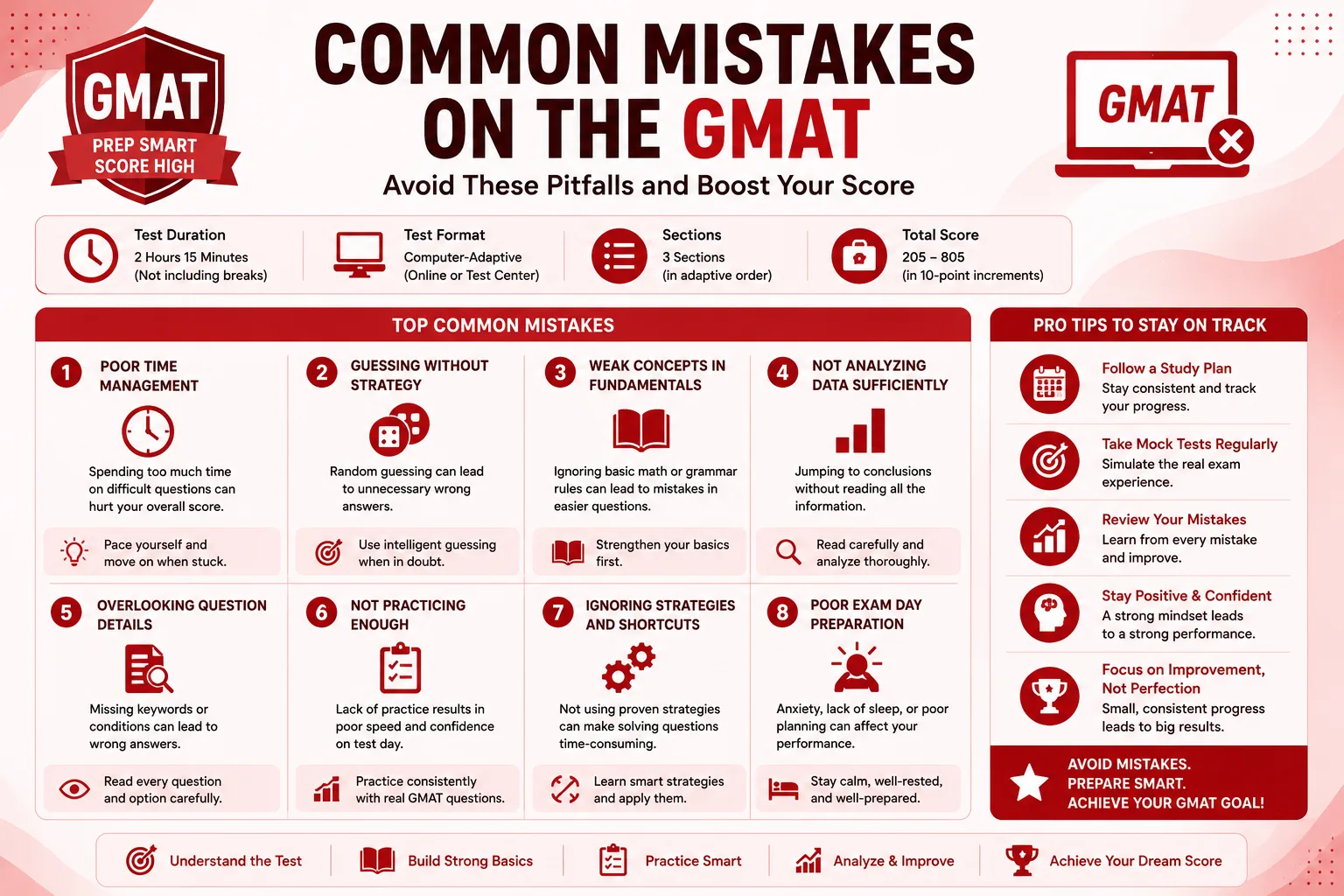
# Frequently Asked Questions
- What is GMAT?
GMAT stands for Graduate Management Admission Test. This exam mainly measures the quantitative reasoning, verbal reasoning, data literacy and critical thinking skills of students applying to MBA and graduate business programs.
- Who needs the GMAT?
The GMAT is mainly useful for students applying to MBA, business master, finance, management, business analytics and other business-oriented graduate programs, and in some cases it may be mandatory.
- How many sections does the GMAT consist of?
The current GMAT consists of 3 sections: Quantitative Reasoning, Verbal Reasoning and Data Insights. Each section lasts 45 minutes.
- How many hours is the GMAT?
The GMAT exam lasts 2 hours and 15 minutes. There is also an optional 10-minute break in the exam.
- What is the GMAT total score?
The current GMAT Total Score is given in the range of 205–805 and all total scores end with 5.
- What is the range of GMAT section scores?
The Quantitative Reasoning, Verbal Reasoning and Data Insights sections each give a score in the range of 60–90.
- How is the GMAT score calculated?
The GMAT Total Score is based on your performance in the Quantitative Reasoning, Verbal Reasoning, and Data Insights sections. All three sections contribute equally to your total score.
- How long is a GMAT score valid?
A GMAT score is valid for 5 years. During this period, scores can be sent to universities.
- Can the GMAT Calculator calculate an official score?
No. The GMAT Calculator does not fully replace the official scoring algorithm. However, it can be useful for analyzing practice results, planning a target score, and identifying weak sections.
- Do universities convert GMAT scores to GPA?
Usually, no. Universities do not convert GMAT scores to GPA. The GMAT is evaluated as a separate standardized test score in the application package along with GPA, CV, essay, recommendation letter, and work experience.
- Which should you choose between GMAT and GRE?
If your main goal is MBA and business school, the GMAT may be more suitable. If you are applying to a broader range of graduate programs, the GRE may be a more flexible option. But before making a decision, you need to check which tests your target universities accept.



How the United States calculates taxes for busin...

21 Jul
278