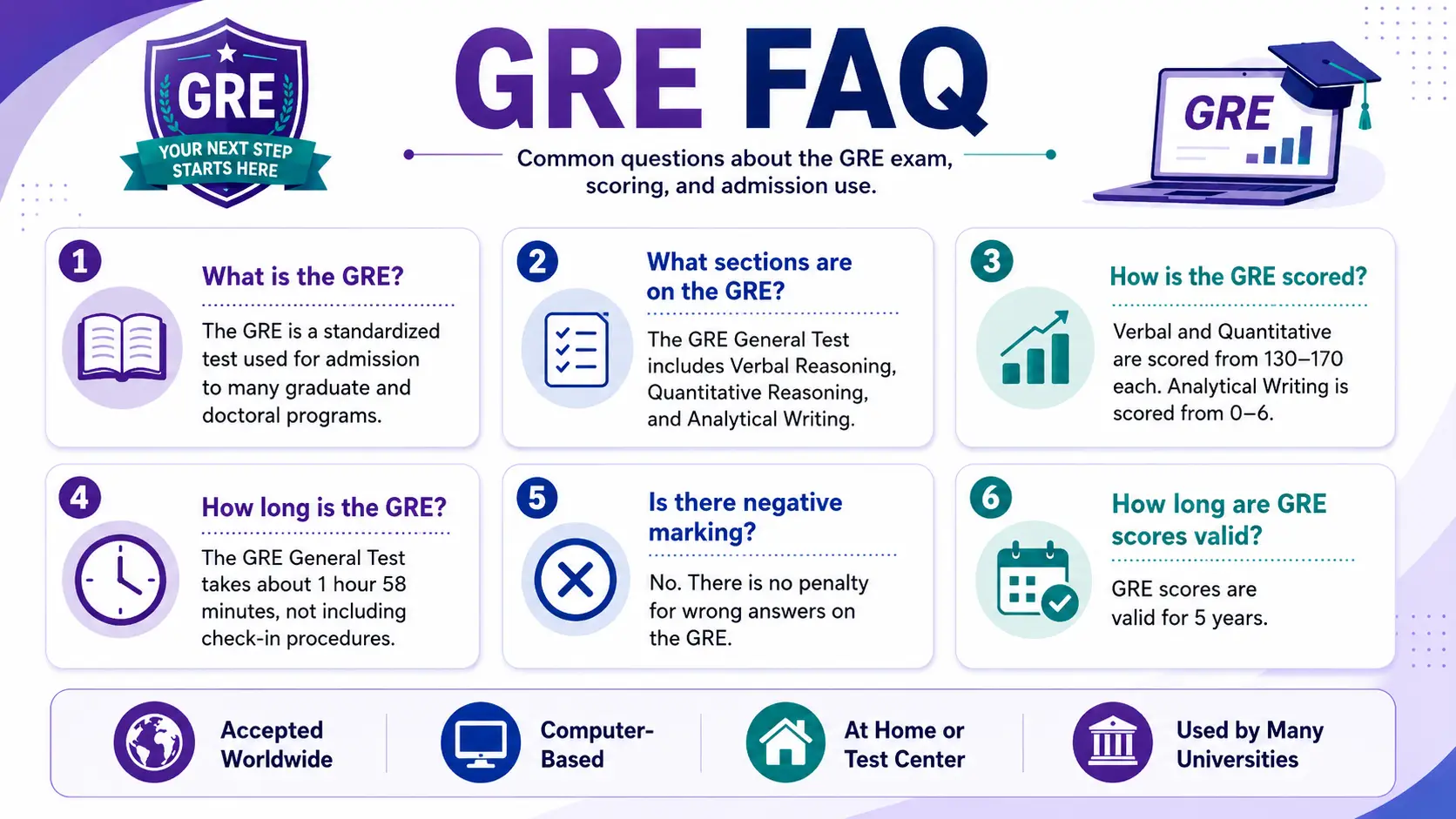


One of the main international exams that students who want to apply for master's, doctoral, MBA and other graduate programs abroad face is the GRE exam. The GRE is mainly used to measure a student's verbal reasoning, quantitative reasoning, critical thinking and analytical writing skills. This exam is intended for candidates applying for post-bachelor's degree programs.
The GRE is mostly accepted by graduate schools located in the USA, Canada, Europe and other countries. However, not every university and every program requires GRE results in the same form. Some programs make GRE mandatory, some accept it optionally, and some do not require GRE at all. Therefore, it is important to check the official admission requirements page of the university and program you will apply to before preparing for the GRE exam.
The GRE General Test currently provides results in three main dimensions: Verbal Reasoning, Quantitative Reasoning and Analytical Writing. Verbal and Quantitative sections are scored in the range of 130–170, while Analytical Writing is scored in the range of 0–6. According to the official ETS score explanation, Verbal and Quantitative scores are given in 1-point increments, while Analytical Writing scores are given in half-point increments.
In this article, we will explain in detail what the GRE exam is, who needs it, the GRE General Test structure, the Verbal, Quantitative, and Analytical Writing sections, how the score is calculated, how universities view GRE results, and how the GRE Calculator can help students.
# What is GRE?
GRE is an abbreviation for Graduate Record Examinations. This exam is mainly used to assess the academic preparation of students applying to graduate-level programs, namely master's, doctoral, and some business programs.
The GRE General Test is not a knowledge test for a specific specialty. That is, this test should not be understood as a math test, an English test, or a writing test. The GRE measures a student's ability to analyze texts, understand the relationships between words and ideas, solve mathematical problems, work with data, and write academic writing.
# Who needs GRE?
GRE is mainly intended for those who have completed their undergraduate studies and want to apply to master's or doctoral programs. Some MBA and business programs may also accept GRE scores in addition to the GMAT.
GRE may be necessary for those who want to apply to master's or doctoral programs, those who want to apply to MBA programs, those who want to apply to fellowship programs, or those who want to balance a weak GPA.
However, GRE is not mandatory for every program. In recent years, many universities have implemented test-optional or test-waiver policies. Therefore, students should research the requirements of their target programs before answering the question "Do I need to take the GRE?"
# Difference between GRE General Test and GRE Subject Test
When talking about GRE, it is necessary to distinguish two main types of tests: GRE General Test and GRE Subject Test.
GRE General Test measures broader skills. It includes Verbal Reasoning, Quantitative Reasoning and Analytical Writing. This is the most required GRE type for applications to graduate programs.
GRE Subject Test measures knowledge in a specific subject. For example, a subject test may be required to demonstrate a candidate's specialized knowledge in certain fields. However, not all programs require a subject test.
If a university simply writes "GRE required", it usually means GRE General Test. But you should always check which GRE type is required on the official website of the program.
# What is the GRE General Test structure?
GRE General Test is currently held in a shorter format. ETS has reduced the GRE test duration from approximately 4 hours to less than 2 hours starting in 2023. According to the official ETS press release, starting in September 2023, GRE General Test will be offered in a shorter and more efficient format.
The GRE General Test consists of three main sections:
- Analytical Writing
- Verbal Reasoning
- Quantitative Reasoning
According to the official test structure of ETS, the Analytical Writing section always comes first. The Verbal Reasoning and Quantitative Reasoning sections may appear in different order.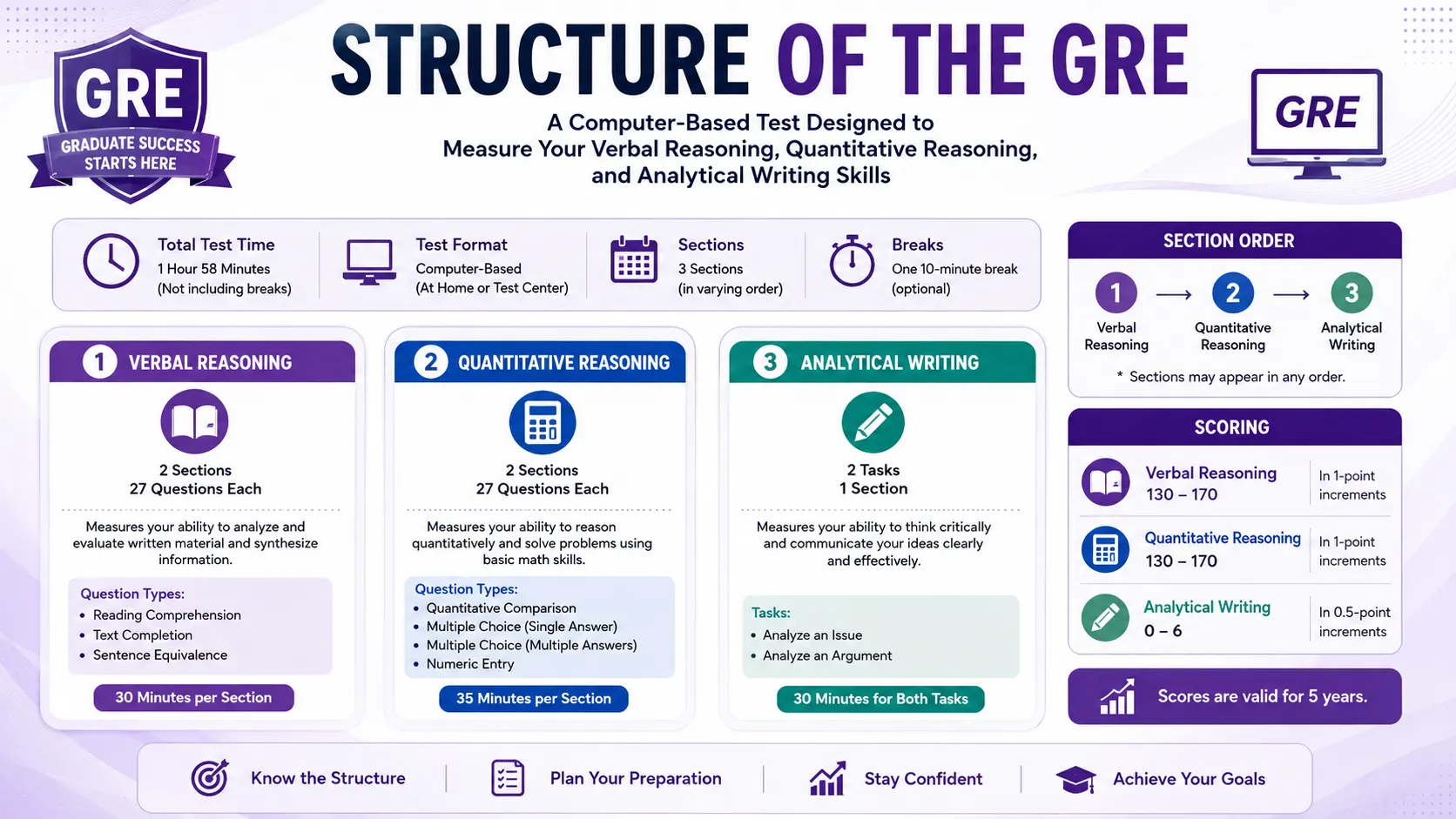
# What is the GRE Analytical Writing section?
Analytical Writing is the first section of the GRE test. In this section, the candidate writes an analytical essay on a specific topic. In the current short GRE format, only the “Analyze an Issue” task remains. The “Analyze an Argument” essay task from the previous format has been removed from the short GRE format. The ETS 2023 changes note that the Analytical Writing “Analyze an Argument” task has been removed.
Analytical Writing is scored on a scale of 0–6 and the result is shown in half-point increments. For example, scores such as 3.0, 3.5, 4.0, 4.5 are possible. This score is not added to the Verbal and Quantitative total score, but is reported separately.
# What does the GRE Verbal Reasoning section measure?
The GRE Verbal Reasoning section measures a candidate’s ability to understand academic texts, determine the meaning of words in context, analyze the relationships between ideas, and draw logical conclusions.
This section is not just an “English vocabulary test.” Of course, vocabulary is important, but the GRE Verbal requires more logical reading and analytical thinking. The student must find the main idea in long and complex sentences, understand the author’s position, and see the subtle differences between answer options.
The Verbal Reasoning score is given in the range of 130–170. This score can be especially important for universities in fields such as humanities, social sciences, law, public policy, and communication. But in technical fields, a strong Verbal score also indicates a candidate’s academic reading and writing skills.
# What does the GRE Quantitative Reasoning section measure?
The GRE Quantitative Reasoning section measures a candidate’s mathematical reasoning, problem-solving, data analysis, and quantitative reasoning skills. This section is based primarily on school and pre-baccalaureate mathematical concepts, rather than high-level university mathematics.
ETS' GRE score guide notes that the Quantitative section includes an on-screen calculator, which is intended to focus on reasoning skills rather than calculation.
The Quantitative score is given in the range of 130–170. This score may be more important in engineering, computer science, data science, economics, finance, statistics, and other quantitative programs.
# What is the GRE scoring system?
Three separate scores are reported on the GRE General Test:
- Verbal Reasoning score
- Quantitative Reasoning score
- Analytical Writing score
Verbal and Quantitative scores are given in 1-point increments, ranging from 130–170. Analytical Writing scores are given in 0–6, in half-point increments. These score ranges are officially noted in the 2026–27 ETS interpreting scores document.
Some students ask the question “What is the GRE total score?” Usually, when we say GRE total score, we mean the sum of Verbal and Quantitative scores. This sum is in the range of 260–340. Analytical Writing score is reported separately and is not included in this total score.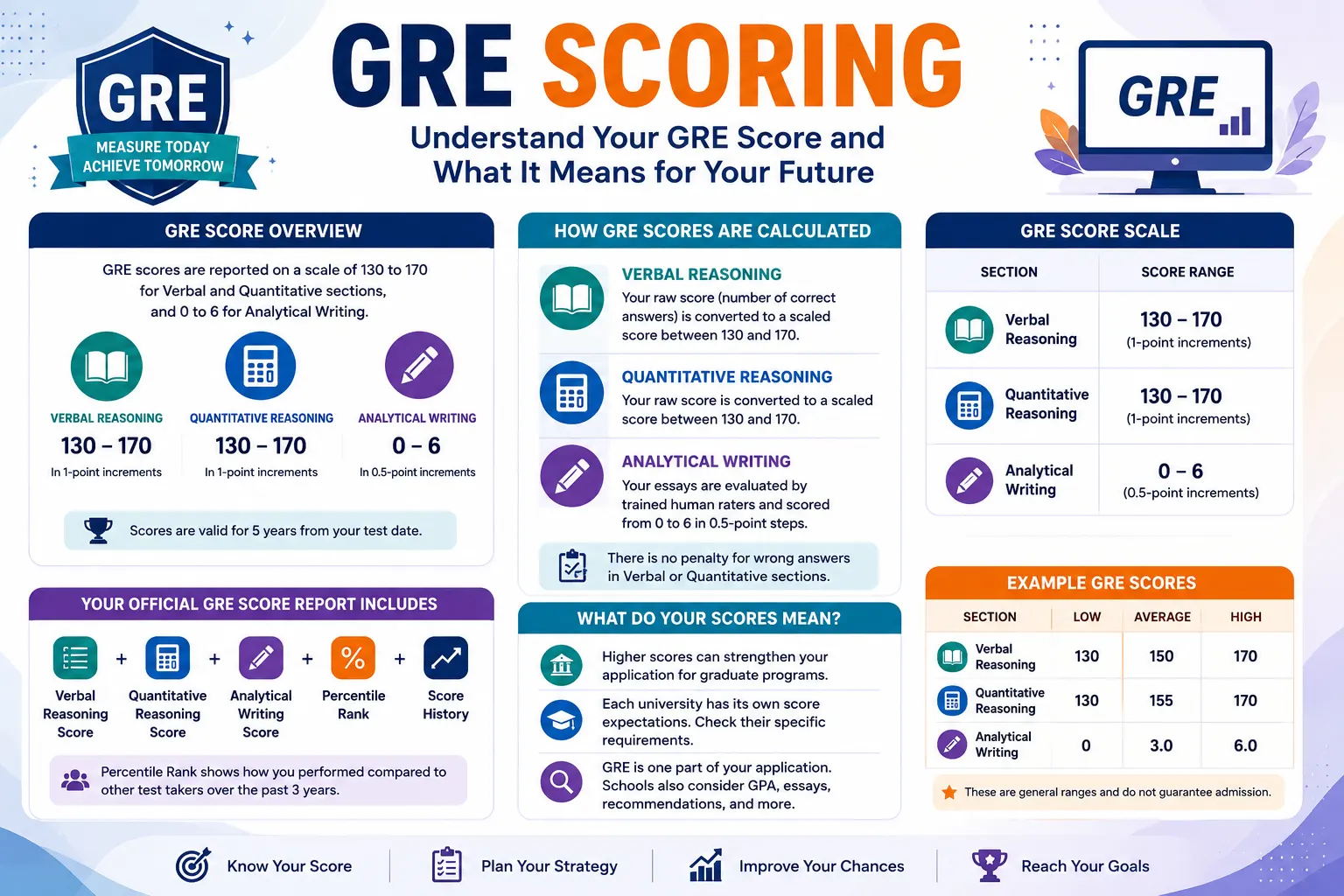
# How is GRE score calculated?
The GRE Verbal and Quantitative sections work with a section-level adaptive system. According to the official score explanation from ETS, Verbal and Quantitative measures are section-level adaptive. This means that the computer selects the difficulty level of the second operational section for that measure based on the performance shown in the first operational section.
The score calculation generally works like this:
- A raw score is calculated for each Verbal and Quantitative measure.
- The raw score is the number of correct answers.
- The difficulty level of the second section is taken into account.
- The raw score is converted into a scaled score through the process of equating.
- The final Verbal and Quantitative score is reported in the range of 130–170.
According to the official information of ETS, the raw score for each measure is the number of questions answered correctly, and then this raw score is converted into a scaled score through the process of equating. This process ensures that the scores are comparable between different test versions.
For this reason, there is no simple rule of “15 correct out of 20 questions = specific score” in the GRE. The difficulty of the question set and the adaptive section system affect the result.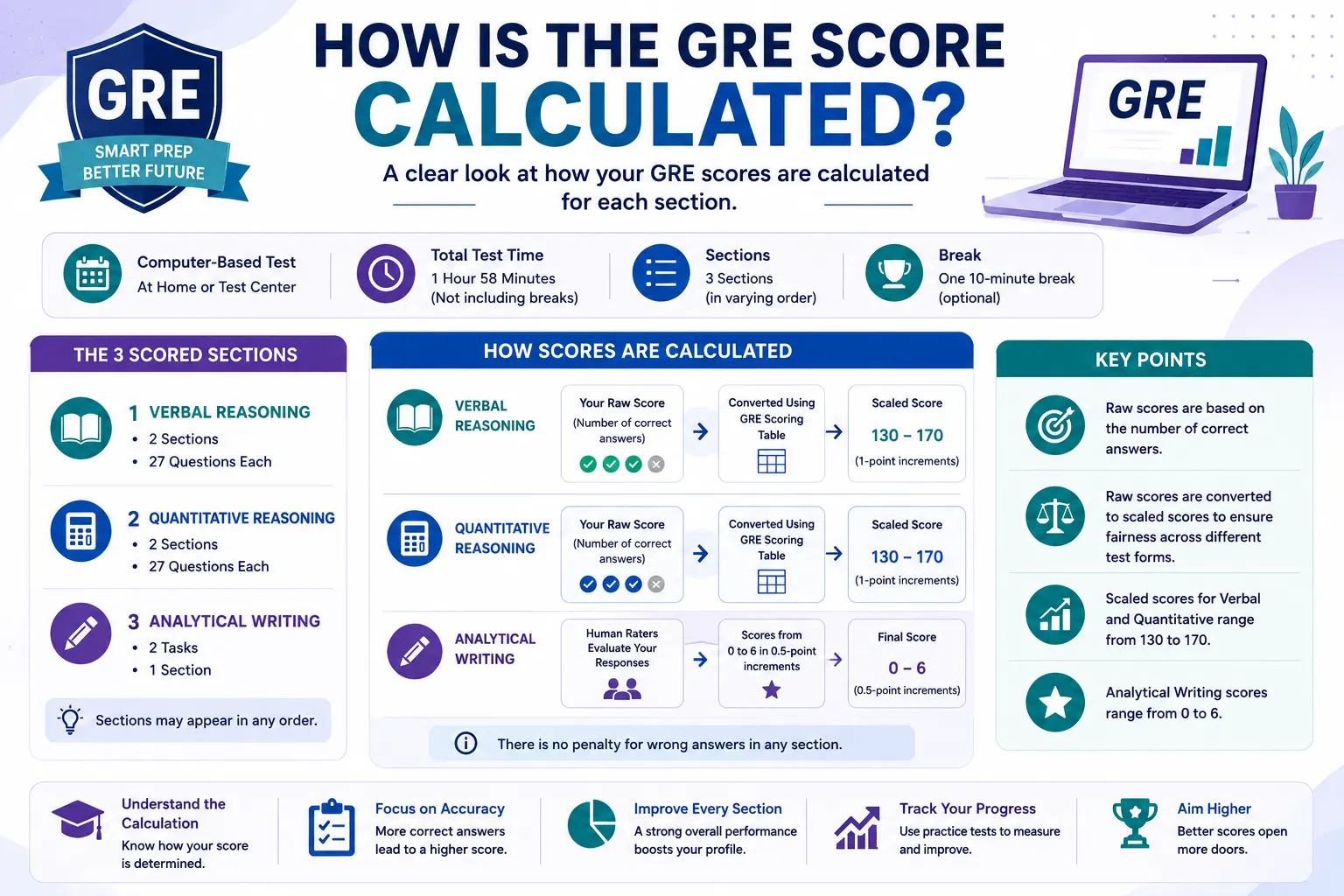
# What does section-level adaptive system mean?
The Verbal and Quantitative sections of the GRE work with a section-level adaptive system. In this system, the first section is of medium difficulty. Depending on the student's performance in the first section, the second section can be easier, medium, or more difficult.
The purpose of this system is to more accurately measure the student's real level. Moving on to the more difficult second section can give a higher score potential. But this does not mean that only passing the difficult section is enough. The number of correct answers in that section is also important.
When calculating the GRE score, all questions within each section contribute equally to the final score, but the difficulty level of the section plays a role in forming the final scaled score. ETS notes this in its official score explanation.
# What is a good GRE score?
A “good GRE score” is not the same for every program. It depends on the major you are applying to, the competitiveness of the university, and the priorities of the program.
For example, in fields such as engineering, data science, economics, and finance, Quantitative scores may be more important. In fields such as humanities, political science, communication, and literature, Verbal and Analytical Writing scores may be more important.
In general, we can think of it this way:
- 290–300 -> Average or entry-level
- 300–310 -> Acceptable range for many programs
- 310–320 -> Strong result
- 320–330 -> Very strong result
- 330+ -> Highly competitive result
This table is for general guidance only. In reality, the best approach is to look at the admitted student GRE average or median score of the target program. Some programs may have a good result of 310, while others may expect a score above 325.
# How do universities evaluate GRE scores?
Universities usually evaluate GRE scores as part of an application package. The GRE alone is not an admissions or rejection decision. Universities look at GRE scores in conjunction with GPA, transcripts, recommendation letters, statement of purpose, research experience, CV, portfolio, English proficiency score, and other documents.
Some programs look at the overall GRE total score, while others focus on section scores. For example, an engineering program may place more emphasis on the Quant score. A Literature or public policy program may place more emphasis on the Verbal and Analytical Writing scores.
# GRE Verbal preparation tips
The GRE Verbal seems difficult to many students because it involves a lot of academic vocabulary and complex sentence structures.
Therefore, memorize words in sentences rather than individual words, read academic texts, learn to make logical connections before and after the gap, pay attention to how two correct answers make similar sense, and analyze the reasons for your incorrect answers.
The goal of the GRE Verbal is not to know all the words. The main goal is to understand the logic of the sentence and see the relationship between the answer options.
# GRE Quant Preparation Tips
High-level university mathematics is not required for GRE Quant, but mathematical logic and attention are very important.
Therefore, our advice to you, Revise the main mathematical topics (Algebra, arithmetic, geometry, data analysis) Practice with specific question formats for GRE. Do not rely too much on the calculator, because, the test measures reasoning, not just calculation. Finally, Practice to manage your time properly.
One of the most common mistakes made in the Quant section is reading the question too quickly and missing details. GRE questions sometimes seem simple, but small conditions can change the answer.
# Analytical Writing Preparation Tips
For Analytical Writing, the student should practice the essay structure in advance. The goal here is not to write an artistic or emotional piece of writing. The goal is to build a logical, clear and academic argument.
To prepare, learn the structure of essay writing, state your position clearly, use examples, accept and respond to the opposite side, and finally, give yourself time to practice writing.
Although the Analytical Writing score is not included in the total GRE score, it can be important in some programs. Writing skills can be especially important in humanities, social sciences, law-related, and research-heavy programs.
# Most common mistakes about the GRE
Students usually make these mistakes when preparing for the GRE: Focusing only on the total score, Relying only on a calculator for Quant, Just memorizing vocabulary, Underestimating Analytical Writing, and Registering for the exam without a Practice test.
Avoiding these mistakes can make your GRE preparation more effective and thus reduce your risks in the application process.
# Frequently Asked Questions
- What is the GRE?
GRE is a standardized test that measures verbal reasoning, quantitative reasoning, critical thinking and analytical writing skills of students applying to graduate programs.
- Who needs the GRE?
GRE may be needed mainly for students applying to master's, doctoral, some MBA and other graduate programs.
- How many sections does the GRE consist of?
The GRE General Test consists of three main dimensions: Verbal Reasoning, Quantitative Reasoning and Analytical Writing.
- How is the GRE score calculated?
The raw score in the Verbal and Quantitative sections, i.e. the number of correct answers, the adaptive section difficulty and the equating process are taken into account and converted into a scaled score of 130–170. Analytical Writing is also evaluated on a scale of 0–6.
- What is the GRE total score?
The GRE total score is usually calculated as the sum of the Verbal and Quantitative scores. This result is in the range of 260–340. Analytical Writing is not included in this sum.
- Is the GRE Analytical Writing score included in the total score?
No. Analytical Writing is reported separately on a 0–6 scale and is not included in the Verbal + Quant total score.
- How long is a GRE score valid?
GRE scores can be reported for 5 years after the test date.
- Why is the GRE Calculator needed?
The GRE Calculator helps you calculate your total GRE score by adding up your Verbal and Quantitative scores. It is also useful for planning your target score.
- Do universities convert GRE scores to GPA?
Usually not. Universities do not convert GRE scores to GPA. GRE is also evaluated as a standardized test score along with GPA, transcript, statement of purpose, and recommendation letters.
- What is a good GRE score?
This target depends on the program. In general, 310+ can be considered good, 320+ strong, and 330+ very competitive. However, the most accurate target score should be determined based on the program's admitted student statistics.