

One of the most important language exams faced by students who want to study in bachelor's, master's, doctoral or other academic programs in Germany is the TestDaF exam. TestDaF is mainly used to measure the academic German language skills of foreign students who want to study at a university in Germany. This exam evaluates the student's German reading, listening, writing and speaking skills in an academic and university environment.
In this article, as "Hesabla.com", we will explain in detail what the TestDaF exam is, who it is for, the exam structure, the TestDaF scoring system, what the levels mean, how universities approach TestDaF results and what you should pay attention to when preparing for TestDaF.
# What is TestDaF and who is it for?
TestDaF is an international language exam that measures the German language level of foreign students who want to study in Germany. This exam tests the language skills needed in a university environment in particular. That is, here the student's ability to read academic texts, listen to lectures and academic talks, express written opinions and speak orally on a certain topic is measured. Thus, this exam serves as a document proving your language skills for your bachelor's, master's, doctoral and research, scholarship programs and academic career in Germany.
But TestDaF is not an absolute option for every student. Some universities may also accept DSH, Goethe-Zertifikat C1/C2, telc Deutsch C1 Hochschule or other German language certificates in addition to TestDaF. Therefore, it is important to check the official language requirements page of the target university before applying.
# What is the structure of the TestDaF exam?
The TestDaF consists of four main sections, each of which is assessed separately:
1. Reading (understanding academic and university texts)
2. Listening (understanding lectures, conversations and academic conversation)
3. Writing (writing academic texts on a topic)
4. Speaking (speaking in various university situations)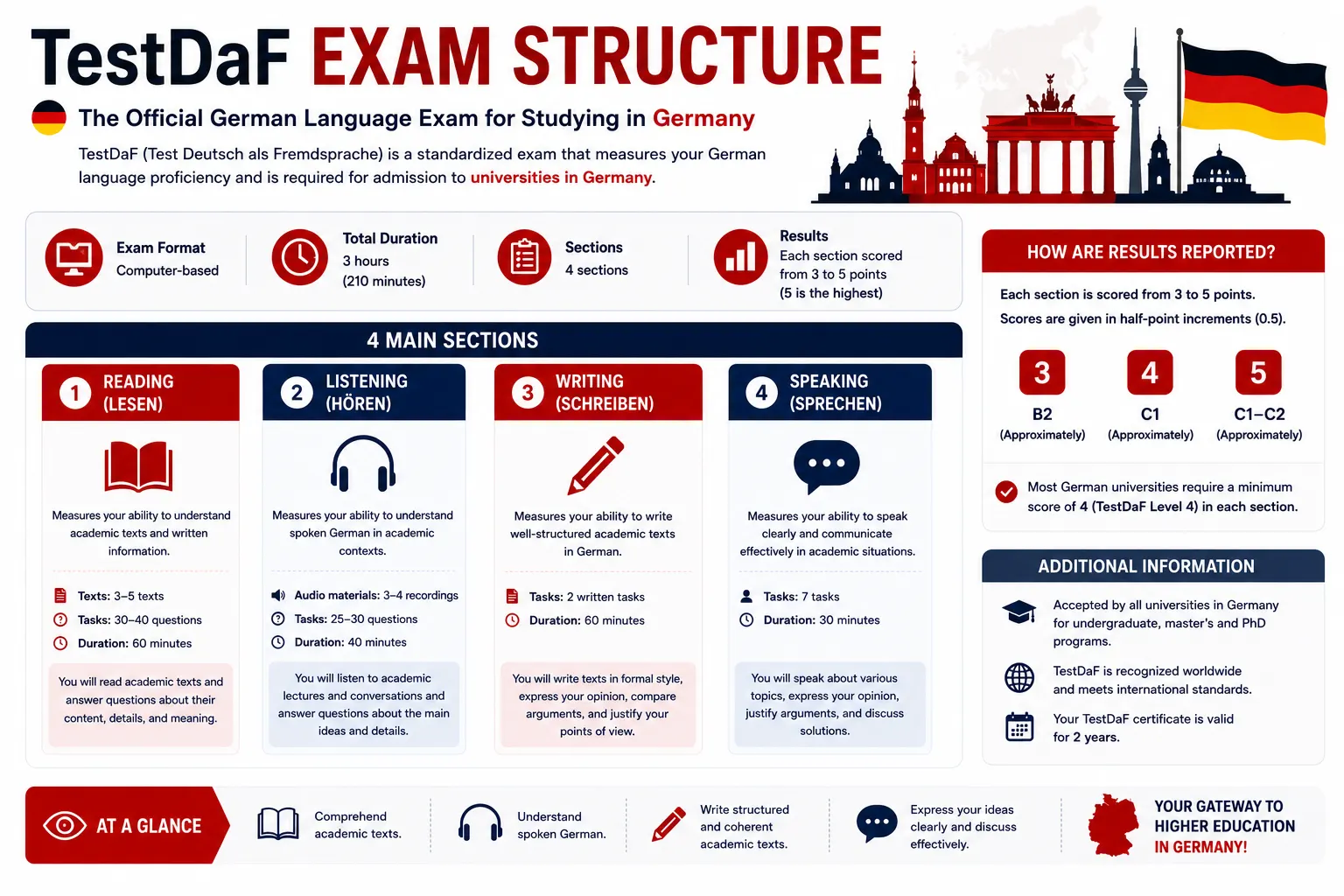
# What is the Reading section of the TestDaF?
Reading is the reading section of the TestDaF exam. This section measures the student's ability to understand texts written in German, find the main idea, select details and analyze information in an academic context. The texts in this section can relate to everyday university life, the student environment and general academic topics. The aim is to test whether the student understands the texts that they will encounter while studying at university in Germany. In other words, the skills required of you in this section are: Understanding the general theme and purpose of the text, Finding specific information from the text, Seeing the relationship between sentences and paragraphs, Understanding expressions related to university and scientific topics, and Analyzing texts in a limited time.
# What is the TestDaF Hörverstehen section?
Hörverstehen is the listening section of the TestDaF exam. This section measures the student's ability to understand German conversation, lectures, university situations, and academic topics. In other words, the skills required of you in this section are: Catching the main idea of the conversation, Listening to details, Understanding lectures and scientific topics, Understanding the purpose of the conversation, and Writing down important information while listening.
# What is the TestDaF Schriftlicher Ausdruck section?
Schriftlicher Ausdruck is the writing section of the TestDaF exam. This section assesses the student's ability to write academic and structured texts in German. In this section, the candidate must usually prepare a written response to a given topic, describe information, express an opinion and justify their arguments logically. In other words, the skills required of you in this section are, Writing in the format of an introduction, main part and conclusion, Explaining a graph, table or given idea, Expressing an opinion on the topic, supporting your expressed opinion with reasons and examples and Writing in formal and clear German.
# What is the TestDaF Mündlicher Ausdruck section?
Mündlicher Ausdruck is the speaking section of the TestDaF exam. This section measures the student's ability to communicate orally in German and express opinions in academic and university situations. The speaking section can be based on situations close to real university life. For example, a student can express an opinion on an issue, explain a problem at university, justify a position on an academic topic or speak in the form of a presentation. In other words, the main skills required of you in this section are: Expressing your thoughts clearly, Speaking fluently, Speaking on an academic topic, Substantiating your opinion with reasons and examples, and Using formal and semi-formal expressions appropriate to the situation.
# What is the TestDaF scoring system and how is the TestDaF score calculated?
TestDaF results are shown separately for each section with a TDN level. TDN stands for TestDaF-Niveaustufe. That is, the TestDaF level. The meaning of your result in this exam can be expressed as follows:
- TDN 5 -> Very high level, Very strong German language skills.
- TDN 4 -> Standard level suitable for university studies.
- TDN 3 -> May be suitable for more limited or conditional admission but Minimum academic German language skills.
- Below TDN 3 -> Usually not sufficient for university admission and you will be required to retake the test.
The TestDaF score is not given on a 0–9 or 0–120 total score system like IELTS and TOEFL. In TestDaF, each section is assessed separately and the result is shown in the form of TDN 3, TDN 4 or TDN 5. So the general logic is as follows:
- The candidate completes four sections: reading, listening, writing and speaking.
- Each section is assessed separately.
- Performance in the section is aligned to a specific TDN level.
- The candidate receives a separate result for each section.
- Universities compare these four results with their own admission requirements.
The Goethe-Institut's general German language exams page states that candidates who achieve a TDN 4 in all four sections of the TestDaF are internationally recognized language proof for admission to almost any subject and degree program at a higher education institution in Germany. For this reason, the main target for many students is:
- Reading comprehension: TDN 4
- Listening comprehension: TDN 4
- Writing comprehension: TDN 4
- Speaking comprehension: TDN 4
This combination is often thought of as a "4x4". However, some universities and programs may accept a different combination. For example, some programs may accept a TDN 3 in one section, while others may require a TDN 4 or higher in all sections.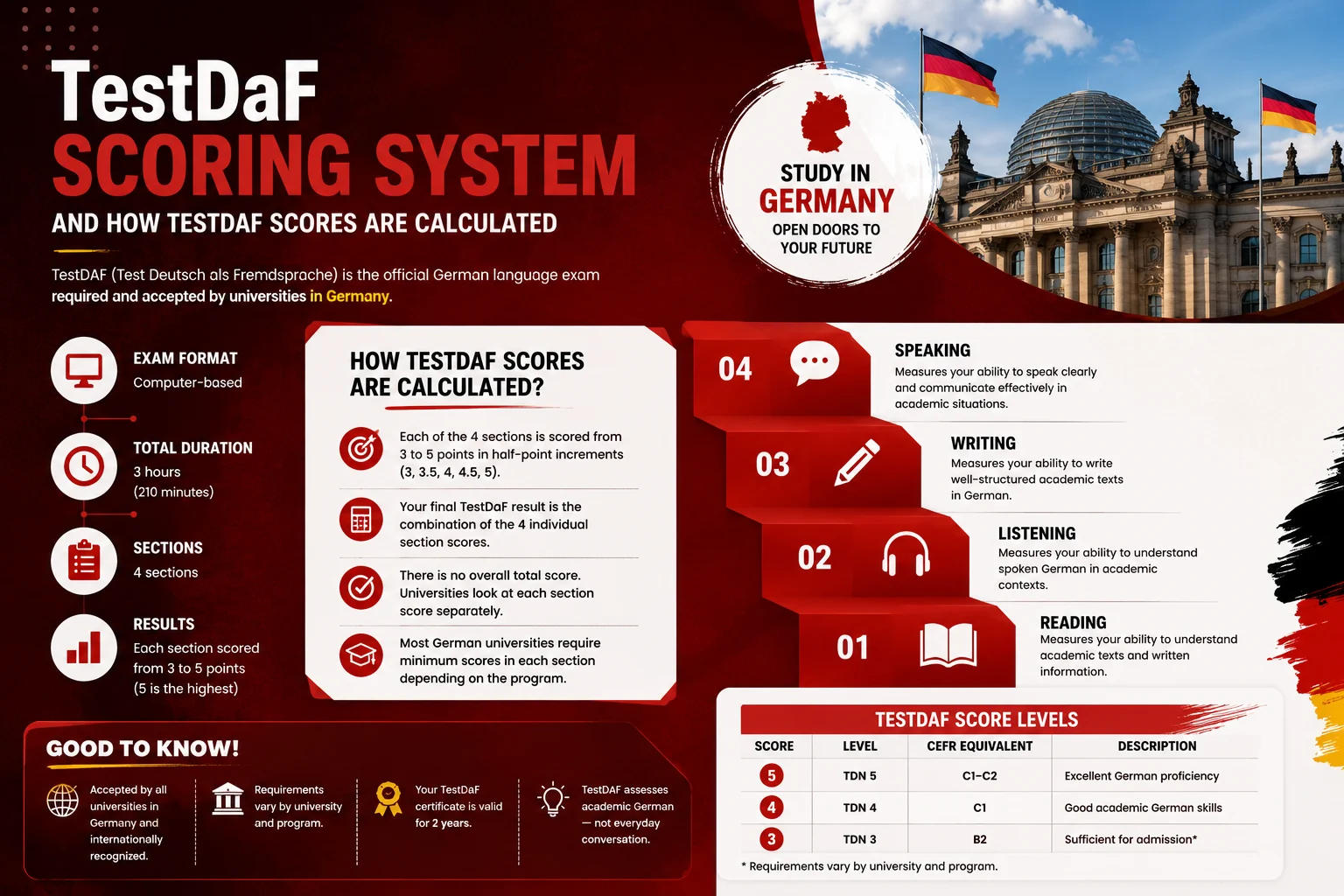
# How long is a TestDaF score valid?
One of the most frequently asked questions about the TestDaF certificate is how long the result is valid. The TestDaF certificate is not a document that is valid for a certain period of time like IELTS or TOEFL, but is usually accepted as an indefinite document, meaning that there is no short expiration date on the official certificate like the classic “2 years”. However, this does not mean that all universities will accept an old result without any problems. Most universities may ask for a language certificate obtained within the last 2 or 3 years. In other words, a TestDaF result can be used as a long-term certificate, but the specific rules of the university are the basis for the admission process. Therefore, be sure to pay attention to the official conditions of the university.
# How do universities treat TestDaF results?
Universities evaluate the TestDaF result as language proof for studying in German. However, just like other exams, the TestDaF is not an admission decision on its own. Universities also look at your academic documents, certificates or diplomas, transcripts, motivation letters, CVs and other documents. When it comes to evaluating the TestDaF result, approaches may differ slightly. For example, some universities may require a TDN 4 result in all sections, which is the most common requirement. In some universities, the requirements may be less strict, for example, a TDN 3 result in one section may be accepted.
So, if your goal is ambitious specialties such as Medicine and Law, in this case you will have higher requirements. Again, sometimes universities may accept you on certain conditions, for example, if your language level is not sufficient, they may refer you to a language school and require you to prepare until your language level reaches a sufficient level.
As Hesbla.com, we would also like to note that it is not mandatory for those wishing to study in Germany to take the TestDaF exam. They can also take other language exams such as the DSH and Goethe-Zertifikat, which prove their language skills, but the TestDaF is simply the most popular of these exams. Again, before you start preparing for the TestDaF, check the admission requirements of your desired university. Because the alternative language exams, the DSH and Goethe-Zertifikat, may not always be required.
# Our recommendations as "Hesabla.com" for those preparing for the TestDaF exam
So, if you have problems in the reading section of the TestDaF exam, read academic texts, learn to quickly find the main idea and specific information, learn words in context in sentences instead of memorizing individual words and analyze the structure of the text. Because the main goal here is not to translate the text. The goal is to understand the text quickly and correctly.
Or if you have problems in the listening section of the TestDaF exam, listen to lectures in German; practice taking notes while listening to those lectures; listen to conversations from different regions of Germany, so you can recognize different accents; Knowing what you are looking for will make it easier for you to listen to the audio material, so be sure to look at the questions before the audio material is presented; Note your mistakes after the first listening and then listen again and again to analyze your mistakes. Because it is not necessary to understand everything 100% in the listening section. The main thing is to understand the main content, important details and the purpose of the conversation.
Or if you have no problems with reading or listening and your problem is in the writing section, then learn the standard essay structure, use connecting words (Deshalb, ausgewählt, jedoch, einerseits, anderseits, etc.), practice graphic descriptions, justify your ideas with reasons and examples. Finally, if possible, have your writing evaluated by a teacher or a person with a high level of language. Similarly, one of the biggest mistakes in this section is to stray from the specified topic. Therefore, before starting, fully understand what the question wants and then start recording your answers.
Or if your problem is neither in the reading, writing or listening section, but your problem is in the speaking section, then our advice is to record your voice so that you can analyze your conversations. Learn ready-made expressions to express opinions, agree or compare. Another problem is the improper use of time, so try to prepare with a timer, practice university situations related to topics such as student life, seminars. Finally, practice expressing your thoughts clearly, that is, giving a more fluent answer, instead of building perfect sentences. Remember, the main goal in this section is not to speak like a native speaker. The main goal is to express the idea in an understandable, logical and situational way.
If we need to talk about the mistakes that students make in general, then we can note that most students prefer to study only grammar. This is not the right approach, but in addition to grammar, you must develop your reading, listening, writing and speaking skills. Practice from the very first day, not when you feel ready for the speaking section. Be sure to have your essays checked. Use academic texts and audio materials to ensure that your academic vocabulary is not weak. Along with these mistakes, two other common mistakes are simply studying German daily and preparing without time management. Remember that this is an academic language exam and you have a certain amount of time to take it!
# Frequently Asked Questions
- What is TestDaF?
TestDaF is a standardized exam that measures the German language skills of foreign students who want to study at a university in Germany. The exam consists of reading, listening, writing and speaking sections.
- Who needs TestDaF?
TestDaF is mainly needed for students applying for bachelor's, master's and other academic programs taught in German in Germany.
- What level does TestDaF measure?
TestDaF mainly measures levels B2–C1. The Goethe-Institut presents TestDaF as an advanced-level exam covering levels B2–C1.
- How many sections does TestDaF consist of?
TestDaF consists of four sections: Leseverstehen, Hörverstehen, Schriftlicher Ausdruck and Mündlicher Ausdruck. That is, reading, listening, writing and speaking.
- How is the TestDaF score calculated?
In the TestDaF, each section is assessed separately and the result is given as TDN 3, TDN 4 or TDN 5. Here, a single total score, like IELTS and TOEFL, is not the main indicator.
- What does TDN 4 mean?
TDN 4 is the most required TestDaF level for university studies. The Goethe-Institut states that a candidate who achieves a TDN 4 in all four sections has obtained language proof that is recognized for admission to almost any specialty and degree program in Germany.
- What is a good result in the TestDaF?
The most common goal is to achieve a TDN 4 in all four sections. A stronger result is to achieve a TDN 5 in one or more sections.
- Can I get admission if I get a TDN 3 in one section?
This depends on the university and the program. Some universities may accept a TDN 3 in a certain combination, while others require a TDN 4 in all sections. Uni-assist states that the universities determine the proficiency levels required for admission.
- How long is the TestDaF certificate valid for?
The TestDaF certificate is usually accepted as a long-term document, but some universities may require a certificate obtained in recent years. Therefore, it is necessary to check the specific rules of the target university.
- What is the difference between the TestDaF and the DSH?
The TestDaF is an internationally standardized exam and is taken at licensed test centers. The DSH is usually organized by German universities and the format can vary depending on the university.
- What is the difference between the TestDaF and the Goethe-Zertifikat?
The TestDaF mainly measures academic language skills for university studies in Germany. The Goethe-Zertifikat is a certification system that proves a general German language level from A1 to C2.


How the United States calculates taxes for busin...

21 Jul
278