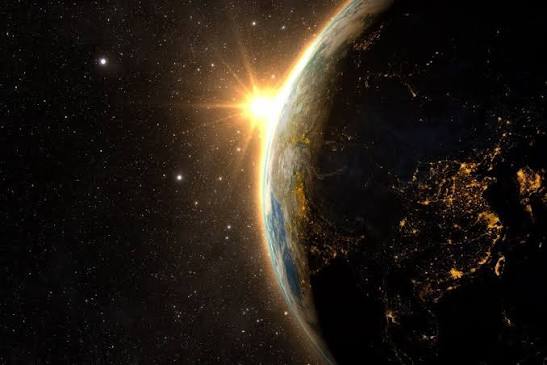

Matter and energy bend space and time. Planets, stars, and galaxies in space may actually create curvature in space-time in proportion to their mass. Einstein’s field equations explain the geometry of the fabric of spacetime and how this geometry changes under the influence of mass and energy distribution.
Time flows more slowly in space than on Earth. This situation becomes more evident in space vehicles traveling at high speeds. According to Newton’s laws, time was an absolute quantity. It was different from space.
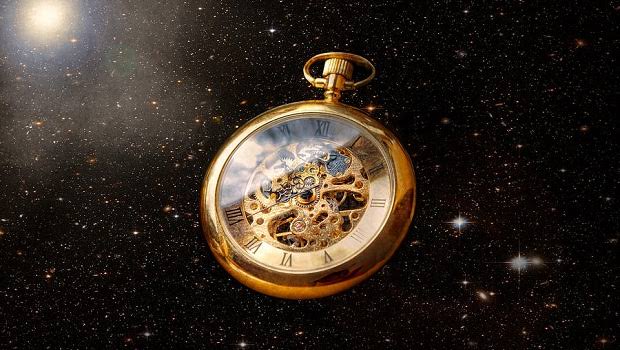
Time dilation is the actual difference in time between events measured by each other or by masses of different gravity, relative motion, or by observers. Due to reduced gravity and high speeds, an astronaut’s clock in space runs slower than a clock on Earth.
How is the perception of time in space? Astronauts tell. Luca Parmitano says that he and his team have been working a lot on the International Space Station (ISS) and therefore, from a daily point of view, time passes very slowly, but the weeks go by very quickly. In a study conducted on the perception of time in astronauts, it was found that “Astronauts perceived less time during space flight than before.” The flow of time in the depths of space is very different from the time we experience on Earth.
Einstein showed that time should be taken into account as space-time in the measurement of movement, which means displacement in space. Space-time is a four-dimensional coordinate system, three spatial dimensions and one time dimension.
An important detail about measuring time is that the rate of flow of time is different in different reference systems. The theory of special relativity states that the time measured by an observer will change depending on the observer’s movements in space (motion direction and speed). Time management is critical on the ISS. Astronauts use Coordinated Universal Time (UTC) to coordinate their missions and communicate with the world. The International Space Station completes one orbit around Earth approximately every 90 minutes.
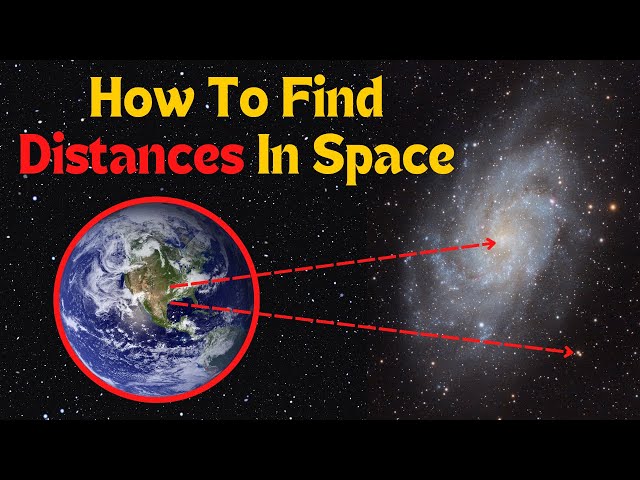
When you change the way you look at an object, the position of that object changes in relation to the more distant objects in the background. Suppose you observe a star at a certain time of the year, for example in March, and mark its position in the sky. A light source with a parallax angle of 1 arc second is 1 parsec away. Light “changes direction” as it passes near stars and similar massive bodies. Photons are massless “at rest”. However, they have a kinetic energy due to their high speed while in motion.
In this text, the nature of space and time is considered in terms of classical mechanics, theory of relativity, common sense and implementation interpretation of quantum mechanics. Space-time is a conceptual model that combines the three dimensions of space with the fourth dimension of time. Einstein, in 1905, assumed that the speed of light is constant and brought all these ideas together in the special theory of relativity. The concept of a space-time coordinate system was first introduced in 1907. It was not long before space-time found a place in modern cosmology.
Time exists because of time dilation, gravity or velocity or nature’s own laws that cause differences (i.e., space-time). While GPS and Galileo satellite clocks work a little faster, say two hours (it is not a mechanical failure), although they work perfectly, atomic clocks on Earth and small differences in space have been proven many times. As the distances in space increase, it becomes more and more difficult to calculate the distance. Einstein predicted that time passes more slowly during a fast travel in space and the hypothesis of time dilation. Astronauts work on the experiment before the flight, on the International Space Station and now to compare the results.
The reason for the different experiences of observers in different positions/situations is time dilation. Gravitational or gravitational time dilation is caused by the deformation created by massive objects in the fabric of space-time. It is not easy to make a general definition of time. When it comes to physics, time is the fourth dimension. The time coordinate is used to express the rate of change of physical quantities. As a result of the movement of substances, there are fluctuations in the space-time dimension. Stars, black holes, etc. quite large masses are enough to create very large sediments over time. These waves in space cause a change in space and time, but this change is not visible to the eye. However, when a black hole or neutron star collides, it appears in a very different way.
How do you calculate how much a star will bend in space time? In general relativity, the extent to which a space object can bend the fabric of space-time is determined by the distortion caused by the interaction of the object’s mass and momentum between the time and space dimensions of space. The geodesic equation is expressed as:
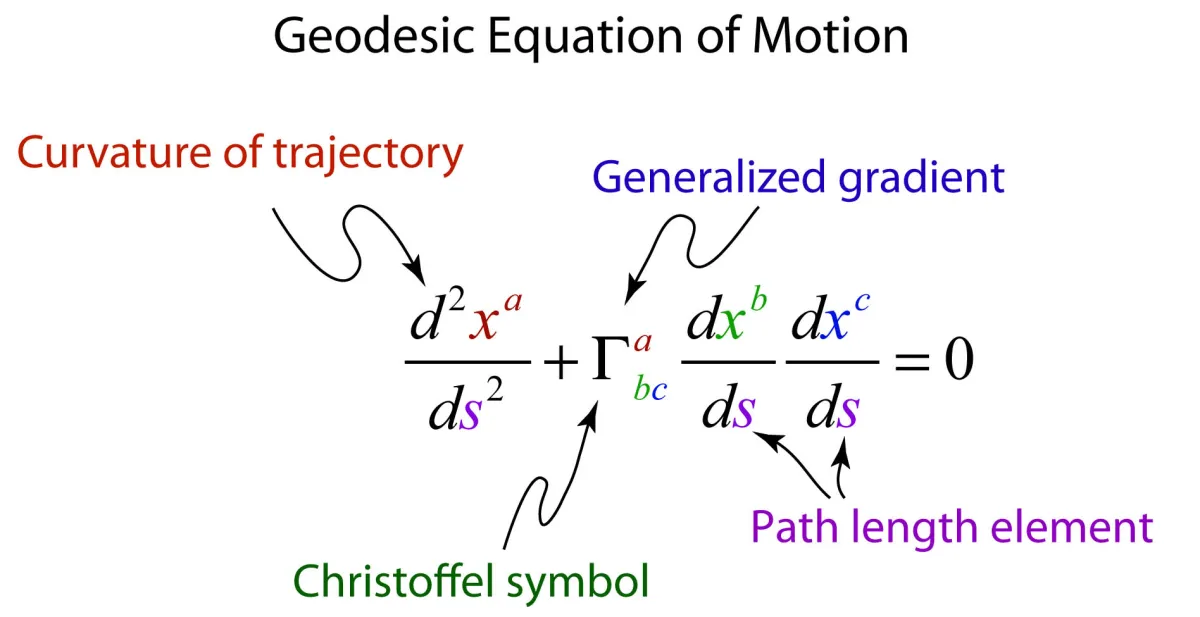
These equations explain the basic principles of general relativity and are used to calculate how much a space body can bend the fabric of space-time.
Even if the fabric of space-time is completely flat, the path you take will be curved because of the “unknown” mass effect on you. That is, whether the fabric of space is curved or straight, every object in space-time is doomed to follow a curved path.
Quantum mechanics is based on the discrete or quantized nature of the tiny particles that make up the universe. Some theorists think that perhaps spacetime itself is contained in these quantum particles, which help establish relativistic and quantum mechanics.
All modern equations are deterministic and time-reversible, while our common sense and intuition tell us that time cannot be turned back or forward. However, quantum matrix equations are indeterminate and have the property of irreversibility with respect to time. Solar calendars are more consistent with seasonal cycles than lunar calendars. The Gregorian calendar was created by improving the Julian calendar. Astronaut watches should have different features than normal watches. These watches are resistant to extreme temperature changes, protected against radiation, and can work at high pressure differences.
The time dilation effect is clearly observed in vehicles orbiting the Earth, such as space stations, as they move at a speed of approximately 7.66 kilometers per second. Also, the weakening of the gravitational field is another important factor affecting the flow of time. Thought experiments like the twins’ paradox embody the relativity of time. Different observers can measure the same objects differently. Gravitational waves are similar to waves after a stone is thrown into a lake. The theory of relativity says that accelerating masses in space will emit gravitational waves.
Would you like to check the time? 1.3 billion years ago, space-time vibrated madly when two black holes of 36 and 29 solar masses merged to form 62 solar masses. Time measurement and synchronization are of great importance in space research. Space agencies are very careful when choosing the hours they will use in their missions. Clock technologies developed for future space travel utilize the principles of quantum physics. This new generation of watches will provide more accurate time measurement during long-distance space travel. What distance can be measured by the parallax method? The distance of stars with a parallax angle of 0.001 arcseconds can be calculated by observations made with space telescopes.
How does time flow in space? The faster an object moves through space, the faster time begins to shorten for that object. It leads to the gravitational lensing effect. In this way, it is possible to see distant celestial structures that we cannot see normally. Along with modern physics, time dimension was added to the concept of space, which we previously accepted as three-dimensional, and the universe began to be accepted as four-dimensional.