The United Arab Emirates, especially Dubai and Abu Dhabi, are known for their low tax burden, international business opportunities, and economic zones created for entrepreneurs. Therefore, many people consider the UAE to be a completely tax-free country. However, it is not correct to say that there are no taxes in the United Arab Emirates.
As "Hesabla.com", in this article, we will explain how Corporate Tax and VAT are calculated in the United Arab Emirates, in which cases individual entrepreneurs pay taxes, the 0 percent tax right of Free Zone companies, small business exemptions, and tax return submission deadlines with examples. We should also note that this article is for general explanation purposes. The tax consequences in the UAE may vary depending on the company's license, residency status, contracts, zone of operation, and structure of operations. When making a real business decision, the Federal Tax Authority - FTA regulations and the opinion of a licensed tax specialist should be taken into account.
# What taxes are there in the UAE?
The main taxes that entrepreneurs in the UAE may face are:
- Corporate Tax (0% on taxable income up to AED 375,000, 9% on the excess)
- VAT (5% on most taxable goods and services)
- Free Zone Corporate Tax (0% on qualifying income, 9% on other non-qualifying income)
- Individual Business Tax (Corporate Tax may be applied when business turnover exceeds AED 1 million per year)
- Small Business Relief (Temporary relief for qualifying resident individuals with a maximum income of AED 3 million)
- Customs Duty (General rule 5% of CIF value)
- Excise Tax (Special rates and amounts for certain products harmful to health)
- Salary Income Tax (General income tax is not applied to salaries of individuals)
- Withholding Tax (0% under the current Corporate Tax system)
Corporate Tax is a direct tax imposed on the net income or profit of a business. VAT is an indirect tax imposed on sales and purchases. These two taxes are not interchangeable and an entrepreneur can be a payer of both at the same time.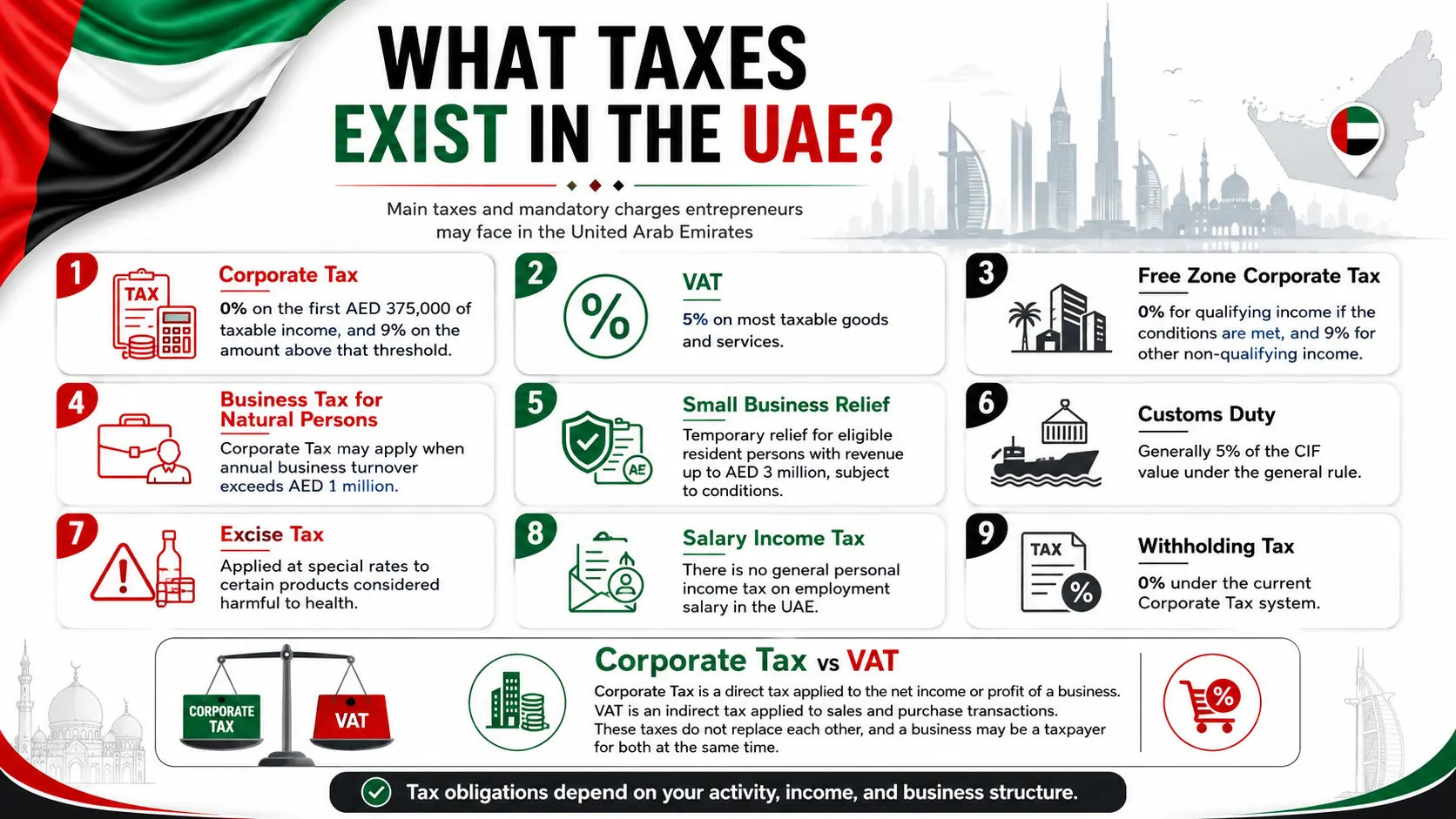
# What is Corporate Tax in the UAE?
Corporate Tax is a federal tax imposed on the taxable net income of companies and other businesses.
The Corporate Tax law in the UAE is applicable to financial years beginning on or after June 1, 2023. The tax is calculated not on the total sales turnover, but on the taxable income after making certain tax adjustments to the accounting profit.
Corporate Tax is applicable to the following persons:
* Companies incorporated in the UAE;
* Foreign legal entities effectively controlled from the UAE;
* Individuals carrying on business activities in the UAE;
* Non-resident companies with a permanent establishment in the UAE;
* Companies registered in a Free Zone.
Being a Free Zone company does not automatically exempt you from Corporate Tax registration. Free Zone companies are also subject to the general tax system and must comply with the reporting requirements of Corporate Tax registration.
The standard Corporate Tax rates are as follows:
- 0–375,000 AED = 0%
- Over 375,000 AED = 9%
Here, the AED 375,000 threshold applies to the taxable profit, not the company’s total turnover.
If the taxable profit exceeds 375,000 AED, the formula is as follows:
Corporate Tax = (Taxable Profit − 375,000 AED) × 9%
# Does a sole proprietor pay Corporate Tax?
In the UAE, general income tax is not levied on the salary of an individual. However, if an individual carries on business or entrepreneurial activity in the UAE, he or she may be subject to Corporate Tax after a certain threshold.
Corporate Tax for an individual is applicable when the following two conditions are met:
1. The individual carries on a business or business activity in the UAE.
2. The total annual turnover derived from that business activity exceeds AED 1,000,000.
Salary, personal investment income and personal real estate investment income are not included in the calculation of this AED 1 million business turnover.
- Example for a sole proprietor
The business results of an individual for 2026 are as follows:
- Total business turnover = AED 1,400,000
- Business expenses = AED 900,000
- Taxable profit = AED 500,000
Since the turnover exceeds AED 1 million, the individual may be subject to Corporate Tax rules.
Tax calculation:
500,000 − 375,000 = 125,000 AED
125,000 × 9% = 11,250 AED
Corporate Tax: 11,250 AED
If an individual’s turnover was 900,000 AED, the individual would not be required to register for Corporate Tax as the AED 1 million Corporate Tax threshold for this activity would not be exceeded.
However, if their VAT-charged sales exceed 375,000 AED, VAT registration may arise even if they are not liable for Corporate Tax. The Corporate Tax and VAT registration thresholds are checked separately.
# Do Free Zone companies always pay 0% tax?
No. Establishing a Free Zone company does not automatically mean that all income is taxed at 0%.
A Free Zone company can benefit from a 0% Corporate Tax rate on Qualifying Income only if it meets the conditions stipulated by law and meets the status of **Qualifying Free Zone Person**.
The general principle is as follows:
- Qualifying Income = 0%(Corporate Tax)
- Other taxable income = 9%(Corporate Tax)
In order for a Free Zone company to benefit from the 0% regime, the type of activity, source of income, customer status, economic existence, financial statements and other conditions are taken into account. The profits earned by a Free Zone company through a permanent establishment in the UAE Mainland can be taxed at 9%.
A Free Zone company must also:
* Register for Corporate Tax;
* Keep financial records;
* File a return;
* Correctly classify its income as Qualifying and Non-qualifying;
* should take into account transfer pricing rules in transactions with related parties.
Therefore, the approach of “I got a Free Zone license, I have no taxes and reports” is not correct.
# What is VAT in the UAE?
VAT is Value Added Tax.
VAT in the UAE is applied at a standard rate of 5 percent on the sale of taxable goods and services. VAT is calculated at each stage of sale, but a registered entrepreneur can deduct the amount of Input VAT paid on eligible purchases from the Output VAT calculated on the sale.
VAT Formula: Sales VAT = VAT-free sales price × 5%
VAT payable = Output VAT − Recoverable Input VAT
# How is VAT payable to the budget calculated?
The company's figures for a tax period are as follows:
- Taxable sales, 200,000 AED (excluding VAT), 10,000 AED (VAT)
- Eligible business purchases, 80,000 AED (excluding VAT), 4,000 AED (VAT)
Output VAT: 200,000 × 5% = 10,000 AED
Input VAT: 80,000 × 5% = 4,000 AED
VAT payable to the budget: 10,000 − 4,000 = 6,000 AED
The company pays 6,000 AED VAT to the FTA.
Not all VAT paid on purchases is automatically recoverable. The expense must be business-related, supported by a valid tax invoice, and meet the conditions for reclaiming VAT legislation.
# Difference between Corporate Tax and VAT
- Type of tax: Direct tax / Indirect tax
- What is it calculated from?: On taxable profit / On sales and purchases
- Basic rate: 0% and 9% / 5%
- Basic threshold: 375,000 AED profit / 375,000 AED taxable sales
- Who bears it?: Business / End consumer, through business
- Reporting: Annual / Usually monthly or quarterly tax period
- Are they interchangeable?: No / No
For example, since the company's profit is 300,000 AED, Corporate Tax may be zero. However, since the sales turnover is 1 million AED, the company must be VAT registered and charge 5 percent VAT.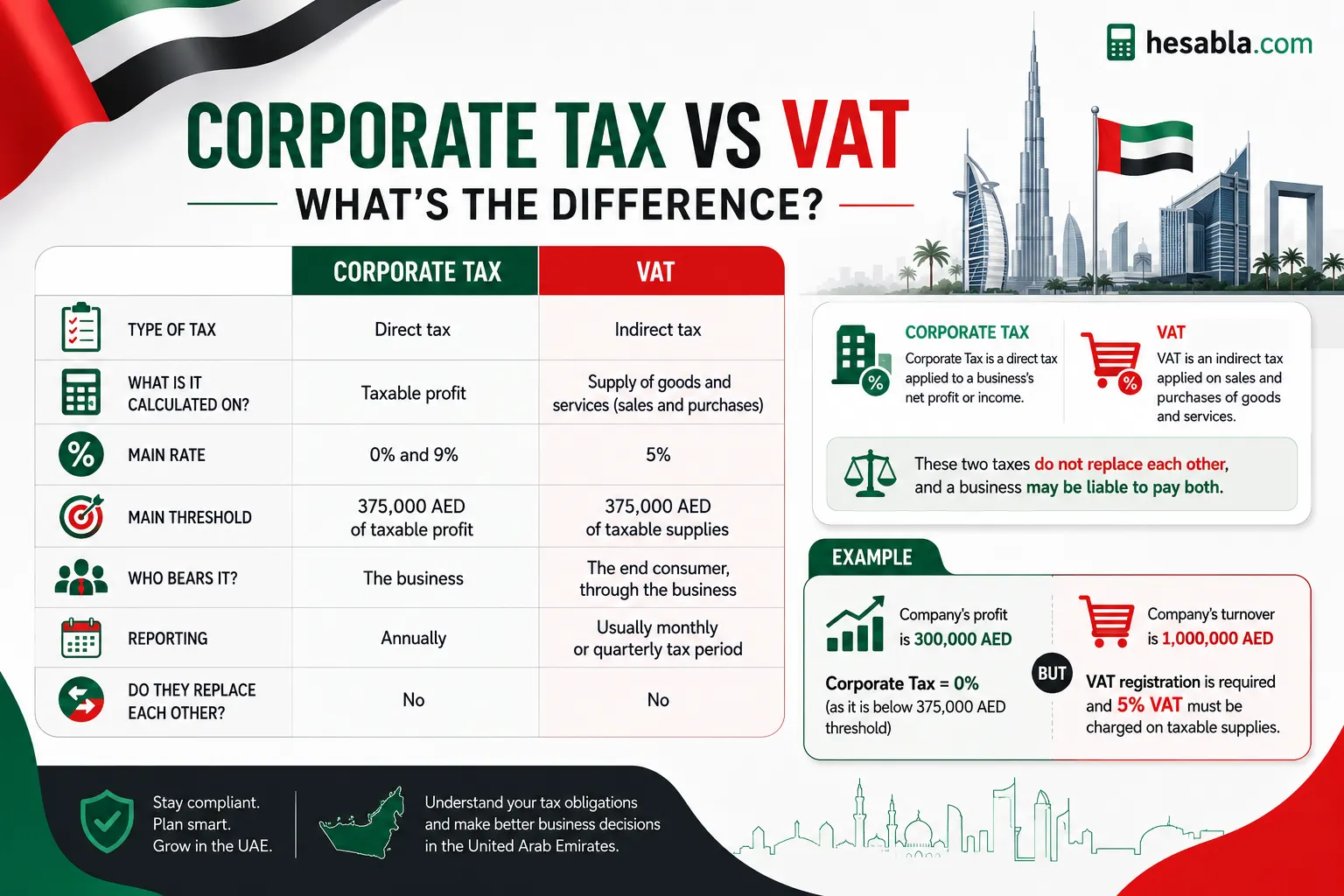
# How is customs duty calculated?
The general customs duty for entrepreneurs importing goods into the UAE is calculated on the basis of 5 percent of the CIF value of the goods for most goods.
CIF is the sum of the following amounts:
* value of goods;
* transportation costs;
* insurance costs.
According to the official UAE platform, the total customs duty is calculated by applying 5 percent to the sum of the value of goods, freight and insurance. There are different rates or exemptions for some categories of goods.
- Purchase value of goods = 100,000 AED
- Transportation = 8,000 AED
- Insurance = 2,000 AED
- CIF value = 110,000 AED
Customs duty: 110,000 × 5% = 5,500 AED
In some cases, import VAT is also calculated separately based on the customs value and other relevant amounts.
# What is Excise Tax?
Excise Tax is an indirect tax imposed on certain products that are harmful to health or the environment. In the UAE, excise tax is levied on tobacco products, e-cigarette devices and liquids, energy drinks and certain sweetened beverages. Businesses that import, manufacture, stock or release these products for consumption from a Designated Zone may be required to register and report.
From 2026, the tax on sweetened beverages has been moved to a per litre model based on sugar content:
- 8 grams or more per 100 ml = AED 1.09/litre
- Less than 5–8 grams per 100 ml = AED 0.79/litre
- Less than 5 grams per 100 ml = AED 0/litre
- Artificial sweetener only = AED 0/litre
Separate excise regulations apply to energy drinks, tobacco and e-cigarette products.
# 15 percent minimum tax for large international companies
The UAE does not impose a general 15 percent Corporate Tax on ordinary small and medium-sized businesses. However, the Domestic Minimum Top-up Tax rules may apply to the UAE members of large multinational enterprise groups with an annual global revenue of at least €750 million. This regime comes into effect for financial years starting on or after January 1, 2025. This rule is not intended for small entrepreneurs, freelancers and ordinary local LLCs.
# How long should tax documents be kept?
Corporate Tax payers must keep documents confirming the information in the tax return for at least 7 years after the end of the relevant tax period.
Documents that must be kept may include:
* sales invoices;
* purchase invoices;
* bank statements;
* contracts;
* asset and liability registers;
* financial statements;
* payroll documents;
* tax calculations;
* Transaction documents with related parties.
FTA may impose administrative penalties for failure to maintain documents and late submission of reports.
# How should an entrepreneur plan for the tax system in the UAE?
Before starting a business, the following questions should be answered:
1. Will the activity be carried out through a Mainland, Free Zone or offshore structure?
2. Will the business operate as a legal entity or an individual?
3. How much AED will the expected annual turnover be?
4. Will the taxable profit exceed AED 375,000?
5. Will the sole proprietorship’s turnover exceed AED 1 million?
6. Will sales subject to VAT exceed AED 375,000?
7. Are customers located within the UAE, in the Free Zone or abroad?
8. Will the income be considered Qualifying Free Zone Income?
9. Are the Small Business Relief conditions met?
10. Will input VAT be recoverable?
11. When does the company's fiscal year end?
12. Who will prepare the tax returns?
It is not right to choose a company structure based solely on the price of the license. Choosing a cheaper Free Zone license may later create additional difficulties in terms of Mainland customers, bank account, operating permit and Corporate Tax.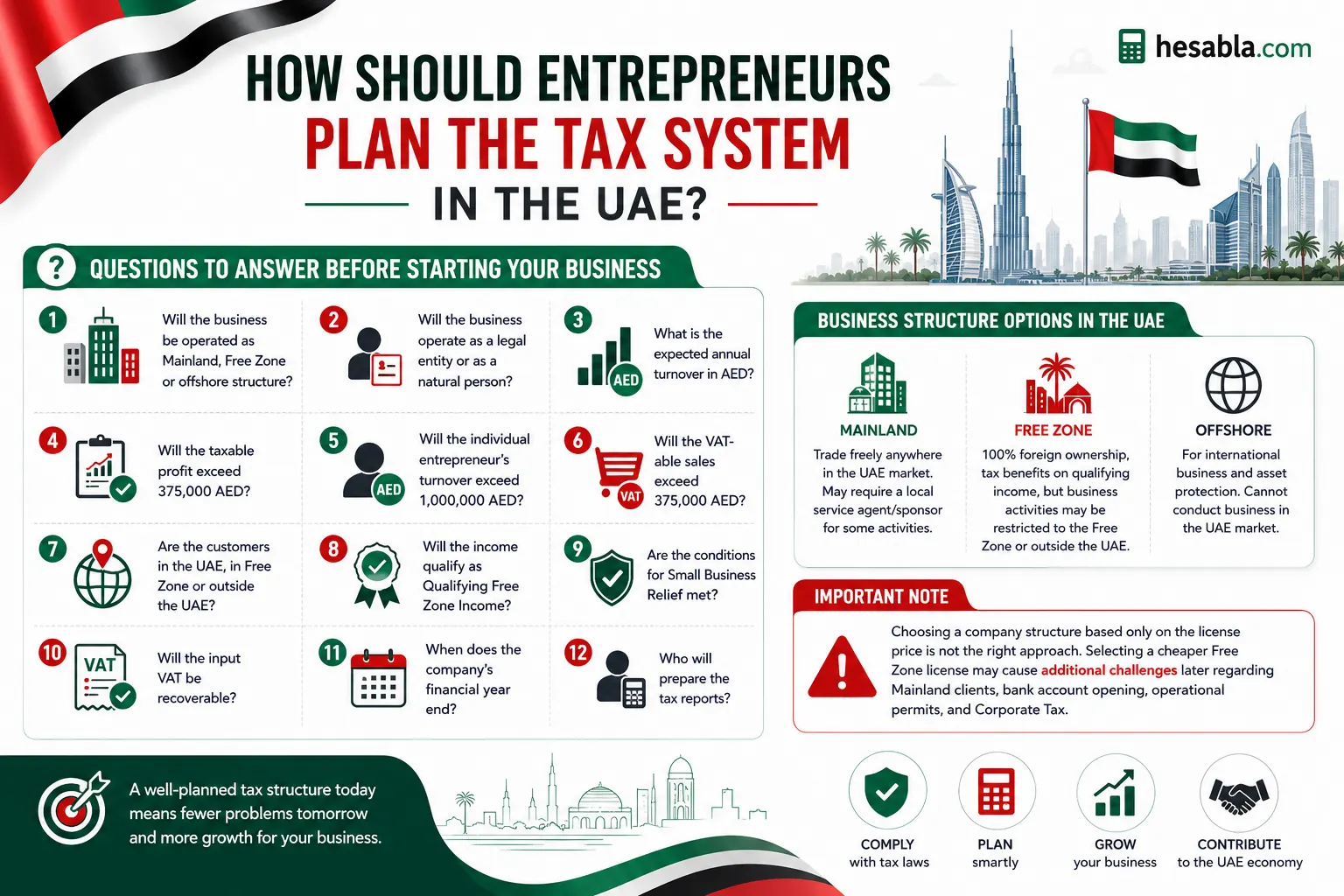
# Frequently Asked Questions
- What percentage of tax do companies pay in the UAE?
Under the standard Corporate Tax system, the first 375,000 AED taxable profit is 0 percent, and the part above this limit is taxed at 9 percent.
- How much is the tax on 500,000 AED profit?
500,000 − 375,000 = 125,000 AED
125,000 × 9% = 11,250 AED
Corporate Tax is 11,250 AED.
- Is 9 percent tax applied to 1 million AED turnover?
No. 9% is applied to taxable profits over AED 375,000, not to total turnover.
- Is tax levied on an individual's salary?
In the UAE, general income tax is not levied on individual salaries.
- Does a freelancer pay tax?
Corporate Tax registration and tax liability may arise when a freelancer or sole proprietor's annual turnover from business activities in the UAE exceeds AED 1 million.
- Does a Free Zone company pay 0% tax?
Only a company that meets the Qualifying Free Zone Person conditions can be subject to 0% tax. Registration in a Free Zone does not in itself guarantee 0% on all income.
- What is the VAT rate?
The standard VAT rate in the UAE is 5%.
- What is the VAT registration threshold?
The total threshold for mandatory VAT registration is AED 375,000 for the previous 12 months or the next 30 days. The voluntary registration threshold is AED 187,500.
- Who is Small Business Relief for?
Resident individuals and legal entities whose income does not exceed AED 3 million in the current and previous eligible tax periods can opt for the relief provided that they meet other conditions.
- Is the Small Business Relief permanent?
Under the current rule, the relief applies to eligible tax periods ending on or before December 31, 2026.
- When is the Corporate Tax return due?
The return must be filed and the tax paid within 9 months of the end of the tax period.
- When is the VAT return due?
The VAT return and payment must be made within 28 days of the end of the tax period.



How is tax calculated in the United Arab Emirate...

18 Jul
3