Turkey is one of the most attractive countries for entrepreneurs with its large domestic market, location between Europe and Asia, developed logistics capabilities and various business sectors. However, when setting up a business in Turkey, it is necessary to understand not only the company registration costs and sales opportunities, but also the tax system correctly.
As “Hesabla.com”, in this article, we will explain how tax is calculated for sole proprietorships and companies in Turkey, the income tax brackets for 2026, Corporate Tax, VAT, withholding, Bag-Kur payments, employer expenses on wages and declaration periods with examples. We should also note that this article is for general information purposes. The real tax result may vary depending on the entrepreneur's residency status, field of activity, documented expenses, benefits and contracts. When making a business decision, the rules of the Revenue Administration - GIB and the opinion of a financial advisor operating in Turkey should be taken into account.
# What taxes are there in Turkey?
The main taxes and mandatory payments that entrepreneurs may face in Turkey are as follows:
* Income Tax – Income tax (Graded tax from 15% to 40% for sole proprietorships and other individuals)
* Corporate Tax – Corporate tax (Generally 25% of company profits)
* Financial sector Corporate Tax (30% for banks and certain financial institutions specified in the law)
* Value Added Tax – VAT (Basically 1%, 10% or 20% for products and services)
* Provisional Tax (Income or corporate tax calculated and paid in advance during the year)
* Withholding Tax – Tax withholding (On rent, professional services, wages, dividends and some other payments)
* Stamp Duty (On contracts, wages and other documents specified in the law)
* Special Consumption Tax – SCT (On fuel, cars, tobacco, alcohol and certain products)
* Bag-Kur premium (Social insurance for sole proprietors and other independent workers)
* Employee social insurance premiums (SSI and unemployment insurance paid by the employee and employer)
* Real Estate Tax (For individuals who own real estate)
* Motor Vehicle Tax – MTV (For owners of vehicles)
* Customs Tax (When importing goods)
Not all of these taxes are applied to every entrepreneur at the same time. For example, for a sole proprietorship that does not have employees and only provides services, income tax, VAT and Bag-Kur liability may arise. For a Limited Company that imports products and employs employees, Corporate Tax, VAT, customs duty, payroll taxes and withholding tax may arise together.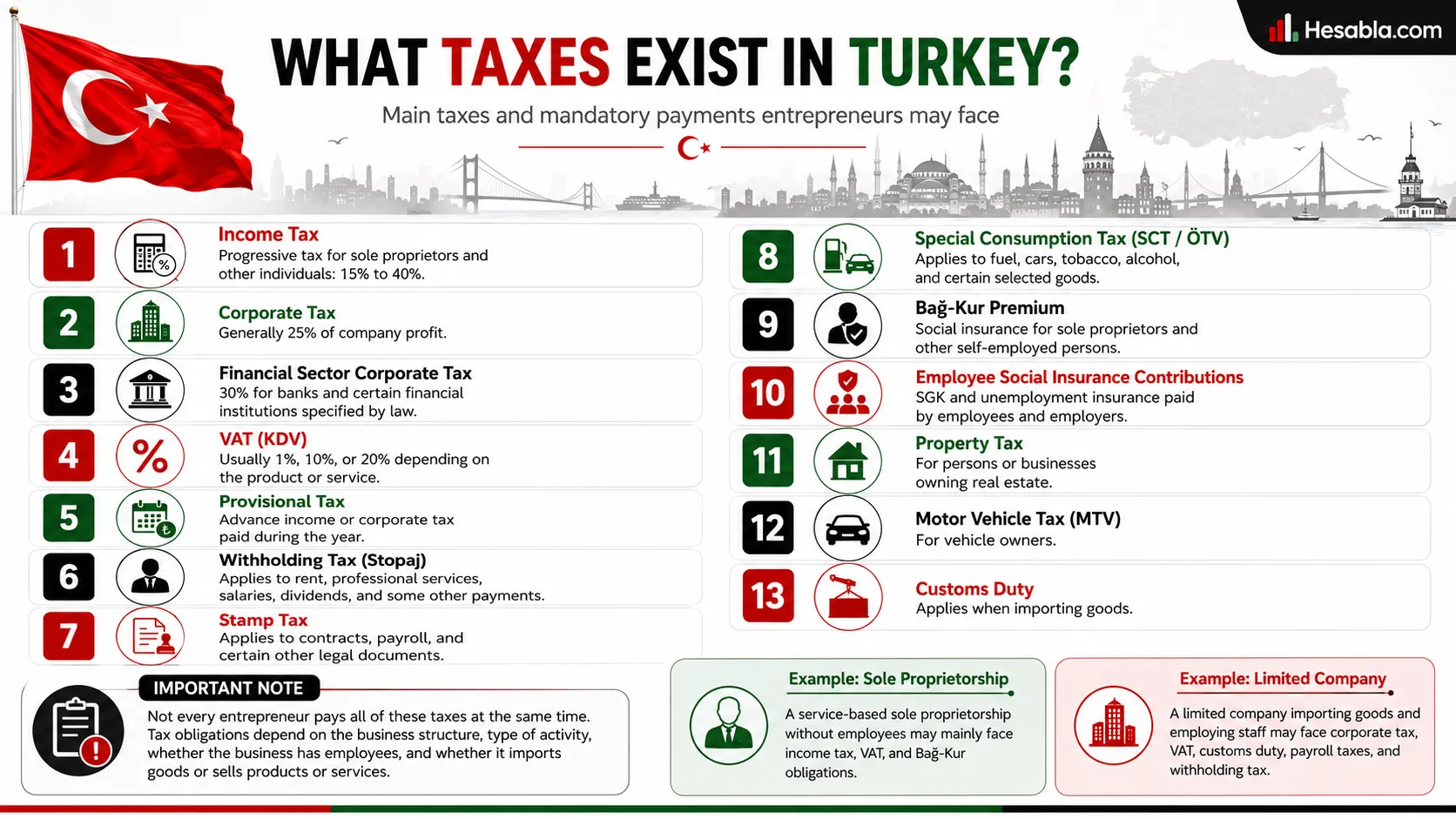
# What business forms are there in Turkey?
The entrepreneur's tax system primarily depends on the legal form of the business.
The main business forms are as follows:
* Sole Proprietorship (established in the name of an individual and pays income tax)
* Limited Company (legal entity and pays Corporate Tax)
* Joint Stock Company (legal entity and pays Corporate Tax)
* Ordinary Partnership (partners pay tax on their share of profits)
* Self-employed (for lawyers, consultants, doctors, architects and certain professionals)
* Simple System (special system only for small tradesmen who meet the conditions specified in the law)
Establishing a sole proprietorship is usually simpler. However, as profits increase, the income tax rate can increase to 40 percent.
In Limited and Joint Stock Companies, the basic corporate tax rate is 25 percent. However, additional withholding and personal income tax may result when the company's profits are distributed to the entrepreneur as dividends.
# What taxes does a sole proprietorship pay?
A sole proprietorship is not a legal entity. Profits earned from business are considered the direct personal income of the entrepreneur.
The main obligations of a sole proprietorship may be:
* Income Tax;
* VAT;
* Temporary Tax;
* Garden-Kur premium;
* Withholding tax on office rent;
* Payroll taxes and SSI if employees are employed;
* Stamp Duty on contracts and certain documents.
Income Tax is not applied to total turnover, but to net profit remaining after deducting legally permissible business expenses from income.
Income Tax formula: Taxable profit = Total business income − Legally permissible expenses
# What is the income tax rate in Turkey in 2026?
The Income Tax rate applied to entrepreneurial and other non-wage income in 2026 is as follows:
* Up to 190,000 TL = 15%
* 28,500 TL for 190,000 TL of 400,000 TL, excess = 20%
* 70,500 TL for 400,000 TL of 1,000,000 TL, excess = 27%
* 232,500 TL for 1,000,000 TL of 5,300,000 TL, excess = 35%
* 1,737,500 TL for the first 5,300,000 TL of income above 5,300,000 TL, excess = 40%
This rate is a phased system. The highest tax rate is not applied to the entire income of the entrepreneur. Each part of the income is calculated at the rate of the tax bracket in which it is included.
For example, if the annual taxable income of the entrepreneur is 1,200,000 TL, 35 percent is not applied to the entire amount.
The calculation is made as follows:
* Tax calculated for the first 1,000,000 TL = 232,500 TL
* The part exceeding 1,000,000 TL = 200,000 TL
* Tax on the excess part = 200,000 × 35%
* Tax on the excess part = 70,000 TL
* Total Income Tax = 232,500 + 70,000
* Total Income Tax = 302,500 TL
The entrepreneur's income tax on the net income of 1,200,000 TL is 302,500 TL.
Effective tax rate: 302,500 ÷ 1,200,000 × 100 = 25.21%
Although the final tax bracket for the entrepreneur is 35 percent, the actual tax burden on all profits is approximately 25.21 percent.
# How is income tax calculated for a sole proprietorship?
Let the annual results of a sole proprietorship be as follows:
* Total sales and service income = 2,400,000 TL
* Cost of goods purchased and produced = 700,000 TL
* Office and store rent = 240,000 TL
* Employee and social security expenses = 180,000 TL
* Advertising, software and other business expenses = 80,000 TL
* Total deductible expenses = 1,200,000 TL
Taxable income: 2,400,000 − 1,200,000 = 1,200,000 TL
2026 income tax: 232,500 + (200,000 × 35%) = 302,500 TL
Result:
* Total turnover = 2,400,000 TL
* Taxable income = 1,200 000 TL
* Calculated Income Tax = 302 500 TL
* Profit after tax = 897 500 TL
This calculation does not include VAT, Bag-Kur, prepaid Temporary Tax and other liabilities. Temporary Tax paid during the year is deducted from the final income tax.
# What business expenses can be deducted from income?
When calculating tax, only expenses related to business activities, accepted by law and confirmed by documents, can be deducted from income.
Depending on the type of activity, the following expenses can be taken into account:
* purchase and production costs of goods sold;
* office, store and warehouse rent;
* employee salaries;
* SSI contributions paid by the employer;
* electricity, water, gas and internet;
* advertising and marketing;
* software and digital services;
* financial advisor and legal services;
* delivery and logistics;
* business travel expenses;
* depreciation on equipment;
* bank commissions;
* business-related telephone and communication expenses;
* legally recognized expenses related to a car used for business.
Expenses incurred for personal consumption cannot be shown as business expenses. Additional restrictions may apply to cars, telephones, and other assets used for both personal and business purposes.
It is important to verify expenses with invoices, self-employed receipts, e-archive invoices, contracts, bank payments, and other legal documents.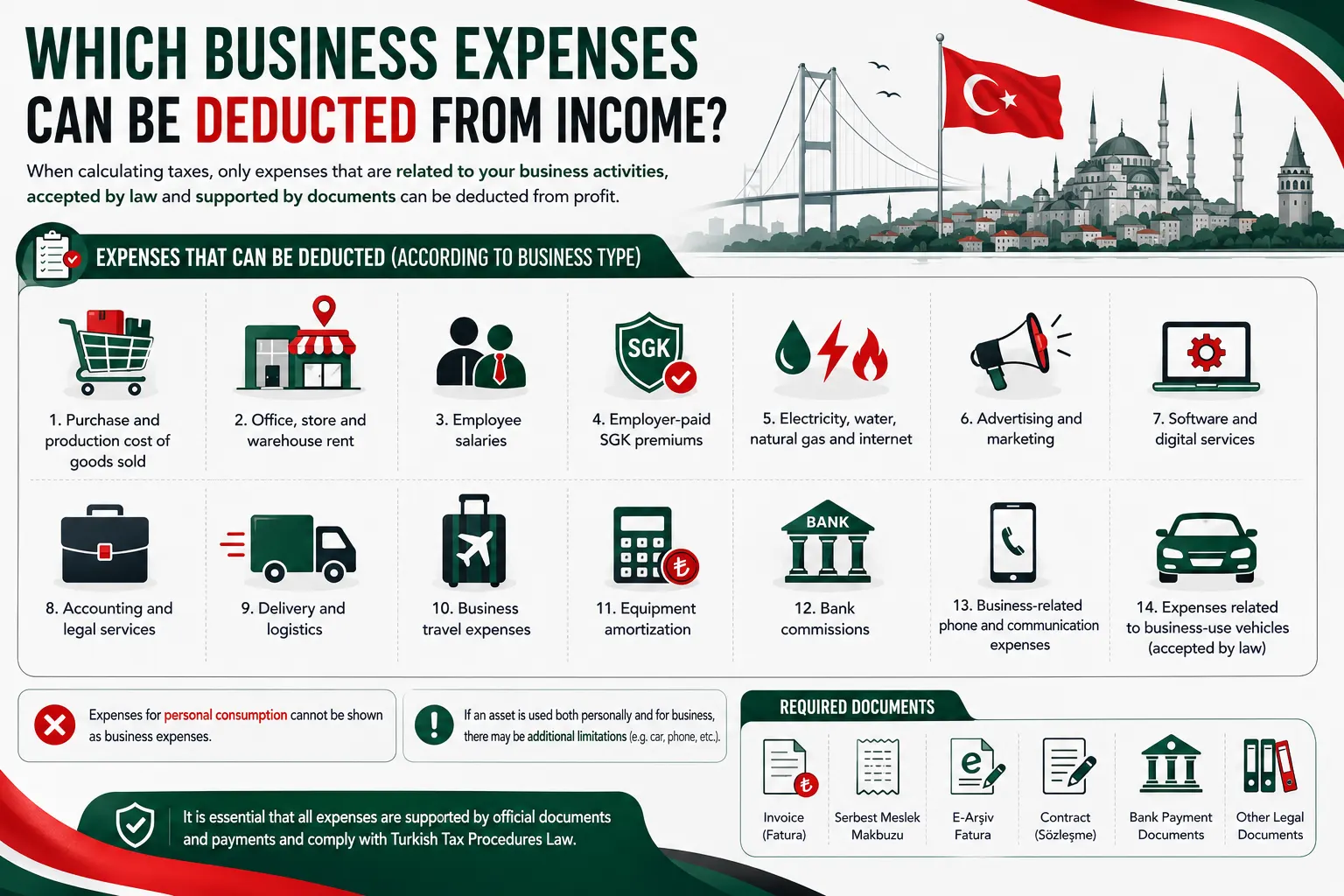
# How much tax do Limited Companies and Joint Stock Companies pay?
Capital companies such as Limited Companies and Joint Stock Companies pay Corporate Tax, not personal income tax.
The general Corporate Tax rate is 25 percent.
Different rates apply for some activities:
* General companies = 25%
* Banks and certain financial institutions specified in the law = 30%
* Eligible profit from export activities = 20%
* Production profit of manufacturers with an industrial registration certificate = 24%
* Eligible companies that have offered at least 20% of their shares for sale on the stock exchange for the first time = 23%
The reduced rate may be applied to the eligible activity profit specified in the law, not to the entire company profit.
Corporate Tax formula: Taxable company profit = Total income − Expenses accepted by law + Expenses added to the tax − Eligible exemptions and discounts
# How is Corporate Tax calculated?
Let the annual results of the Limited Company be as follows:
* Total sales revenue = 5,000,000 TL
* Cost of goods and services = 1,800,000 TL
* Salary and SSI expenses = 600,000 TL
* Rent and utilities = 300,000 TL
* Advertising, logistics and other expenses = 300,000 TL
* Total deductible expenses = 3,000,000 TL
Taxable profit: 5,000,000 − 3,000,000 = 2,000,000 TL
Corporate Tax: 2,000,000 × 25% = 500,000 TL
Result:
* Company taxable profit = 2,000,000 TL
* Corporate Tax = 500,000 TL
* After tax, the company remaining profit = 1 500 000 TL
The 500 000 TL Corporate Tax paid by the company does not mean that the profit is automatically transferred to the entrepreneur. The profit can be retained within the company or distributed as dividends to shareholders.
# What is VAT?
VAT is Value Added Tax.
VAT is not calculated from the entrepreneur's profit, but from the transactions arising from the provision of goods and services.
The basic VAT rates in Turkey are as follows:
* Certain goods and services in list (I) = 1%
* Certain goods and services in list (II) = 10%
* Other generally taxable goods and services = 20%
The rate to which a product or service belongs is determined by its classification in the law. Two entrepreneurs operating in the same field may apply different VAT rates because they sell different products.
VAT formula:
Calculated VAT = VAT-excl. sales price × VAT rate
VAT payable = VAT calculated on sales − VAT deducted on purchases
# How is VAT calculated in Turkey?
Let the company's transactions subject to 20 percent VAT for a month be as follows:
* Sales without VAT = 1,000,000 TL
* Business purchases without VAT = 400,000 TL
VAT calculated on sales: 1,000,000 × 20% = 200,000 TL
VAT paid and deductible on purchases: 400,000 × 20% = 80,000 TL
VAT to be paid to the budget: 200,000 − 80,000 = 120,000 TL
Result:
* Calculated VAT = 200,000 TL
* VAT to be deducted = 80,000 TL
* VAT to be paid = 120,000 TL
Not all VAT on purchases can be automatically deducted. The purchase must be business-related, properly documented, and allow for VAT deduction by law.
# How is VAT included in the price calculated?
If the price of the product already includes 20 percent VAT, it is not correct to calculate 20 percent of the total amount.
The formula for the amount including 20 percent VAT is: VAT = VAT included price × 20 ÷ 120
For example, the sales price including VAT is 1,200,000 TL.
VAT: 1,200,000 × 20 ÷ 120 = 200,000 TL
Price excluding VAT: 1,200,000 − 200,000 = 1,000,000 TL
Result:
* Price excluding VAT = 1,000,000 TL
* VAT = 200,000 TL
* Price including VAT = 1,200,000 TL
For an amount including 10 percent VAT: VAT = Total amount × 10 ÷ 110
For an amount including 1 percent VAT: VAT = Total amount × 1 ÷ 101
# Is there a VAT registration threshold in Turkey?
Turkey does not have a general VAT registration threshold of 375,000 AED, which applies to all entrepreneurs, as in the UAE.
As a general rule, goods and services provided within the scope of continuous commercial, industrial, agricultural and professional activities in Turkey are subject to VAT. If the entrepreneur's activity is not specifically exempted by law, VAT liability may arise from the period in which the activity begins.
There may be special VAT exemptions for simple methods, social media income, exports, diplomatic transactions and other activities specified in the law.
# What is Provisional Tax?
Provisional Tax is the advance payment of the entrepreneur's annual income or Corporate Tax liability in installments during the year.
Provisional Tax Rates in 2026:
* For Income Tax Payers = 15%
* For Corporate Tax Payers = 25%
The Provisional Tax paid during the year is deducted from the final annual income or Corporate Tax. Therefore, Provisional Tax is not a separate second income tax.
Provisional Tax is calculated in 3-month periods.
Declaration dates:
* January-March period = until May 17
* April-June period = until August 17
* July-September period = until November 17
* October-December period = until February 17 of the following year
The fourth Provisional Tax period is applied again from 2025.
For example, if the taxable profit of a sole proprietorship in the first 3 months is 300,000 TL:
300,000 × 15% = 45,000 TL Provisional Tax
If the final Income Tax at the end of the year is 302,500 TL and a total of 250,000 TL Provisional Tax has been paid during the year:
302,500 − 250,000 = 52,500 TL
The additional income tax to be paid on the annual declaration is 52,500 TL.
# What is withholding tax?
Withholding tax is withheld at source by the entrepreneur or company making the payment, not by the person earning the income.
An entrepreneur may encounter withholding tax during the following payments:
* workplace rental;
* freelance work;
* salary;
* dividend;
* construction and repair contracts;
* certain services purchased from abroad;
* copyright and other rights payments.
Withholding tax is not an additional income of the entrepreneur. The entrepreneur does not pay a certain part of the payment to the other party, but withholds it as tax and declares it to the state.
# What payments should an entrepreneur who employs an employee make?
When an entrepreneur employs an employee, he must calculate not only the amount that goes into the hands of the employee, but also social insurance and tax obligations from the gross salary.
Main payments for wages:
* employee's SSI share;
* employee's unemployment insurance share;
* employer's SSI share;
* employer's unemployment insurance share;
* income tax;
* Stamp Duty.
Standard social insurance rates:
* Total employee share = 15%
* Total employer share = 23.75%
* Total social insurance burden = 38.75%
The employee's 15 percent share includes 14 percent SSI and 1 percent unemployment insurance.
The employer's 23.75 percent share includes 21.75 percent SSI and 2 percent unemployment insurance. Legal incentives may reduce the amount actually paid by the employer.
# Tax difference between a company and a sole proprietorship
Sole proprietorship:
* Owner = Individual
* Basic direct tax = Income Tax
* Rate = 15% to 40%
* Transfer of profits to the owner = Does not require a separate dividend decision
* Social insurance = Usually Bag-Kur
* Accounting and registration = Can be simpler than a company
* Tax on high profits = Can rise to 40%
Limited and Joint Stock Company:
* Owner = One or more partners
* Basic direct tax = Corporate Tax
* General rate = 25%
* Transfer of profits to the owner = Requires dividend distribution
* Dividend withholding tax = Generally 15%
* Social insurance = Depends on the status of the partner and manager
* Accounting and legal obligations = More extensive
* Personal liability = May be more limited depending on the type of company and operation
The choice of company form should not be based solely on the tax rate. For example, even though the income tax for a sole proprietorship may rise to 40 percent, a company may incur an additional 15 percent withholding tax on profits after the 25 percent corporate tax.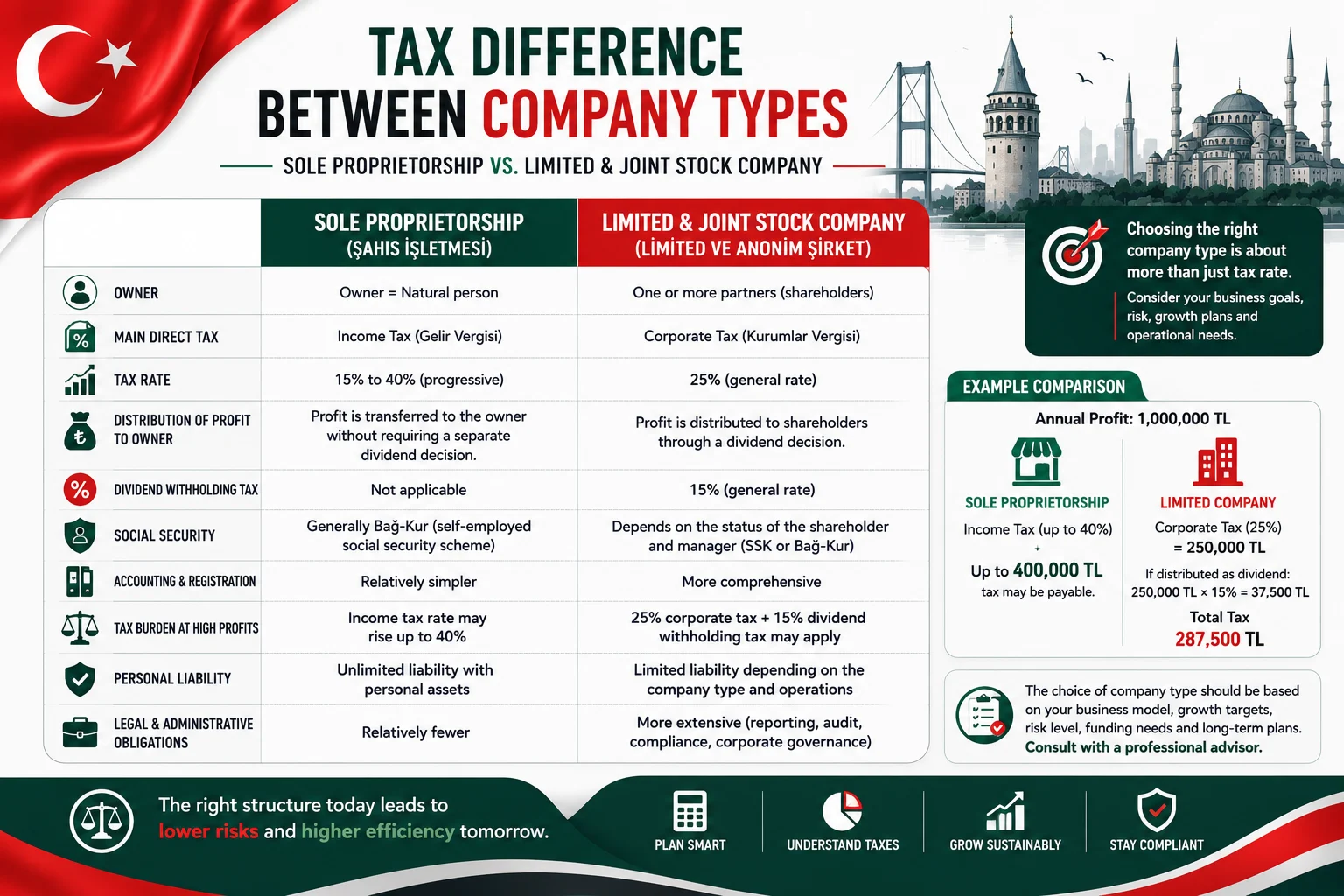
# When are tax returns filed?
The general deadlines for the main tax returns in Turkey are as follows:
* Annual Income Tax Return = By the end of March of the following year
* First installment of Income Tax = By the end of March
* Second installment of Income Tax = By the end of July
* Annual Corporate Tax Return = By the end of the fourth month following the month in which the reporting period ends
* Corporate Tax for calendar year companies = Usually by April 30
* VAT Return = By the 28th of the following month
* Summary and Premium Service Return = By the 26th of the following month
* Provisional Tax Return = By the 17th of the second month following the three-month period
* Permanent Stamp Duty payers = By the 26th of the following month
VAT and other taxes are generally paid within the deadline for filing the return.
# Full tax calculation example
Let the results of a sole proprietorship operating in Turkey for 2026 be as follows:
* Sales revenue excluding VAT = 2,400,000 TL
* Expenses accepted by law = 1,200,000 TL
* Taxable annual profit = 1,200,000 TL
* VAT calculated on sales = 480,000 TL
* VAT deducted on purchases and expenses = 180,000 TL
* Provisional Tax paid during the year = 250,000 TL
* Bag-Kur paid during the year = 121,880.76 TL
Income Tax: 232,500 + (200,000 × 35%) = 302,500 TL
Additional income tax to be paid on the annual declaration: 302,500 − 250,000 = 52 500 TL
VAT: 480 000 − 180 000 = 300 000 TL
Bağ-Kur: 10 156,73 × 12 = 121 880,76 TL
Total result:
* Calculated annual Income Tax = 302 500 TL
* Provisional Tax paid during the year = 250 000 TL
* Additional Income Tax in the annual declaration = 52 500 TL
* Calculated net VAT liability = 300 000 TL
* Annual sample Bağ-Kur premium = 121 880,76 TL
VAT is not a business profit tax. The entrepreneur collects the sales VAT from the customer and pays the difference to the state by deducting the input VAT.
# How should an entrepreneur plan the tax system in Turkey?
Before starting a business, the following questions should be answered:
1. Will the business be established as a sole proprietorship, Limited Company, or Public Limited Company?
2. How much is the expected annual turnover?
3. How much is the expected net profit?
4. What level of income tax will a sole proprietorship reach?
5. When a Limited Company is established, will the profit be retained in the company or distributed as dividends?
6. Is the VAT rate on products and services sold 1%, 10%, or 20%?
7. Can input VAT be deducted?
8. Will withholding tax be incurred if an office is rented from an individual?
9. Will tax and VAT liability arise if services are purchased from abroad?
10. Will employees be employed?
11. Does the employer have the right to use SSI incentives?
12. Will the entrepreneur pay the Bag-Kur premium?
13. Can the simplified method or other tax exemption be applied?
14. Is a three-month cash reserve set aside for the Provisional Tax?
15. Which financial advisor will manage the company's documents and declarations?
It is not correct to choose a legal form based solely on the company's registration price or tax rate. For low-profit and simple activities, a sole proprietorship may seem appropriate. When there is high profit, partnership, investment, number of employees and increased legal risk, a Limited or Joint Stock Company may be more suitable.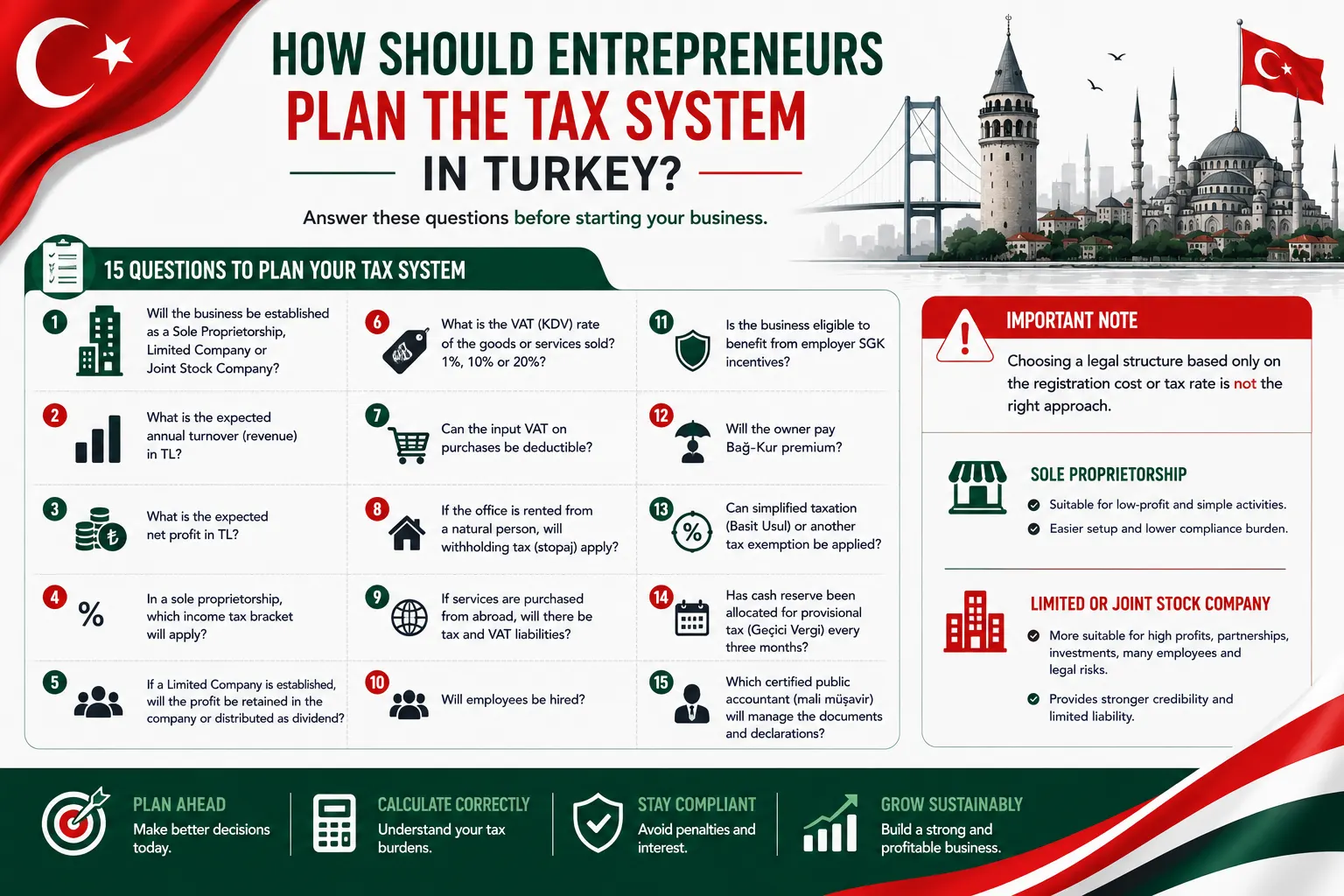
# Frequently Asked Questions
- What percentage of tax does a sole proprietorship pay in Turkey?
A sole proprietorship pays a progressive Income Tax ranging from 15 percent to 40 percent of its net profit. The same rate is not applied to all profits.
- How much is the income tax on a profit of 1,200,000 TL?
According to the 2026 tariff: 232,500 + (200,000 × 35%) = 302,500 TL
- What percentage of tax does a Limited Company pay?
According to the general rule, it pays 25 percent of the taxable profit as Corporate Tax.
- How much is the Corporate Tax on a profit of 2 million TL?
2,000,000 × 25% = 500,000 TL
- Can the entrepreneur take the profit after the company pays the tax?
Profit must be distributed as dividends. When a dividend is paid to a natural person partner, a 15 percent withholding tax may be incurred according to the general rule.
- What is the VAT rate in Turkey?
Depending on the product and service, 1 percent, 10 percent or 20 percent is applied. The general rate is 20 percent.
- How is VAT deducted from the VAT-inclusive price?
For a price including 20 percent VAT: VAT = Total amount × 20 ÷ 120
- Is there a minimum turnover for VAT registration in Turkey?
There is no single registration threshold for general entrepreneurial activities like in the UAE. If the transaction is not exempt, VAT liability may arise from the start of the activity.
- Is the Provisional Tax an additional tax?
No. The Provisional Tax paid during the year is deducted from the final income or Corporate Tax.
- Does a sole proprietorship pay Bag-Kur?
As a general rule, yes. The minimum monthly amount with a 5-point discount in 2026 is 10,156.73 TL.
- What is the percentage of the business rental withholding tax?
As a general rule, 20 percent of the gross rent is withheld as withholding tax for business premises rented from an individual.
- Does a simple tax payer pay income tax?
The commercial profits earned by a simple tax payer who meets the conditions under this system are exempt from income tax. However, the conditions of activity, location, rent and turnover must be examined together.
- Can an entrepreneur file a tax return himself?
In some systems, an entrepreneur can use electronic services himself. However, when it comes to employee, VAT, import, foreign service, withholding and company accounting, working with a Freelance Accountant significantly reduces tax risks.

How is tax calculated in Turkey? A complete expl...

19 Jul
10