Germany is one of the largest economies in Europe, has the largest consumer market and offers the most opportunities for entrepreneurs. However, the German tax system is quite detailed and varies depending on the legal form of the business, its profits, its field of activity, the city where it is located and the number of employees. In addition, when a company distributes its profits as dividends to its shareholders, a separate Kapitalertragsteuer arises. In addition, an entrepreneur who employs employees must pay social security contributions in addition to the taxes withheld from their wages.
In this article, we at “Hesabla.com” will explain how taxes are calculated in Germany for Einzelunternehmen, Freiberufler, UG and GmbH, the income tax brackets for 2026, the Körperschaftsteuer and Gewerbesteuer formula, Umsatzsteuer rules, Kleinunternehmer allowance, dividend tax and employee expenses with examples. We should also note that the article is for general information purposes. The actual tax liability in Germany may vary depending on the person’s residency status, marital status, whether the activity is considered commercial or freelance, the municipality where the company is located, contracts and applicable exemptions. When making a real business decision, the opinion of a Steuerberater, i.e. a tax advisor, operating in Germany should be taken into account.
# What taxes are there in Germany?
The main taxes and mandatory payments that entrepreneurs in Germany may face are:
* Einkommensteuer – Income tax (a graduated tax from 0% to 45% for sole proprietors, freelancers and individuals in partnerships)
* Körperschaftsteuer – Corporate tax (15% of taxable profits for capital companies such as GmbH, UG and AG)
* Gewerbesteuer – Trade tax (municipal tax for businesses engaged in commercial activities)
* Umsatzsteuer – Value added tax (mainly 19%, 7% for certain products and services)
* Solidaritätszuschlag – Solidarity surcharge (5.5% of certain Einkommensteuer and Körperschaftsteuer amounts)
* Kapitalertragsteuer – Capital income tax (mainly 25% on dividends and certain capital gains)
* Lohnsteuer – Wage tax (a form of employee income tax withheld from wages)
* Social insurance contributions (health insurance, pension, unemployment and care insurance)
* Grundsteuer (for real estate owners)
* Grunderwerbsteuer (federal land tax when purchasing real estate)
* Kfz-Steuer (vehicle tax)
* Customs and import taxes (when importing goods from outside the European Union)
Not all of these taxes apply to every entrepreneur at the same time. For example, a programmer or consultant working as a freelancer may pay Einkommensteuer and Umsatzsteuer, but if their activity is truly considered a freelance profession, they do not pay Gewerbesteuer. GmbHs are usually subject to Körperschaftsteuer, Solidaritätszuschlag, Gewerbesteuer and Umsatzsteuer. The official German business portal notes that freelancers do not pay Gewerbesteuer, but are subject to the income and VAT system.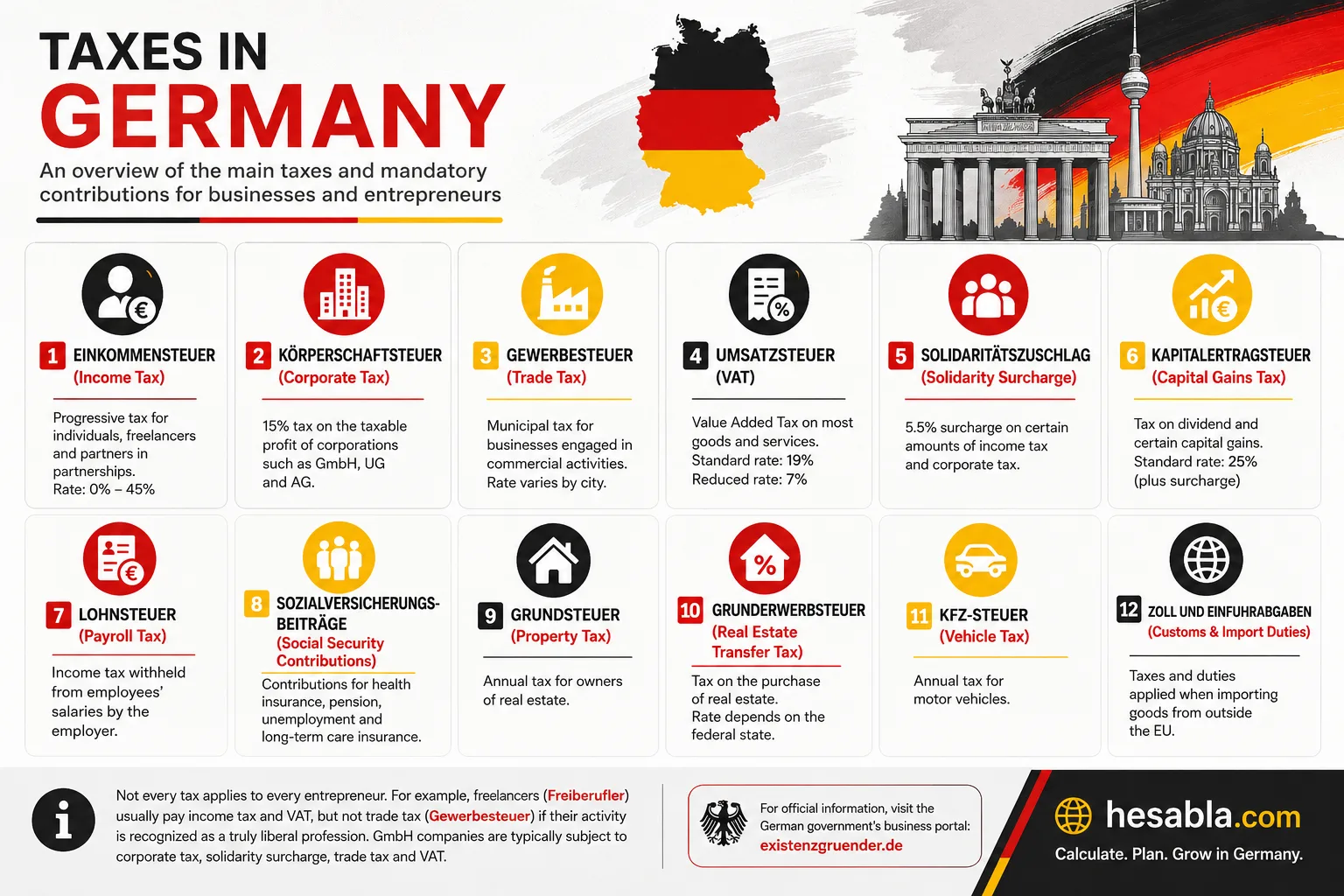
# What business forms are there in Germany?
The tax burden of the entrepreneur depends primarily on the legal form chosen.
The main business forms are:
* Einzelunternehmen (sole proprietorship)
* Freiberufler (freelance professional activity)
* GbR – Gesellschaft bürgerlichen Rechts (simple partnership of two or more persons)
* OHG and KG (commercial partnerships)
* UG – Unternehmergesellschaft (limited liability small capital company)
* GmbH – Gesellschaft mit beschränkter Haftung (limited liability company)
* AG – Aktiengesellschaft (joint stock company)
Einzelunternehmen and Freiberufler are not separate legal entities. The profits of the business are directly considered the personal income of the entrepreneur and are included in the Einkommensteuer system.
GmbH and UG are separate legal entities from their owners. The company pays Körperschaftsteuer and Gewerbesteuer on its profits. If the entrepreneur receives a salary or dividend from the company, additional tax consequences may arise at the personal level. The official German business portal highlights the main differences, such as the 15 percent Körperschaftsteuer for GmbHs, the lack of a Gewerbesteuer discount, and the requirement for double accounting.
# What is a sole proprietorship and what taxes does it pay?
A sole proprietorship is a form of business in which a natural person carries out business activities in his own name.
The main obligations of a sole proprietorship can be:
* Einkommensteuer;
* Gewerbesteuer;
* Umsatzsteuer;
* Solidaritätszuschlag;
* Lohnsteuer and social insurance if there are employees;
* other local and special taxes on activity.
A sole proprietorship does not pay a separate Körperschaftsteuer. The net profit from the business is included in the personal income of the entrepreneur.
The basic formula: Taxable business income = Gross business income − Legally permissible business expenses
The business income is then included in the calculation of Einkommensteuer together with the entrepreneur's other income.
# What is the income tax rate in Germany in 2026?
In Germany, Einkommensteuer is not calculated at a fixed rate, but at a graduated rate.
The basic income tax brackets for 2026 are as follows:
* Taxable income up to €12,348 = 0%
* €12,349–€17,799 = progressive zone starting at around 14%
* €17,800–€69,878 = progressively increasing tax
* €69,879–€277,825 = 42%
* The part above €277,826 = 45%
The amount of €12,348 is the Grundfreibetrag, i.e. the basic tax-free minimum. This amount does not apply to a person's turnover or total business income, but to their taxable personal income after all deductions.
This rate is graduated. Once the entrepreneur's income reaches €100,000, the 42 percent tax is not applied to the entire income. Only the portion of income in the corresponding upper bracket is calculated at that marginal rate.
# How is Einkommensteuer calculated?
The simplified official formula for taxable income between €69,879 and €277,825 in 2026 is as follows:
Einkommensteuer = Taxable income × 42% − €11,135.63
Let the annual taxable income of the sole proprietor after all deductions be €100,000.
Calculation:
100,000 × 42% = 42,000 euros
42,000 − 11,135.63 = 30,864.37 euros
In the official calculation, the result is rounded to the nearest euro according to the rule in the law:
Einkommensteuer = 30,864 euros
Result:
* Taxable income = 100,000 euros
* Accrued Einkommensteuer = 30,864 euros
* Average income tax rate = 30.86%
* Marginal rate on the final income portion = 42%
This example does not include personal insurance contributions, marital status, children, special discounts, Solidaritätszuschlag and Gewerbesteuer credit. The 2026 Einkommensteuer formula applies a 42 percent rate and a deduction of 11,135.63 euros for the range of 69,879–277,825 euros.
# How are business expenses deducted from income?
For Einzelunternehmen and Freiberufler, the tax is calculated on business profits, not on total turnover.
For example:
* Annual sales and service revenue = 180,000 euros
* Office rent = 18,000 euros
* Software and equipment = 12,000 euros
* Advertising and marketing = 8,000 euros
* Professional services = 6,000 euros
* Staff and other expenses = 36,000 euros
* Total business expenses = 80,000 euros
Business income: 180,000 − 80,000 = 100,000 euros
When calculating income tax, the starting business income is 100,000 euros. However, the final “zu versteuerndes Einkommen” may differ as a result of the entrepreneur’s health insurance premiums, pension costs and other personal tax deductions.
Acceptable business expenses may include the following, depending on the activity:
* office, shop and warehouse rent;
* employee salaries;
* employer's social security contributions;
* software and subscriptions;
* computers and other equipment;
* advertising and marketing;
* financial and legal services;
* business insurance;
* telephone and internet;
* business trips;
* transportation;
* depreciation;
* bank and payment system fees.
Personal expenses cannot be declared as business expenses. Separate rules apply to expenses such as cars, telephones and home offices used for both personal and business purposes.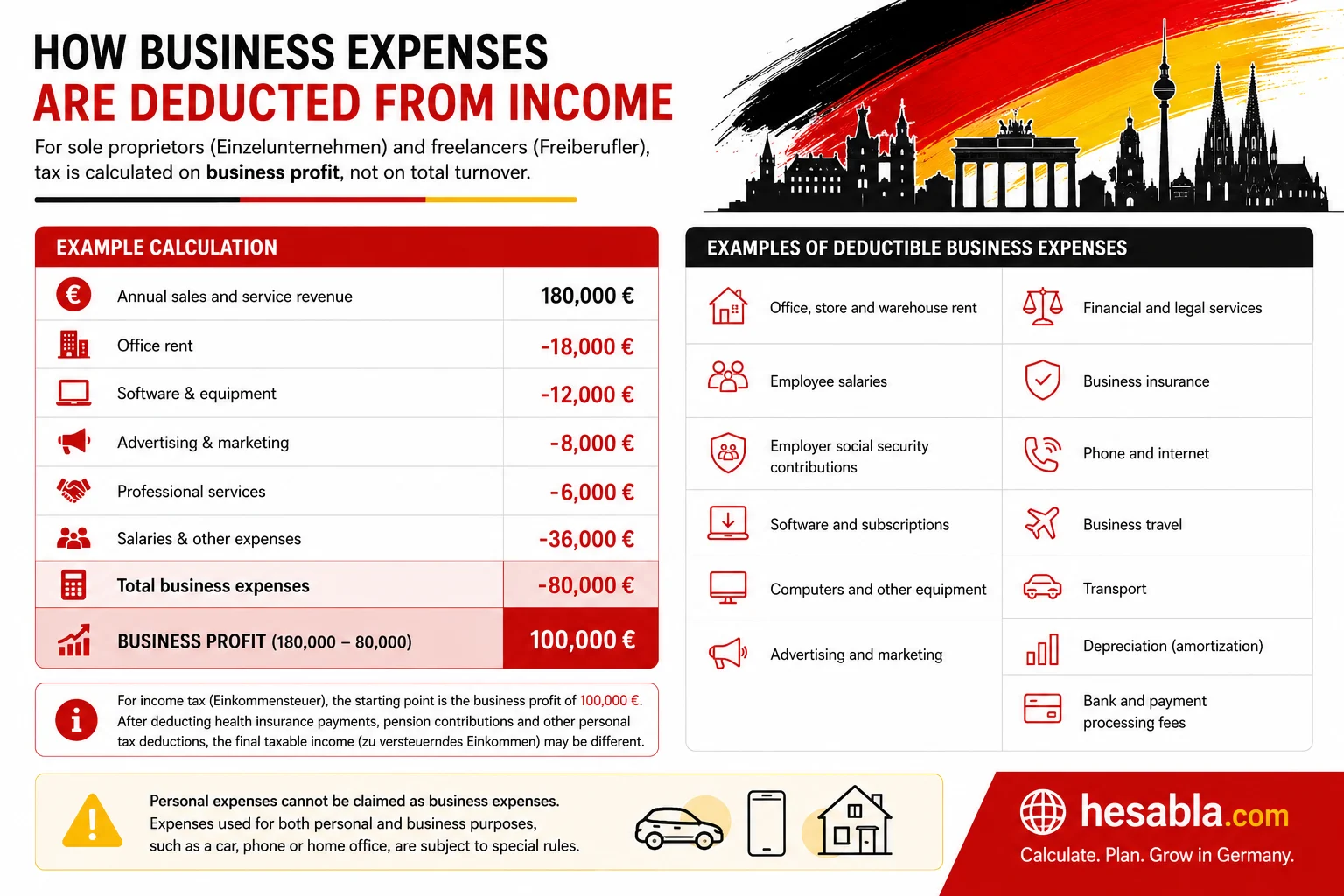
# What is Gewerbesteuer?
Gewerbesteuer is a municipal tax imposed on businesses operating commercially in Germany. The main feature of this tax is that the final rate depends on the city or municipality in which the business is located.
Gewerbesteuer is calculated in three stages:
1. The Gewerbeertrag, i.e. the trading profit, is determined.
2. A Steuermesszahl of 3.5 percent is applied to the tax base.
3. The result is multiplied by the municipality's Hebesatz rate.
Basic formula: Gewerbesteuer = Taxable Gewerbeertrag × 3.5% × Hebesatz
If the Hebesatz is 400%, the formula looks like this: Gewerbesteuer = Tax base × 3.5% × 400%
That is, in a city with a Hebesatz of 400%, the simplified effective Gewerbesteuer rate is 14 percent. According to the law, the Steuermesszahl is 3.5 percent and the municipalities determine the Hebesatz. There is a discount of 24,500 euros for sole proprietors and partnerships.
# How is Gewerbesteuer calculated for a sole proprietor?
Let the simplified Gewerbeertrag amount of a sole proprietor be 100,000 euros.
- Allowance for sole proprietors: 24,500 euros
- Tax base: 100,000 − 24,500 = 75,500 euros
- Steuermessbetrag: 75,500 × 3.5% = 2,642.50 euros
Let the municipality's Hebesatz be 400%.
Trade tax: 2,642.50 × 400% = 10,570 euros
Result:
* Trade income = 100,000 euros
* Relief = 24,500 euros
* Trade tax base = 75,500 euros
* Steuermessbetrag = 2,642.50 euros
* Hebesatz = 400%
* Trade tax = 10,570 euros
The €24,500 Gewerbesteuer relief does not apply to capital companies such as GmbH and UG. Sole proprietors and private partnerships can benefit from the relief under the conditions set out in the law.
# Is Gewerbesteuer deductible from income tax?
For sole proprietors and private partnerships, Gewerbesteuer can be deducted from Einkommensteuer up to a certain limit. The law generally allows a deduction of up to four times the amount of the Gewerbesteuer Steuermessbetrag.
In the example above: Steuermessbetrag = 2,642.50 euros
Maximum theoretical Einkommensteuer deduction: 2,642.50 × 4 = 10,570 euros
The Gewerbesteuer calculated at a Hebesatz of 400% is also 10,570 euros. If other legal restrictions allow, a large part of the tax can be deducted from Einkommensteuer.
In a simplified example of 100,000 euros:
* Initial income tax = 30,864 euros
* Trade tax = 10,570 euros
* Trade tax credit = maximum 10,570 euros
* Trade tax after credit = 20,294 euros
* Trade tax + Trade tax = 30,864 euros
Therefore, if the Hebesatz is up to 400%, the Trade tax is often largely offset by the income tax credit for the sole proprietor. If the Hebesatz is higher than 400%, the excess may not be fully offset.
The deduction is limited to the actual Trade tax, the Trade tax related to the business income and other limits in the law. The Trade tax credit is calculated based on four times the Steuermessbetrag.
# How is the GmbH tax calculated?
Let the GmbH have a taxable annual profit of 100,000 euros.
- Körperschaftsteuer: 100,000 × 15% = 15,000 euros
- Solidaritätszuschlag: 15,000 × 5.5% = 825 euros
The Hebesatz rate of the municipality where the company is located is 400%.
- Trade tax: 100,000 × 3.5% × 400% = 14,000 euros
- Total corporate tax: 15,000 + 825 + 14,000 = 29,825 euros
- Profit remaining in the company after tax: 100,000 − 29,825 = 70,175 euros
Result:
* Taxable profit = 100,000 euros
* Körperschaftsteuer = 15,000 euros
* Solidaritätszuschlag = 825 euros
* Trade tax = 14,000 euros
* Total corporate tax = 29,825 euros
* Profit remaining in the company = 70,175 euros
* Effective corporate tax burden = 29.83%
The total corporate tax burden can exceed 30 percent in large cities due to the high Hebesatz. In international comparisons, the BMF estimates that the 15 percent corporation tax in Germany, the related Solidaritätszuschlag and the approximately 15 percent trade tax together result in a total corporate tax burden of approximately 30 percent.
# What is Solidaritätszuschlag?
Solidaritätszuschlag is not a separate tax levied on the income or sales base. It is added to the calculated Einkommensteuer, Körperschaftsteuer and certain withholding taxes.
Total rate: Solidaritätszuschlag = Basic tax × 5.5%
A 5.5 percent Solidaritätszuschlag is generally added to the Körperschaftsteuer for capital companies.
For individuals, however, there is a high exemption threshold and a gradual transition zone. This means that most low- and middle-income earners will not have to pay Solidaritätszuschlag. In 2026, the basic threshold for joint taxpayers was increased to 40,700 euros; the corresponding threshold for single individuals is half that.
# What is Umsatzsteuer?
Umsatzsteuer is a value-added tax applied in Germany to the sale of goods and services.
Basic rates:
* General sales tax = 19%
* Certain products and services = 7%
A reduced rate of 7% may apply to certain food products, books, newspapers and other transactions specified by law. The 7% rate is not automatically applied to all products.
Sales tax is not calculated on the profits of the business. The entrepreneur collects the tax from the customer at the time of sale, deducts the Vorsteuer he has paid on purchases and pays the difference to the Finanzamt.
Basic formula: Sales tax payable = Sales tax − Deducted Vorsteuer on purchases
The German Sales Tax Act sets the standard rate at 19%; a reduced rate applies to certain legal transactions.
# How is sales tax calculated?
Let the company's figures for a month be as follows:
* Sales without VAT = 10,000 euros
* Sales rate = 19%
* Business purchases without VAT = 4,000 euros
* Purchase rate = 19%
- Sales tax: 10,000 × 19% = 1,900 euros
- Input tax on purchases: 4,000 × 19% = 760 euros
- Amount to be paid to the Finanzamt: 1,900 − 760 = 1,140 euros
Result:
* Sales without VAT = 10,000 euros
* Input tax calculated = 1,900 euros
* Input tax deducted = 760 euros
* Output tax payable = 1,140 euros
Not all VAT on purchases can be deducted automatically. The expense must be business-related, supported by a correct Rechnung and the law allows for the deduction of Vorsteuer.
# Is there a general VAT registration threshold in Germany?
There is no general system in Germany of the type “VAT starts after turnover exceeds 375,000” as in the UAE. If the business does not use the Kleinunternehmer discount and its activities are not separately exempted from tax, the first eligible sale may generally be subject to Umsatzsteuer liability.
When starting up, the entrepreneur submits a Fragebogen zur steuerlichen Erfassung to the Finanzamt, in which he indicates the expected income, legal form and Umsatzsteuer choice.
# What payments does an employer make?
In Germany, an employer pays the employer's social security contributions in addition to the gross salary.
The basic general social security rates in 2026 are:
* Pension insurance – Rentenversicherung = 18.6%
* Unemployment insurance – Arbeitslosenversicherung = 2.6%
* State health insurance – Krankenversicherung = 14.6%
* Official average supplementary health insurance rate for 2026 = 2.9%
* Care insurance – Pflegeversicherung = 3.6%
* Supplementary Pflegeversicherung for certain employees without children = 0.6%
The basic insurance contributions are generally divided between the employee and the employer. The actual Zusatzbeitrag rate for health insurance may vary depending on the chosen Krankenkasse. In Saxony, there is a separate rule for the distribution of Pflegeversicherung.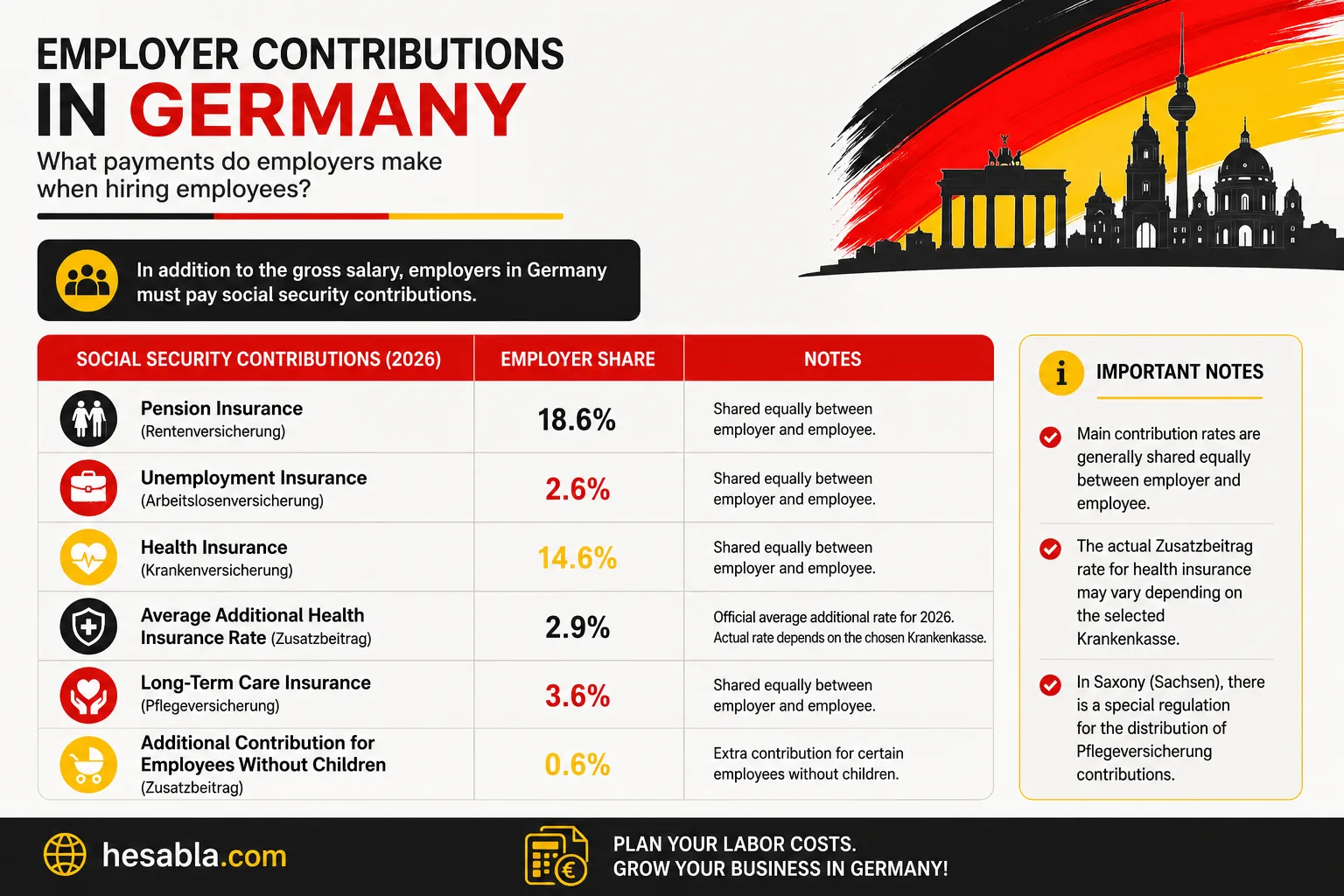
# Cost to the employer of a gross salary of 5,000 euros
Let the employee's monthly gross salary be 5,000 euros. The example uses the standard distribution and an average supplementary health insurance rate of 2.9 percent.
- Employer's pension contribution: 5,000 × 9.3% = 465 euros
- Employer's unemployment insurance contribution: 5,000 × 1.3% = 65 euros
- Employer's health insurance contribution: 5,000 × 7.3% = 365 euros
- Half of the supplementary health insurance contribution: 5,000 × 1.45% = 72.50 euros
- Employer's Pflegeversicherung contribution: 5,000 × 1.8% = 90 euros
- Main employer's social insurance cost: 465 + 65 + 365 + 72.50 + 90 = 1,057.50 euros
- Employer's initial total salary cost: 5,000 + 1,057.50 = 6,057.50 euros
Result:
* Gross salary = 5,000 euros
* Main employer social security contribution = 1,057.50 euros
* Initial total employer costs = 6,057.50 euros
This calculation does not include Unfallversicherung, sickness and maternity funds U1/U2, Insolvenzgeldumlage and other employer contributions. The actual employer costs may therefore be higher than 6,057.50 euros.
In 2026, the maximum monthly base for health and care insurance is 5,812.50 euros, and for pension and unemployment insurance 8,450 euros. The corresponding social security contribution is not calculated for the part of the salary above these limits.
# How should an entrepreneur plan the tax system in Germany?
Before starting a business, the following questions should be answered:
1. Will the activity be considered a Freiberuf or Gewerbe?
2. Will the business be established as a sole proprietorship, GbR, UG or GmbH?
3. How much is the expected annual turnover?
4. How much is the expected net profit?
5. What level of income tax will be reached?
6. Will the company's profits be retained in the business or distributed as dividends?
7. What percentage is the municipality's Gewerbesteuer Hebesatz?
8. Will the Gewerbesteuer discount of €24,500 apply?
9. How much can be deducted from the Gewerbesteuer Einkommensteuer?
10. Are the conditions for small business owners met?
11. Is it more profitable to voluntarily switch to the normal Umsatzsteuer system?
12. Will the products and services sold be subject to 19%, 7% or a tax exemption?
13. Can input tax on purchases be reclaimed?
14. Will employees be employed?
15. Are social insurance and additional employer funds included in the budget?
16. Will there be customers in other EU countries?
17. Will there be a reverse charge rule when purchasing services from abroad?
18. Will the accounting be done using the EÜR or double-entry bookkeeping method?
19. Is a quarterly cash reserve set aside for advance payments?
20. Which Steuerberater will handle the tax returns?
It is not a good idea to choose a legal form based solely on the company registration costs or the nominal tax rate.
A sole proprietorship can offer low start-up costs and simple management. A GmbH can be advantageous in terms of limiting legal liability and keeping profits within the company.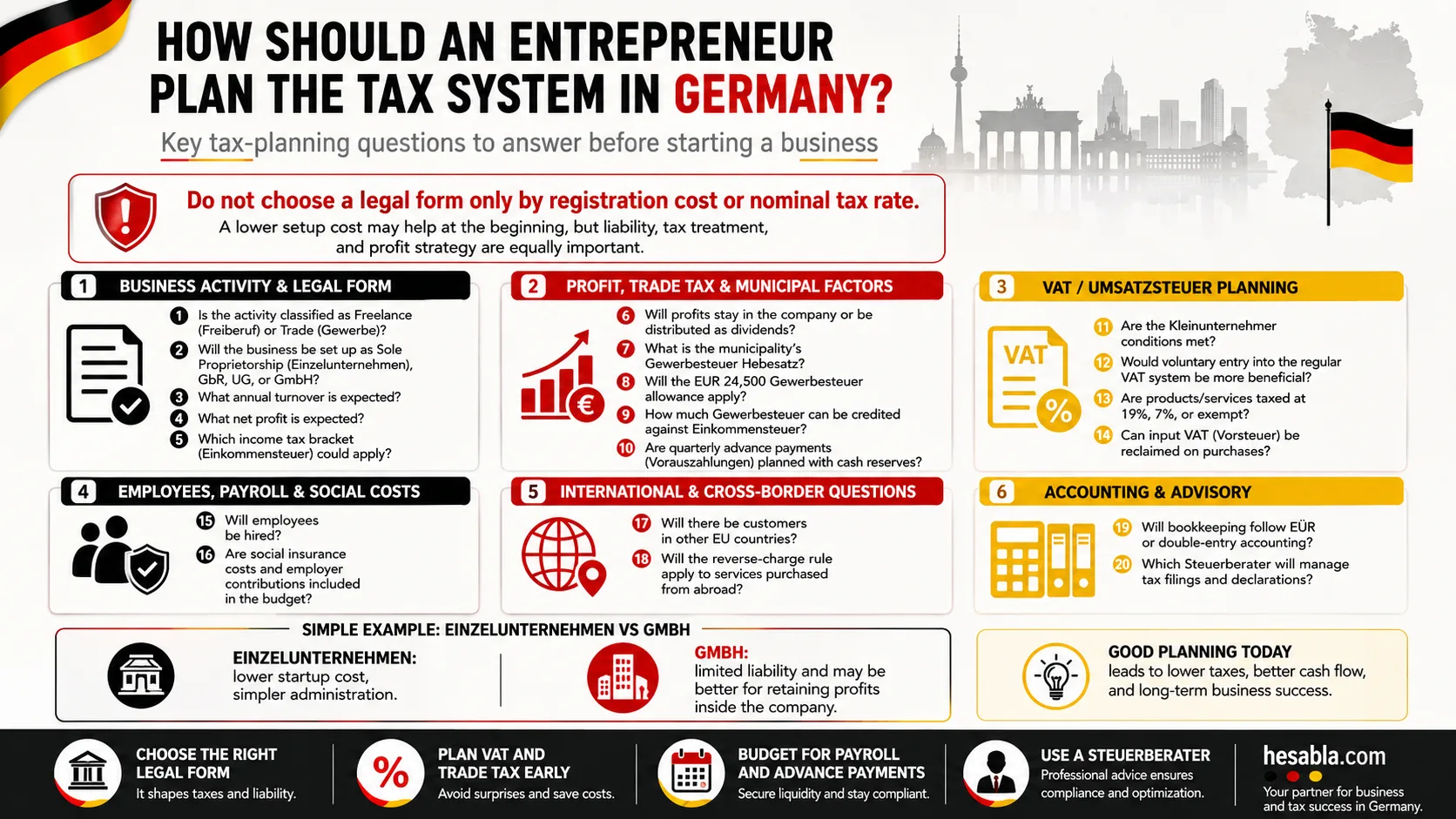
# Frequently asked questions
- How much tax does a sole proprietor pay in Germany?
Individual entrepreneurs and freelancers pay income tax in stages, from 0 percent to 45 percent, on their net taxable income.
- How much is the tax-free income in 2026?
The basic exemption for a single person in 2026 is €12,348.
- How much is the income tax on a taxable income of €100,000?
According to the simplified 2026 rate:
100,000 × 42% − 11,135.63 = €30,864.37
The rounded tax is approximately €30,864.
- Do freelancers pay trade tax?
If the activity is officially considered a freelancer, trade tax is generally not payable.
- How much is the trade tax exemption for a sole proprietorship?
There is an annual trade tax exemption of €24,500 for sole proprietors and private partnerships.
- How is trade tax calculated?
Gewerbesteuer = (Gewerbeertrag − possible deduction) × 3.5% × Hebesatz
- How much tax does a GmbH pay?
A GmbH pays 15 percent Körperschaftsteuer, a Solidaritätszuschlag of 5.5 percent of that tax, and a municipally-dependent Gewerbesteuer. The total corporate tax burden is often around 30 percent.
- What is the VAT rate in Germany?
The basic Umsatzsteuer rate is 19 percent. 7 percent applies for certain products and services.
- How is tax deducted from the VAT-inclusive price?
For a 19 percent VAT-inclusive price:
Umsatzsteuer = Total price × 19 ÷ 119
- What is the Kleinunternehmer threshold?
If the turnover of the previous year is a maximum of 25,000 euros and the turnover of the current year is a maximum of 100,000 euros, the Kleinunternehmer discount can be applied under other conditions.
- Does the Kleinunternehmer pay VAT?
The Kleinunternehmer does not show the Umsatzsteuer on the Rechnung for eligible sales and does not collect VAT from the customer. In return, he cannot reclaim the input VAT.
- What percentage is withheld when the company's profits are distributed as dividends?
In the general simplified case, 25 percent Kapitalertragsteuer and 5.5 percent of that tax are withheld. An additional amount may arise if there is a church tax.
- How much does the employee's cost to the employer exceed the gross salary?
The main employer contribution to social insurance is often around 20–22 percent of gross salary. Accident insurance and other fund contributions can increase the total cost even further.
- How are tax returns filed?
Most business tax returns and Umsatzsteuer reports are filed electronically via the ELSTER system.
How is tax calculated in Germany? A complete exp...

20 Jul
5