The United States of America is one of the world's largest consumer markets, most developed financial systems, and most business opportunities for entrepreneurs. Starting a business in the United States may seem relatively simple, but the tax system varies depending on the state in which the business is established, its legal form, the entrepreneur's residency status, the number of employees, and the source of income.
In this article, “Hesabla.com”, we will explain how taxes are calculated in the United States for Sole Proprietorship, LLC, Partnership, S Corporation, and C Corporation, the 2026 federal income tax brackets, self-employment tax, QBI deduction, payroll tax, sales tax, and estimated tax rules with examples. We should also note that the article is for general information purposes. The actual tax consequences in the United States may vary depending on the entrepreneur's residency status, the state in which it operates, whether the income is US-sourced, the legal and tax classification of the company, and the exemptions that apply. When making a real business decision, the opinion of a CPA, Enrolled Agent, or a US tax law expert should be considered.
# What taxes are there in the US?
The main taxes and mandatory payments that entrepreneurs in the United States may face are:
* Federal Income Tax (a tax ranging from 10% to 37% on taxable income of individuals and pass-through business owners)
* Corporate Income Tax (a 21% federal tax on C Corporation profits)
* Self-Employment Tax (a total of 15.3% for self-employed individuals, including Social Security and Medicare)
* Social Security Tax (6.2% for employees and employers separately)
* Medicare Tax (1.45% for employees and employers separately)
* Additional Medicare Tax (an additional 0.9% for high-income individuals)
* FUTA – Federal Unemployment Tax (federal unemployment tax paid by employers)
* State Income Tax (state-dependent income or corporate tax)
* Franchise Tax or Gross Receipts Tax (applied to the operation or turnover of a company in some states)
* Sales Tax (a state and federal tax on the sale of goods and certain services) (applied at the local level)
* Property Tax (on business real estate and some assets)
* Excise Tax (on fuel, certain transportation, manufacturing, and specialty products)
* Estimated Tax (on income and self-employment taxes paid in advance during the year)
The tax system in the United States consists of federal, state, and local levels. The location of a business can affect its income tax, sales tax, property tax, and other local obligations. Therefore, two companies with the same profits may face different total tax burdens in different states.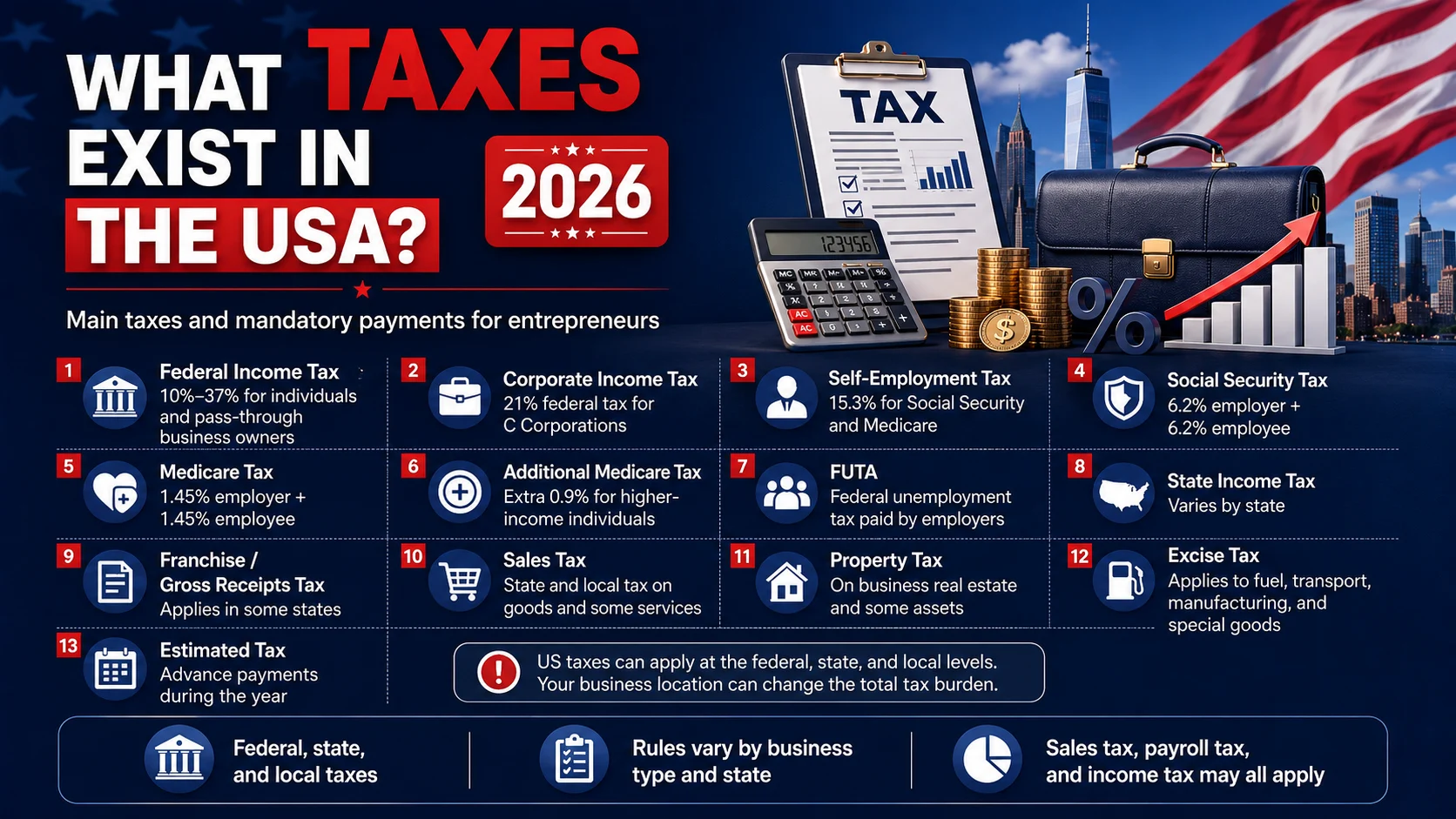
# What business forms are there in the United States?
The most common business forms in the United States are:
* Sole Proprietorship
* Single-Member LLC
* Multi-Member LLC
* Partnership
* S Corporation
* C Corporation
In the United States, legal form and tax classification are not always the same.
For example, an LLC is a legal structure created under state law. However, the IRS may tax an LLC as:
* Sole Proprietorship;
* Partnership;
* S Corporation;
* C Corporation
depending on the number of members and the tax election made. A single-member local LLC is generally not considered a separate federal income tax payer from its owner and is considered a “disregarded entity.” An LLC with multiple members is taxed as a Partnership unless it elects otherwise. An LLC can elect corporate tax status by filing Form 8832 or, if applicable, Form 2553.
# What is a Sole Proprietorship?
A Sole Proprietorship is a form in which an individual carries on business activities in his or her own name without forming a separate corporation. A Sole Proprietorship is not a separate taxpayer for federal income tax. The income and expenses of the business are reported on Schedule C, which is attached to the owner's Form 1040 personal tax return.
The basic formula is: Net business income = Gross business income − Business expenses incurred
This net income:
* is included in the owner's federal income tax calculation;
* may provide a basis for self-employment tax;
* may be subject to state income tax;
* may provide a QBI deduction in some cases.
A single-member LLC can also be treated as a Sole Proprietorship for federal income tax purposes, unless it elects another tax status.
# What is the federal income tax rate in the United States in 2026?
Federal income tax for individuals in the United States is calculated on a phased basis.
The basic federal tax brackets for Single filing status in 2026 are as follows:
* Up to $12,400 = 10%
* Next bracket from $12,400 to $50,400 = 12%
* Next bracket from $50,400 to $105,700 = 22%
* Next bracket from $105,700 to $201,775 = 24%
* Next bracket from $201,775 to $256,225 = 32%
* Next bracket from $256,225 to $640,600 = 35%
* Above $640,600 = 37%
The tax brackets apply to taxable income. If the owner has income of $120,000, the 24 percent tax is not applied to all income. Only the portion above $105,700 is taxed at 24 percent.
# What is the Standard Deduction?
The Standard Deduction is a standard amount that an individual is allowed to deduct from their taxable income without reporting any expenses.
For 2026:
* Single and Married Filing Separately = $16,100
* Married Filing Jointly = $32,200
* Head of Household = $24,150
The owner's business expenses are first deducted from their business income on Schedule C. The Standard Deduction is then applied when calculating their personal federal income tax.
The Standard Deduction does not reduce the amount of self-employment tax. It mainly affects the calculation of federal income tax.
# How is federal income tax calculated?
Let's say a single person's taxable income after all deductions is $80,000.
Calculation:
- First $12,400: $12,400 × 10% = $1,240
- $12,400–$50,400 portion: $38,000 × 12% = $4,560
- $50,400–$80,000 portion: $29,600 × 22% = $6,512
- Total federal income tax: $1,240 + 4,560 + 6,512 = $12,312
Result:
* Taxable income = $80,000
* Final tax bracket = 22%
* Federal income tax = $12,312
* Effective income tax rate = 15.39%
22 percent is the entrepreneur's marginal rate. This does not mean that all income is taxed at 22 percent. The IRS states that income tax is applied to different income brackets.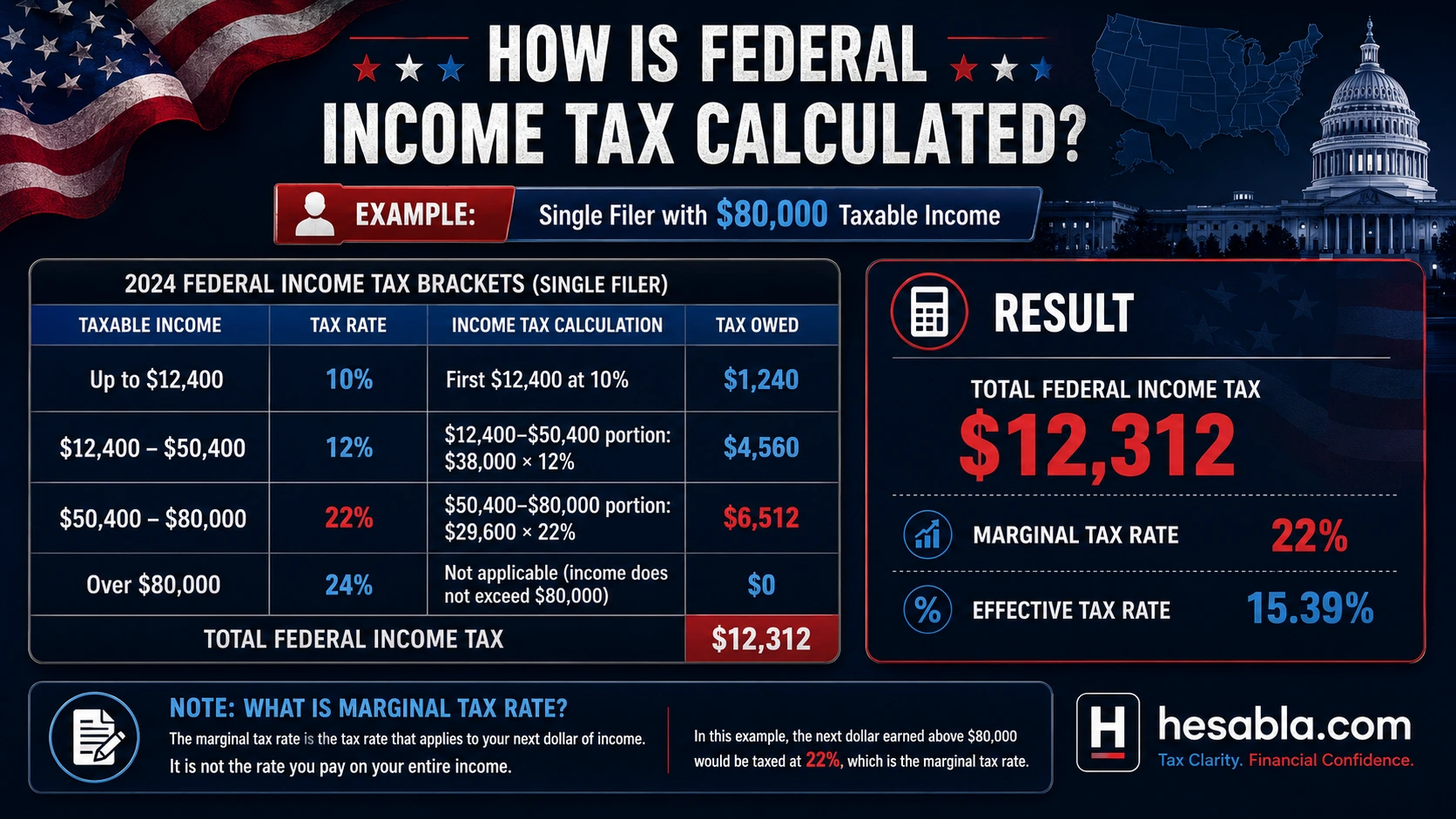
# How are business expenses deducted from income?
In the United States, a business expense must generally be both “ordinary” and “necessary” for federal tax purposes.
An ordinary expense is an expense that is customary and acceptable in the line of business.
A necessary expense is an expense that is useful and appropriate for the business. The expense does not necessarily have to be irreplaceable.
Depending on the activity, allowable business expenses may include the following:
* office and store rent;
* salaries;
* employer payroll tax payments;
* advertising and marketing;
* software and subscriptions;
* accounting and legal services;
* business insurance;
* inventory and raw materials;
* business telephone and internet;
* shipping and logistics;
* equipment and depreciation;
* bank and payment system fees;
* eligible home office expenses;
* business travel.
Personal expenses are not deductible as business expenses. Only the qualifying business portion of a home, car, telephone, or other asset used for both personal and business purposes can be included.
# What is Self-Employment Tax?
Self-employment tax is a tax paid by self-employed individuals to the Social Security and Medicare systems.
General rate:
* Social Security portion = 12.4%
* Medicare portion = 2.9%
* Total self-employment tax = 15.3%
However, the 15.3 percent does not apply to all direct business profits.
As a general rule, the self-employment tax base is calculated as 92.35 percent of net self-employment earnings.
Formula:
- Self-employment tax base = Net business earnings × 92.35%
- Self-employment tax = Tax base × 15.3%
In 2026, the Social Security portion applies to a maximum qualifying income base of $184,500. There is no gross income limit for Medicare tax. Self-employment tax is generally due when net self-employment earnings are $400 or more.
# How is self-employment tax calculated?
The owner's net business income is $100,000.
- Self-employment tax base: 100,000 × 92.35% = $92,350
- Social Security portion: 92,350 × 12.4% = $11,451.40
- Medicare portion: 92,350 × 2.9% = $2,678.15
- Total self-employment tax: 11,451.40 + 2,678.15 = $14,129.55
Result:
* Net income = $100,000
* Self-employment tax base = $92,350
* Social Security = $11,451.40
* Medicare = $2,678.15
* Self-employment tax = $14,129.55
The entrepreneur can use half of the self-employment tax amount as a deduction when calculating adjusted gross income can be:
14,129.55 ÷ 2 = $7,064.78
This deduction does not reduce self-employment tax, but it can reduce income on federal income tax.
# What is the Additional Medicare Tax?
Self-employment and wage income may incur an additional 0.9 percent Medicare tax when it exceeds certain limits.
Basic income limits:
* Single and most other filing statuses = $200,000
* Married Filing Jointly = $250,000
* Married Filing Separately = $125,000
The additional 0.9 percent applies only to the portion of eligible Medicare income that exceeds the limit.
For example, if a single-employer has eligible Medicare income of $230,000:
230,000 − 200,000 = $30,000
30,000 × 0.9% = $270
Additional Medicare tax: $270
# What is the QBI Deduction?
The QBI Deduction, or Section 199A deduction, allows certain pass-through business owners to deduct up to 20 percent of their qualified business income from their federal income tax liability.
The following business owners may be eligible:
* Sole Proprietorship;
* Partnership;
* S Corporation;
* certain LLCs;
* certain trusts and estates.
C Corporation income and wages earned as employees are not eligible for the QBI deduction.
Beginning in 2026, a minimum deduction of $400 may be applied if the qualifying individual has at least $1,000 in QBI. The total deduction is still subject to various limits.
The taxable income limits for the wage, property, and specified service business limits for QBI that will phase in in 2026 are:
* Married Filing Jointly = $403,500
* Married Filing Separately = $201,775
* Other filing statuses = $201,750
Phase limit ranges:
* Married Filing Jointly = $403,500–$553,500
* Married Filing Separately = $201,775–$276,775
* Other filing statuses = $201,750–$276,750
Calculating the QBI deduction is usually simpler for incomes below these limits. For higher incomes, the type of business, W-2 wages paid to employees, and business property can affect the limits.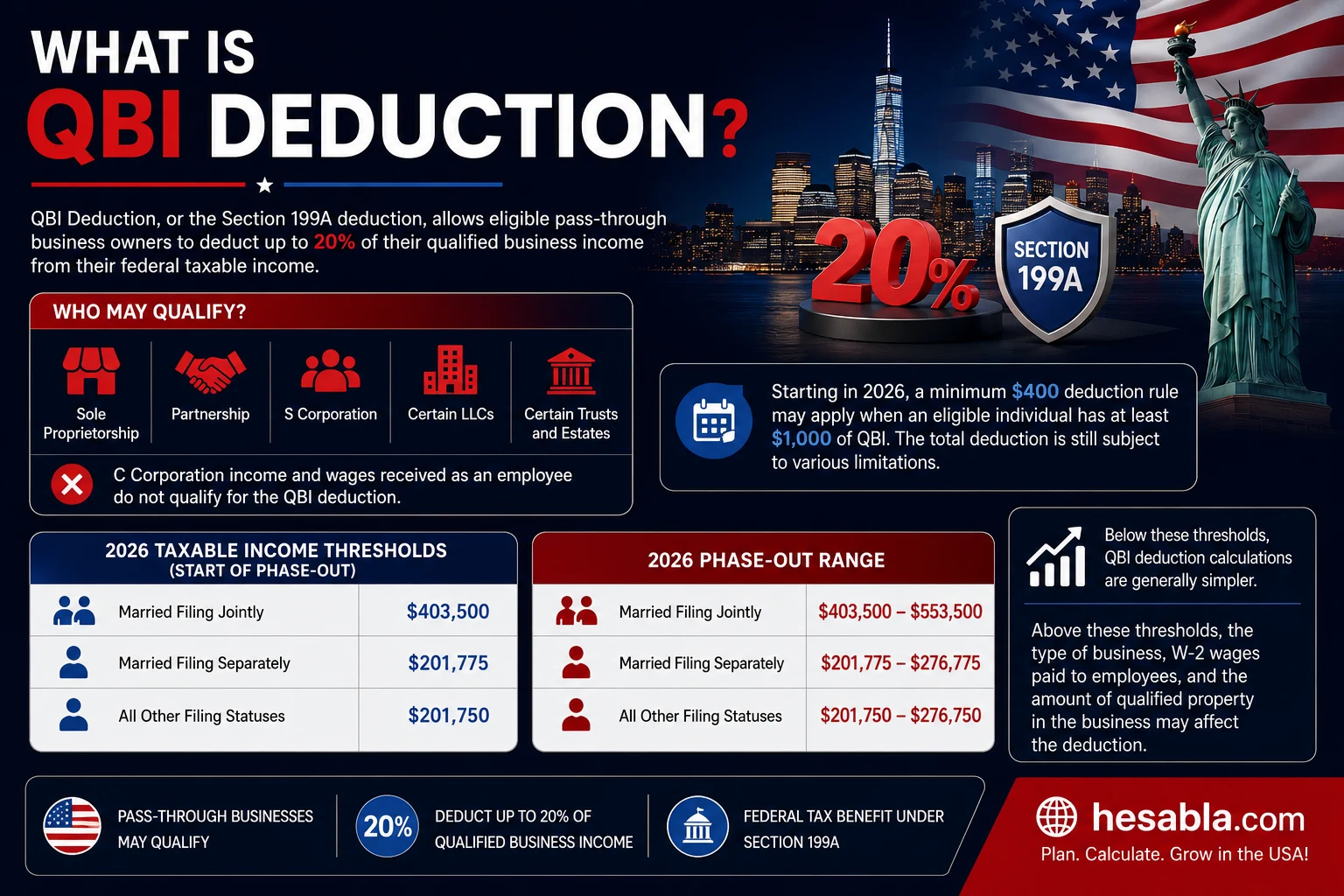
# Example of a complete Sole Proprietorship with $100,000 in income
In the example below, the owner:
* Is a single filer;
* Has no other income;
* Has $100,000 in net business income;
* Uses the Standard Deduction;
* Qualifies for the QBI deduction;
* Does not include additional state taxes and personal exemptions.
- Self-employment tax: 100,000 × 92.35% × 15.3% = $14,129.55
- Deductible half of self-employment tax: 14,129.55 ÷ 2 = $7,064.78
- Adjusted income: 100,000 − 7,064.78 = $92,935.22
- Standard Deduction: $16,100
- Taxable income before QBI: 92,935.22 − 16,100 = $76,835.22
- Theoretical QBI deduction: 92,935.22 × 20% = $18,587.04
- However, due to the deduction taxable income limit: 76,835.22 × 20% = $15,367.04 dollars
- QBI deduction: $15,367.04
- Final federal taxable income: $76,835.22 − $15,367.04 = $61,468.18
Federal income tax:
* First $12,400 × 10% = $1,240
* Next $38,000 × 12% = $4,560
* Remaining $11,068.18 × 22% = $2,435
- Total federal income tax: $1,240 + 4,560 + 2,435 = approximately $8,235
- Total federal taxes: $8,235 + 14,129.55 = $22,364.55
Result:
* Net business income = $100,000
* Federal income tax = about $8,235
* Self-employment tax = $14,129.55
* Total federal tax = about $22,364.55
* Federal effective rate = about 22.36%
This simplified example does not include state income tax, health insurance deduction, retirement contributions, child credits, itemized deductions, and other personal tax consequences.
# Does an LLC pay separate taxes?
An LLC does not automatically have separate federal tax status.
Single-Member LLC:
* is generally treated as a disregarded entity;
* income can be reported on the owner’s Schedule C;
* the owner can pay federal income tax and self-employment tax.
Multi-Member LLC:
* is generally treated as a partnership;
* files a Form 1065 information return;
* profits are passed through to members on a Schedule K-1.
LLC election:
* S Corporation
* Can be taxed as a C Corporation
Therefore, there is no single answer to the question “How much tax does an LLC pay?” Taxes are determined based on the LLC’s federal classification choice and the state in which it operates.
# How is partnership tax calculated?
A partnership generally does not pay federal income tax at the business level. Instead, it files a Form 1065 information return.
Partnership profits, losses, deductions, and credits are allocated among the partners and reported on a Schedule K-1.
For example:
* Partnership profit = $200,000
* Two partners’ shares = 50% each
Each partner’s share of the profit: $200,000 × 50% = $100,000
Each partner reports their $100,000 share on their personal federal and state tax returns.
An active partner’s business income may also result in self-employment tax under the general rule. Not withdrawing the entire amount from the partnership’s bank account does not automatically eliminate the partner’s tax liability. Tax is often based on the share of the profit reported on the K-1, not the money distributed. The IRS states that Partnerships file an information return instead of an income tax return.
# What is an S Corporation?
In addition to being a separate legal form, an S Corporation is primarily used as a federal tax option.
An S Corporation:
* Passes income, expenses, and losses through to shareholders;
* Does not pay the 21 percent federal corporate tax rate on total business income like a C Corporation;
* Shareholders report their shares on their personal tax returns;
* May pay entity-level taxes on certain specific income and transactions.
This pass-through system allows for the elimination of the classic double taxation of a C Corporation.
# Does an S Corporation owner have to pay himself a salary?
If a shareholder working in an S Corporation provides services to the business, the company must pay him reasonable compensation, i.e., a reasonable salary for his work.
The owner cannot avoid payroll tax by taking all of the profits as a distribution. The IRS may reclassify a portion of the distribution as wages if the employee is underpaid.
Salary:
* federal income tax withholding;
* Social Security;
* Medicare;
* payroll reporting
Includes the following rules:
Any qualifying earnings remaining after a reasonable salary may be distributed as a shareholder distribution. Although the distribution is not subject to FICA taxes as wages, the shareholder's pass-through income may be included in federal and state income tax calculations.
# S Corporation Tax Example
Suppose the S Corporation has business income before the owner's salary and payroll taxes of $150,000.
Reasonable salary for an entrepreneur: $80,000
Employer's Social Security share: 80,000 × 6.2% = $4,960
Employer's Medicare share: 80,000 × 1.45% = $1,160
Employer's total FICA share: 4,960 + 1,160 = $6,120
Pass-through profit remaining in the company: 150,000 − 80,000 − 6,120 = $63,880
Employer's income:
* W-2 salary = $80,000
* S Corporation pass-through income = $63,880
FICA withheld from employee's pay: 80,000 × 7.65% = $6,120
$63,880 Pass-through profits are generally not subject to self-employment tax. However, it is important that the wages are truly reasonable.
This example illustrates the potential payroll tax advantage of an S Corporation, but the company's payroll, accounting, tax return, and compliance costs also increase.
# Who cannot own an S Corporation?
To qualify for S Corporation status, a company must:
* be a domestic corporation incorporated in the United States;
* have a maximum of 100 shareholders;
* have only one class of stock;
* have only permitted shareholders.
A nonresident alien, i.e. a foreign individual who is not a U.S. tax resident, cannot be a direct shareholder of an S Corporation. This rule is especially important for Azerbaijani citizens. A nonresident foreign entrepreneur should often consider a C Corporation or a qualifying LLC structure.
# What is a C Corporation?
A C Corporation is a company that is a separate federal taxpayer from its owner.
A C Corporation:
* reports its income and expenses on Form 1120;
* pays 21 percent federal corporate income tax on taxable income;
* is legally and tax-separate from shareholders;
* can retain profits or distribute them as dividends.
Federal Corporate Tax Formula: Corporate Income Tax = Taxable Corporate Income × 21%
The IRS states that corporations calculate federal corporate tax by multiplying their taxable income by 21 percent.
# How is C Corporation tax calculated?
Let the annual results of the C Corporation be as follows:
* Gross income = $500,000
* Business expenses incurred = $400,000
* Taxable income = $100,000
Federal corporate tax: 100,000 × 21% = $21,000
After-tax income retained by the corporation: 100,000 − 21,000 = $79,000
Result:
* Taxable income = $100,000
* Federal corporate tax = $21,000
* Retained earnings = $79,000
* Federal corporate tax rate = 21%
This calculation does not include state corporate income tax, franchise tax, or other state taxes.
# How does double taxation occur in a C Corporation?
A C Corporation's profits are first taxed at the corporate level. When the remaining profits are distributed to shareholders as dividends, the individual may pay a separate tax on those dividends. The IRS describes this system as corporate profits being taxed first at the corporate level and then at the shareholder level when the dividends are distributed.
In the previous example:
* Initial profits = $100,000
* Corporate tax = $21,000
* Amount remaining for dividends = $79,000
In the example, let's assume that the shareholder is subject to a 15 percent federal rate on qualified dividends.
- Dividend tax: 79,000 × 15% = $11,850
- Net dividend to shareholder: 79,000 − 11,850 = $67,150
- Total federal tax: 21,000 + 11,850 = $32,850
- Total effective federal burden: 32,850 ÷ 100,000 × 100 = 32.85%
The real rate on a dividend depends on the shareholder's total income, whether the dividend is qualified, the Net Investment Income Tax, and state taxes. Long-term capital gains and qualified dividend rates can generally be 0%, 15%, or 20%.
# Is an S Corporation or a C Corporation more profitable?
S Corporation:
* Federal income = passed through to shareholders
* Entity-level federal income tax = generally not applicable
* Owner employed = reasonable salary required
* Salary = included in payroll tax
* Distribution = generally not applicable
* QBI deduction = may apply
* Foreign nonresident shareholder = not permitted
* Number of shareholders = maximum 100
* Stock class = one class
C Corporation:
* Federal corporate tax = 21%
* Profits may be retained by the company
* When dividends are distributed = second tax may apply
* QBI deduction = not applicable to corporate income
* Foreign shareholder = possible
* For investors and venture capital structures = may be more suitable
* Number of shareholders and stock class = more flexible than S Corporation
S Corporations may be suitable for payroll tax planning for small to medium-sized, active US resident entrepreneurs.
A C Corporation may be more suitable for foreign shareholders, startups that attract investment, and businesses that plan to retain profits within the company.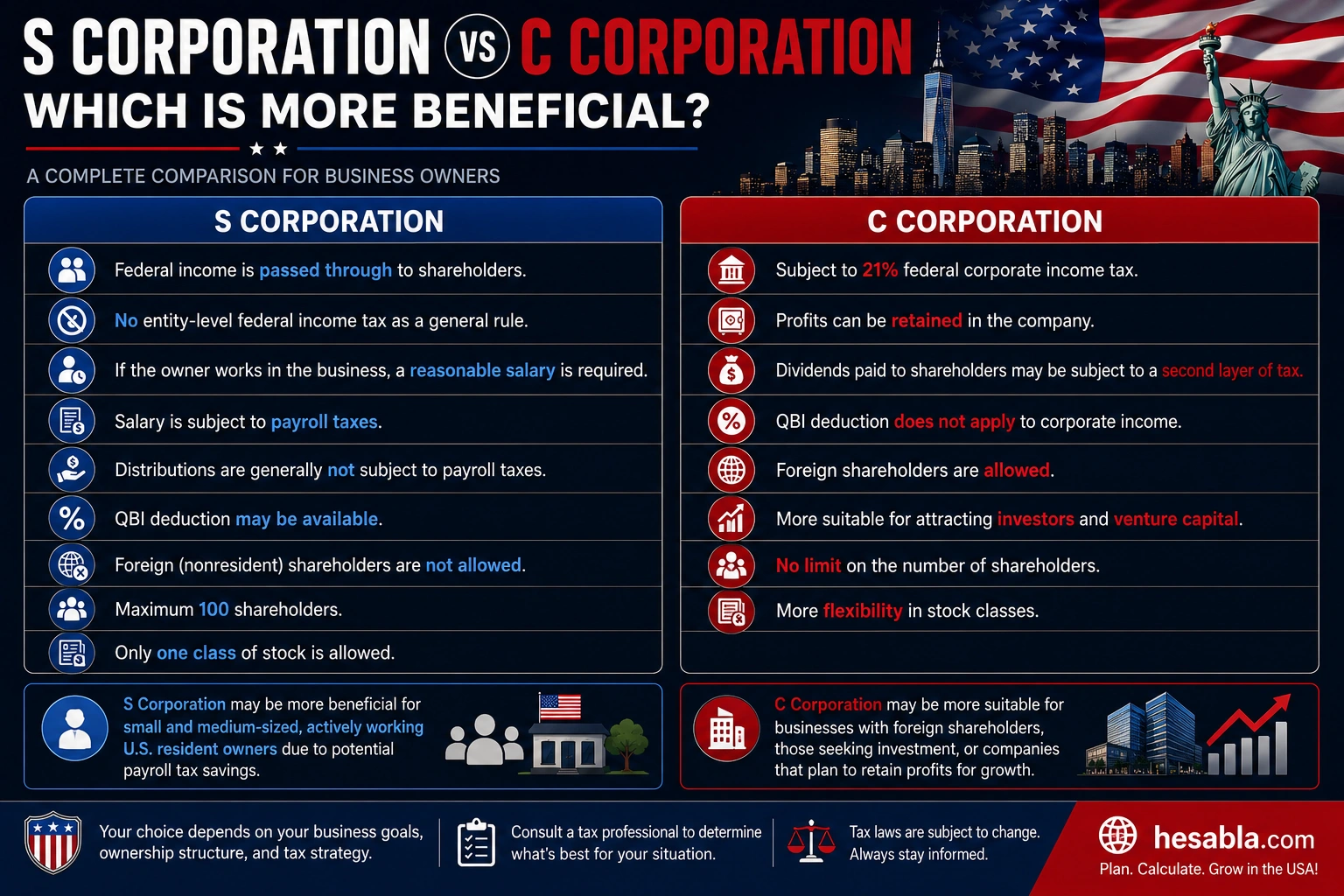
# What is State Income Tax?
In the United States, in addition to federal income tax, state income and business taxes may also arise.
Depending on the state, a business may pay one or more of the following:
* state individual income tax;
* state corporate income tax;
* franchise tax;
* gross receipts tax;
* business privilege tax;
* annual LLC fee;
* state unemployment tax;
* local city tax.
Some states do not have a general state income tax for individuals. However, this does not mean that a business is completely tax-free in that state. Sales tax, franchise fee, property tax, and other fees may still apply.
The SBA notes that a business's tax liability depends on the state and city in which it is located.
# What is Sales Tax?
Sales Tax is not a federal tax in the United States. It is imposed by state and local governments.
Sales Tax:
* on the sale of physical goods;
* on some digital goods;
* on some services;
* on certain subscriptions and software
may be applied.
The rate may be made up of several parts, including state, county, and city.
Some states and territories have no general sales tax. Some products, such as certain foods, clothing, and medicines, may be fully or partially exempt.
# How is Sales Tax calculated?
In this example, let's say the price of a product excluding sales tax is $1,000, and the combined state and local rate is 8.25 percent.
Sales Tax: 1,000 × 8.25% = $82.50
Total amount paid by customer: 1,000 + 82.50 = $1,082.50
Result:
* Product price = $1,000
* Sales Tax = $82.50
* Amount paid by customer = $1,082.50
The business should record the $82.50 collected as tax collected on behalf of the state, not as its own income.
# What is Sales Tax Nexus?
A business may be required to collect sales tax in a state when it has a sufficient legal and economic connection with that state.
A nexus can arise from:
* having an office in the state;
* having an employee or representative;
* maintaining a warehouse and inventory;
* having a physical store;
* having sales in the state that exceed a certain economic threshold;
* marketplace and other business relationships.
Each state has different rules and limits. An online store should check not only the state where the company is incorporated, but also the nexus obligations in other states where it sells.
# What taxes does an employer pay when hiring employees?
An employer who hires employees in the United States may face the following federal obligations:
* Federal income tax withholding;
* Social Security tax;
* Medicare tax;
* Additional Medicare tax withholding;
* FUTA;
* state unemployment tax;
* state income tax withholding;
* some local payroll taxes.
The basic FICA rates in 2026 are:
* Employee Social Security share = 6.2%
* Employer Social Security share = 6.2%
* Employee Medicare share = 1.45%
* Employer Medicare share = 1.45%
So, under standard FICA:
* Employee withholding = 7.65%
* Employer additional share = 7.65%
* Total FICA burden = 15.3%
The Social Security wage base in 2026 is $184,500. There is no total wage base limit for Medicare.
# Cost to the employer of a $60,000 salary
Let the employee's annual gross salary be $60,000.
- Employer's Social Security share: 60,000 × 6.2% = $3,720
- Employer's Medicare share: 60,000 × 1.45% = $870
- Employer's FICA share: 3,720 + 870 = $4,590
The normal 6 percent FUTA rate applies to the first $7,000 of wages. However, the effective FUTA can be reduced to 0.6 percent when the maximum 5.4 percent credit is applied based on eligible state unemployment tax payments.
Example FUTA: 7,000 × 0.6% = $42
Employer’s initial federal cost: 60,000 + 4,590 + 42 = $64,632
Result:
* Gross salary = $60,000
* Employer FICA share = $4,590
* Example net FUTA = $42
* Initial federal employer cost = $64,632
This calculation does not include state unemployment tax, workers’ compensation, health insurance, retirement contributions, and other benefits. FUTA is paid only by the employer, and the total rate is 6 percent on the first $7,000 of wages; the rate is often reduced to 0.6 percent due to qualifying credits.
# What is Estimated Tax?
In the United States, the automatic withholding of taxes from wages may not be sufficient for individuals who earn income such as Sole Proprietor, Partner, and S Corporation shareholder.
If an individual expects to owe at least $1,000 in taxes on their annual return, they may be required to make estimated tax payments under the general rule.
A C Corporation, on the other hand, is generally required to pay estimated corporate tax when it expects to owe at least $500 in federal taxes.
The 2026 individual estimated tax due dates are:
* First payment = April 15, 2026
* Second payment = June 15, 2026
* Third payment = September 15, 2026
* Fourth payment = January 15, 2027
These payments are not based on equal quarterly calendar periods. If income is earned unevenly throughout the year, the annualized income method may be applied.
# Can a foreign owner form a U.S. corporation?
Yes. Individuals who are not U.S. citizens or residents can form an LLC or C Corporation in the U.S. under the general rule.
However, the formation of the corporation automatically:
* No U.S. tax;
* only tax is paid in the state of registration of the company;
* the entrepreneur does not file a personal return;
* does not mean that the income is not of US source
If a nonresident person carries on a trade or business in the US, the net income that is effectively connected to that business as effectively connected income – ECI – may be taxed in the US.
ECI may be taxed at the graduated rates applicable to US citizens and residents after deducting eligible expenses.
Dividends, rents, royalties and other FDAP income that is of US source but not effectively connected to the business may be subject to a 30 percent withholding as a general rule. A lower rate may apply if a tax treaty exists.
# What is EIN?
EIN – Employer Identification Number is the federal tax identification number of a business.
An EIN may be needed for the following:
* federal tax return;
* employing employees;
* business bank account;
* payroll;
* Form 1099 and other information returns;
* business licenses;
* payment processor accounts.
An EIN does not indicate that a company pays taxes or is authorized to operate in the United States. It is only a federal tax and business identification number. The SBA provides the EIN as one of the primary identifiers for businesses to open bank accounts and pay taxes.
# How should an entrepreneur plan for the tax system in the US?
Before starting a business, the following questions should be answered:
1. In which state will the business be incorporated?
2. In which states will the activity actually be conducted?
3. Will the business be a Sole Proprietorship, LLC, Partnership, S Corporation, or C Corporation?
4. What federal tax classification will the LLC have?
5. Is the entrepreneur a US tax resident or a nonresident alien?
6. Are shareholders eligible for S Corporation status?
7. What is the expected annual turnover in dollars?
8. What is the expected net profit in dollars?
9. How much will the self-employment tax be?
10. Can the QBI deduction be applied?
11. What should be the reasonable salary if an S Corporation is chosen?
12. Will the C Corporation retain profits in the company or distribute dividends?
13. Is there a state income and franchise tax?
14. In which states will sales tax nexus be created?
15. Will the product or service be subject to sales tax?
16. Will employees be employed?
17. Are FICA, FUTA, and state unemployment taxes included in the budget?
18. Is Form 5472, Form 1040-NR, or Form 1120-F required for a foreign entrepreneur?
19. Is a quarterly provision for estimated tax set aside?
20. Which CPA or Enrolled Agent will handle accounting and returns?
It is not a good idea to choose only the state where company registration is cheap. The company's actual business address, investor plan, sales tax nexus, annual state fee, and federal classification should be considered together.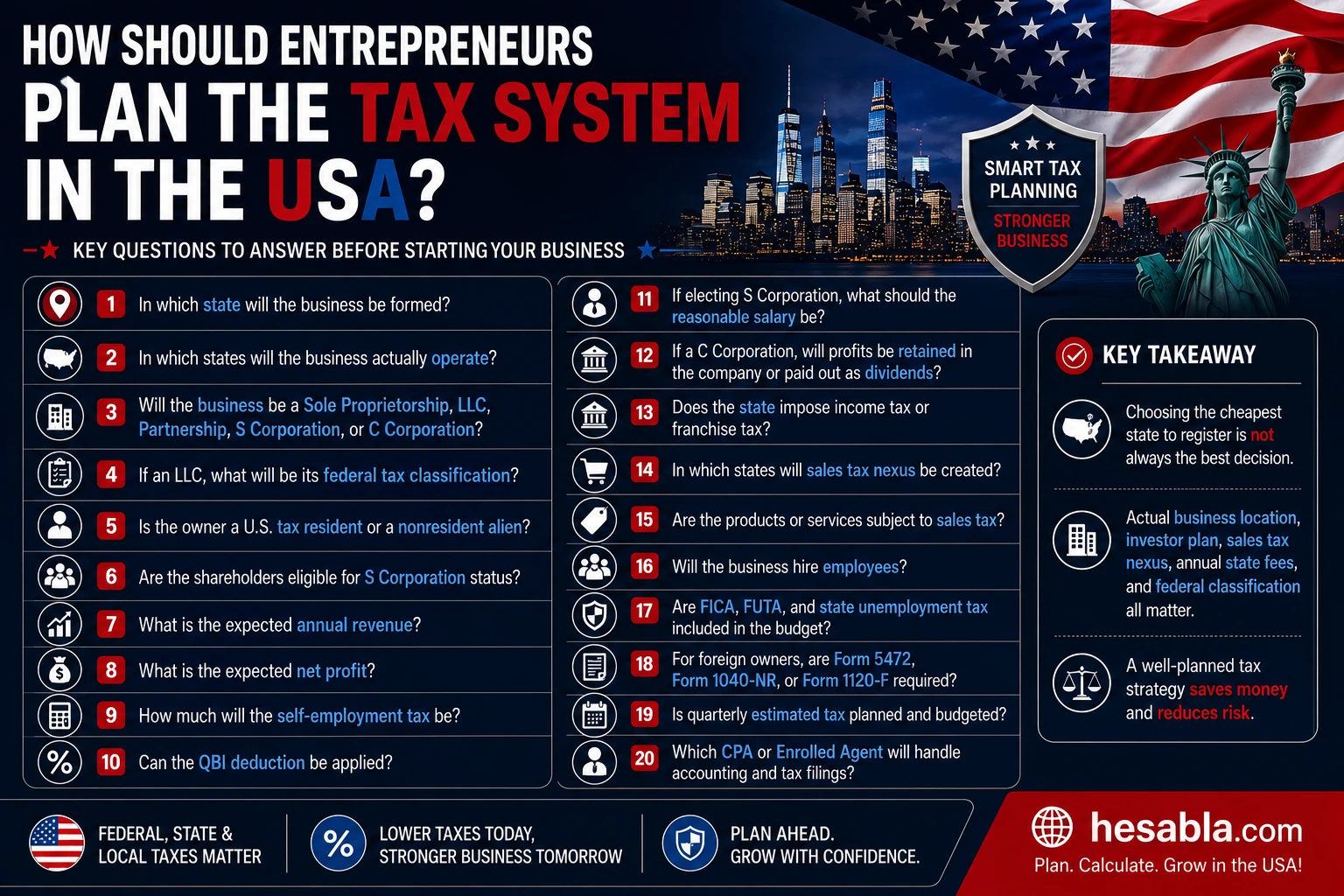
# Frequently Asked Questions
- How much tax does a sole proprietor pay in the US?
A sole proprietorship may pay a federal income tax rate ranging from 10 percent to 37 percent on net business profits and a general 15.3 percent self-employment tax. A separate state tax may be due.
- Is self-employment tax 15.3 percent of all profits?
Not directly. The general rule is to first calculate 92.35 percent of net self-employment income, then apply 15.3 percent.
- How much self-employment tax is due on $100,000 in profits?
100,000 × 92.35% × 15.3% = $14,129.55
- What percentage of taxes does an LLC pay?
There is no separate flat federal tax rate for LLCs. LLCs can be taxed as Sole Proprietorship, Partnership, S Corporation, or C Corporation.
- What percentage of taxes does a C Corporation pay?
A C Corporation pays 21 percent federal corporate income tax on its taxable income. A separate state corporate tax may also be imposed.
- Does an S Corporation pay federal corporate tax?
Because the total business income is passed through to the shareholders under the pass-through rule, an S Corporation does not typically pay the 21 percent federal corporate tax rate that a C Corporation does. Certain special taxes are exempt.
- Must an S Corporation owner receive a salary?
If the owner is actively employed by the company, he or she must receive a reasonable salary commensurate with his or her services. Taking all of the money as a distribution creates a payroll tax risk.
- How much is the QBI deduction?
Qualifying pass-through business owners may be entitled to deduct up to 20 percent of their qualified business income. Additional limitations apply for higher incomes.
- What is the Sales Tax in the United States?
There is no single federal sales tax. The rate varies by state, county, city, and product type.
- Can a foreigner own an S Corporation?
A nonresident alien cannot be a direct S Corporation shareholder.
- Can a foreign person form an LLC in the United States?
Yes. However, the LLC's income, the owner's residency, and related party transactions may trigger Form 5472, Form 1040-NR, and other reporting obligations.
- What is Form 5472?
Form 5472 is an information return filed by certain foreign-owned U.S. companies and disregarded entities to show reportable transactions with foreign related parties.
- When is Estimated Tax due?
The key dates for 2026 are April 15, June 15, September 15, 2026, and January 15, 2027.
- How much does an employer pay in payroll taxes?
Under federal FICA, the employer pays 6.2 percent for Social Security and 1.45 percent for Medicare, for a total of 7.65 percent. FUTA and state unemployment taxes are calculated separately.


How are taxes calculated in America? A complete...

21 Jul
2