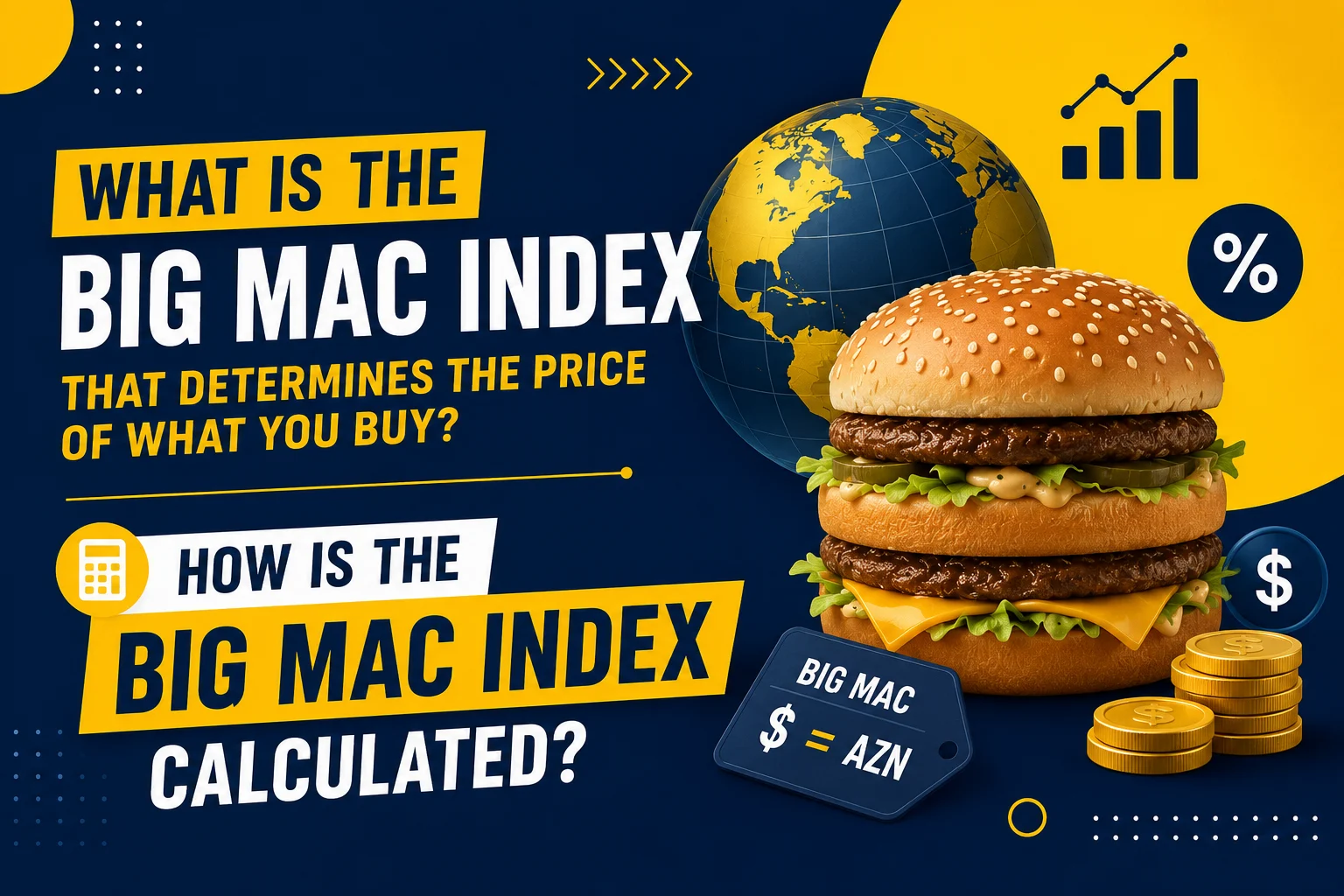
Have you ever wondered how prices are determined in countries? In fact, a method that may seem strange to you when you first hear it is called the "Big Mac Index". Yes, this is the Big Mac sold at McDonalds that you know. The Big Mac Index is an unofficial economic indicator that measures the relative value of currencies by comparing the local price of a Big Mac hamburger sold in different countries.
Although it is an unofficial economic indicator, many small entrepreneurs determine the price of their products using this method. In this article, as "Hesabla.com", we will explain in detail what the Big Mac Index is, why the Big Mac is used, what formula the Big Mac Index is calculated with, and how the result for the Azerbaijani manat is determined.
# What is the Big Mac Index?
The index was created in 1986 by "The Economist" to show in a simple way whether currencies are at the correct level from a theoretical point of view. Although it was initially presented as a somewhat humorous economic indicator, it has since become widely used in universities, economic reports, and international comparisons.
For example, if a Big Mac costs $6 in the United States and the local price in another country is $4 when converted to dollars, the product is cheaper in that country than in the United States. The index interprets this as a theoretical undervaluation of that country's currency against the dollar. Conversely, if the price of a Big Mac in dollars is higher than the US price, the local currency is considered theoretically overvalued against the dollar.
# Why is the Big Mac used?
To compare prices between countries, a product that is as standard as possible should be selected. The Big Mac is considered suitable for this purpose because:
- it is sold in a large number of countries;
- the basic composition of the product is similar across countries;
- it is produced by a well-known international company;
- it is relatively easy to collect price data;
- both international and domestic costs are involved in its production.
The price of a Big Mac does not only include bread, meat, and cheese. This price also includes "wages", "rent", "taxes", "electricity and utilities", "raw materials" and "logistics".
Therefore, the price of a Big Mac reflects, in a sense, the general price level of a country and the cost of local services. However, one hamburger cannot be a complete representative of the entire economy. Therefore, the Big Mac Index is not an official inflation or cost of living indicator.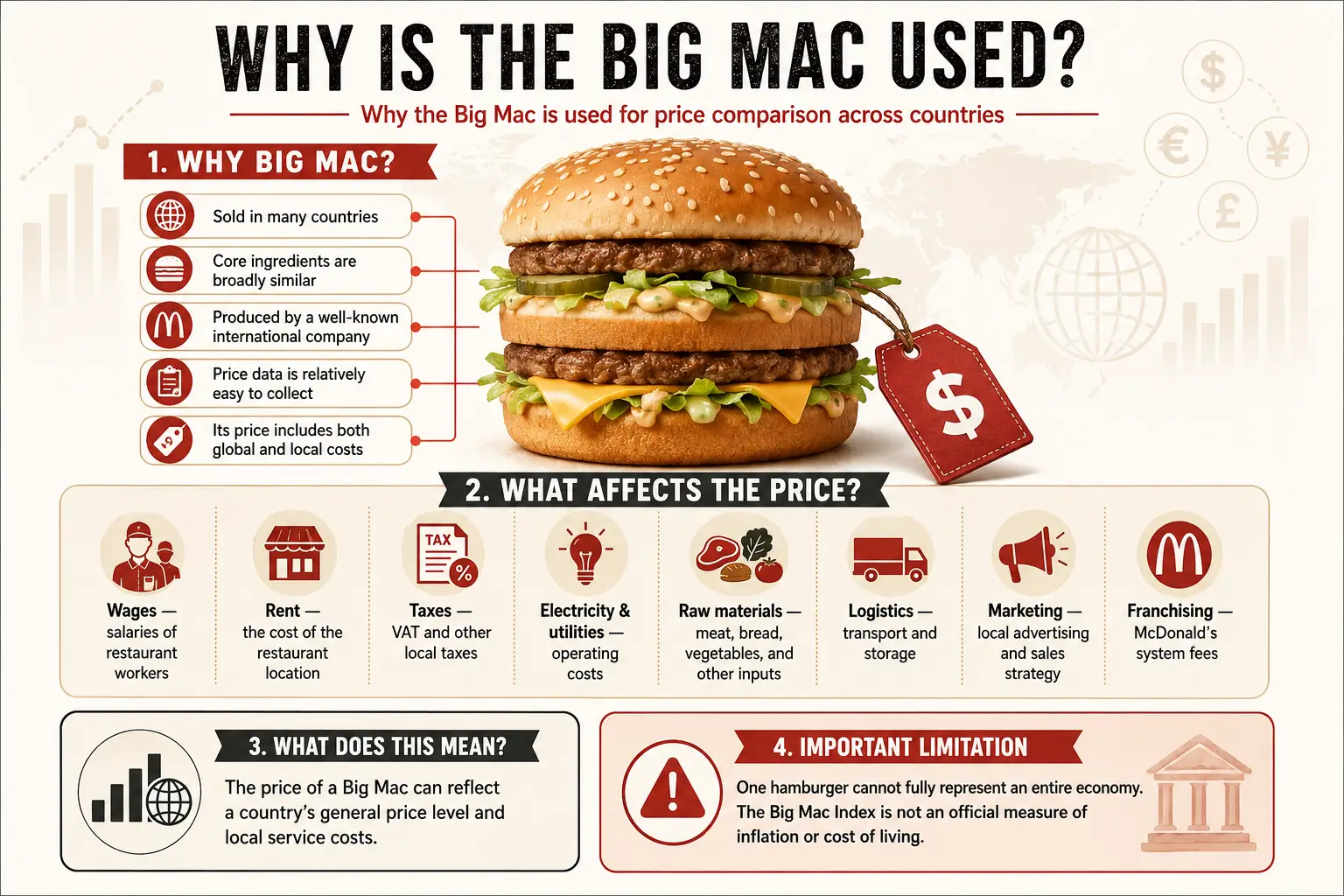
# What data does the Big Mac Index use?
To calculate a simple Big Mac Index, three main indicators are needed:
1. The local price of a Big Mac in the country we are comparing
2. The price of a Big Mac in the United States
3. Exchange rate
# How is the Big Mac Index calculated?
The calculation of the Big Mac Index consists of three main steps:
1. A theoretical exchange rate is calculated based on the Big Mac.
2. The theoretical exchange rate is compared with the actual market exchange rate.
3. The difference is expressed as a percentage.
- Step 1: Calculate the Big Mac PPP exchange rate
Formula: Big Mac PPP exchange rate = Local Big Mac price ÷ US Big Mac price
For example:
- Big Mac in Azerbaijan: 6.65 AZN
- Big Mac in the US: 6.12 USD
Calculation: 6.65 ÷ 6.12 = 1.0866
Based on this result, the theoretical exchange rate that equalizes Big Mac prices is: 1 USD = 1.0866 AZN
- Step 2: Compare the theoretical exchange rate with the actual exchange rate
The actual exchange rate in the example is: 1 USD = 1.7025 AZN
The theoretical exchange rate based on Big Mac prices is: 1 USD = 1.0866 AZN
At the actual exchange rate, it takes more manats than the theoretical calculation.
- Step 3: Calculate the difference in value in percent
Formula: Big Mac Index = ((PPP exchange rate ÷ Actual exchange rate) − 1) × 100
Put the numbers in the formula:
((1.0866 ÷ 1.7025) − 1) × 100
(0.6382 − 1) × 100 = −36.18%
As a result, the Azerbaijani manat is approximately 36.2% undervalued against the US dollar based on the Big Mac Index. This does not mean that the market exchange rate of the manat must necessarily change. The result is only a theoretical comparison based on the price of the Big Mac.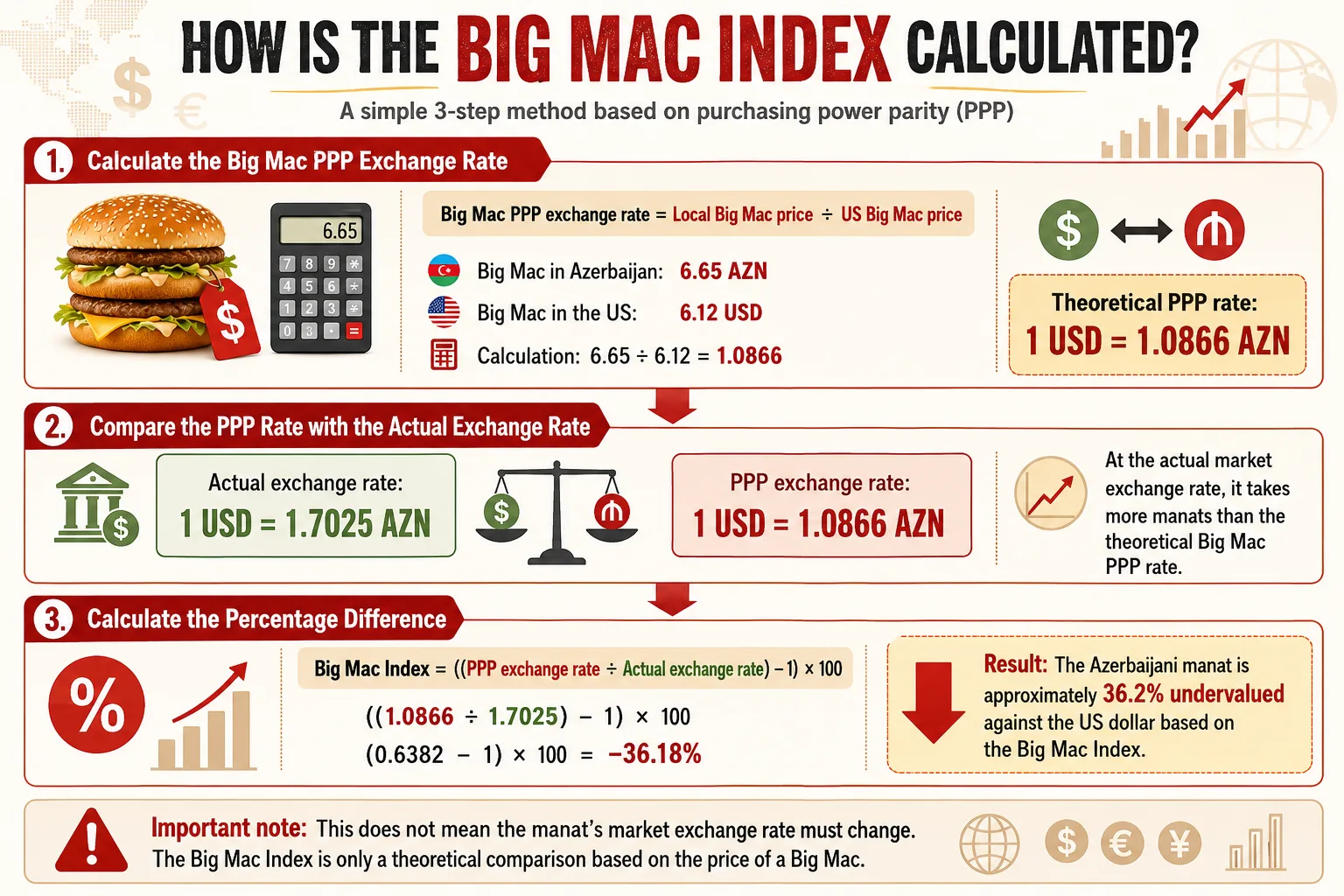
# What does a negative and positive Big Mac Index mean?
The index result can take three forms:
- 0% -> Currency is in equilibrium with the price of a Big Mac
- Positive percentage -> Currency is overvalued against the base currency
- Negative percentage -> Currency is undervalued against the base currency
For example:
- If the result is +20%
This means that the price of a Big Mac in that country in dollars is 20% higher than the US price.
The currency is theoretically considered to be overvalued against the dollar by 20%.
- If the result is −20%
This means that the price of a Big Mac in that country in dollars is 20% lower than the US price.
The currency is theoretically considered to be undervalued against the dollar by 20%.
- If the result is 0%
The price of a Big Mac in both countries in the common currency is the same. In this case, the currencies in the index are at parity.
# What is the Income-Adjusted Big Mac Index?
Wages, rent, and many services are cheaper in lower-income countries. So it makes sense that Big Macs would be cheaper in those countries. To account for this difference, The Economist uses the Income-Adjusted Big Mac Index, or GDP-Adjusted Big Mac Index.
The current methodology estimates the relationship between a country’s per capita income and the price of a Big Mac using a statistical model. The actual price of a Big Mac in a country is then compared to the expected price for that income level. The same comparison is made for the United States.
A simplified formula can be written as:
Adjusted index =
((Country’s actual price ÷ Expected price for the country) ÷
(US actual price ÷ Expected price for the US) − 1) × 100
# Does the Big Mac Index show the cost of living?
The Big Mac Index can give some idea of the general level of prices in a country, but it is not a complete cost of living index.
Living expenses include:
- rent;
- food;
- transportation;
- healthcare;
- education;
- utilities;
- clothing;
- communications;
- entertainment.
A Big Mac is just one product. Therefore, it is not correct to say that all products and services are cheap in a country where a Big Mac is cheap. For example, a Big Mac may be cheap in a country because wages and restaurant rent are low. At the same time, imported electronics, cars, and medicines in that country may be expensive.
Broad official calculations of PPP use baskets of hundreds or thousands of goods and services instead of a single product. The IMF also states that broad international PPP comparisons are based on the prices of multiple products.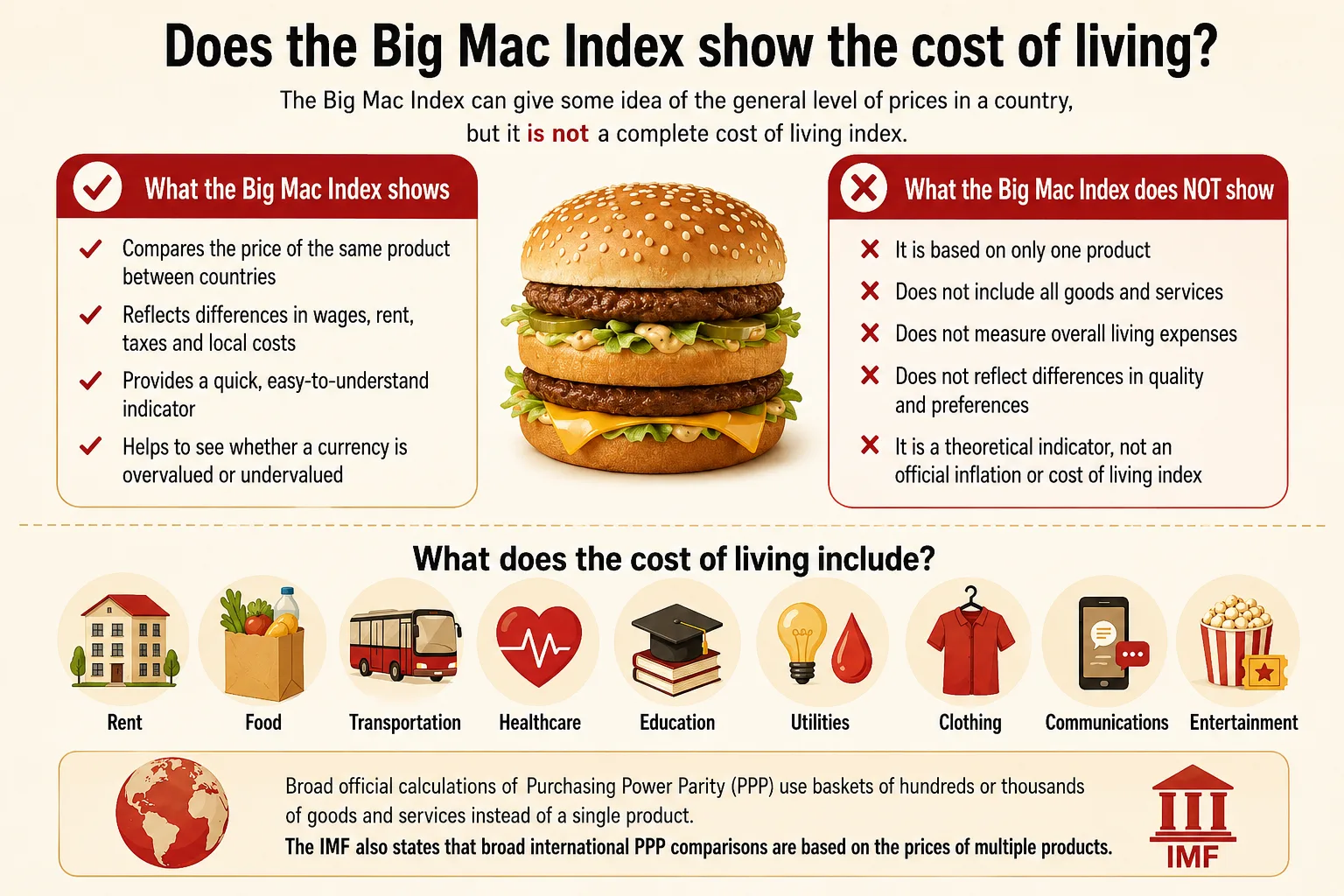
# Why is the Big Mac Index used?
The Big Mac Index can be useful for the following purposes:
- Comparing currencies, Shows whether a currency is theoretically cheap or expensive
- Explaining PPP, Explains complex economic theory with a simple product
- Comparing price levels, Gives insight into restaurant and service costs between countries
- Tracking historical changes, Shows a currency's position in the index over the years
- Used as a practical example in education, economics and finance lessons
- Creating a simple calculator, Can calculate the index with local prices and exchange rates
The Big Mac Index is particularly famous for explaining the complex concept of PPP with a product from everyday life.
# Most common mistakes when calculating the Big Mac Index
- Comparing local prices without converting them to US prices
- Confusing the direction of the exchange rate
- Considering negative interest as a price increase
- Using the index as a future exchange rate forecast
- Mixing raw and adjusted indices
- Determining the entire cost of living based on one product
- Combining prices and exchange rates from different dates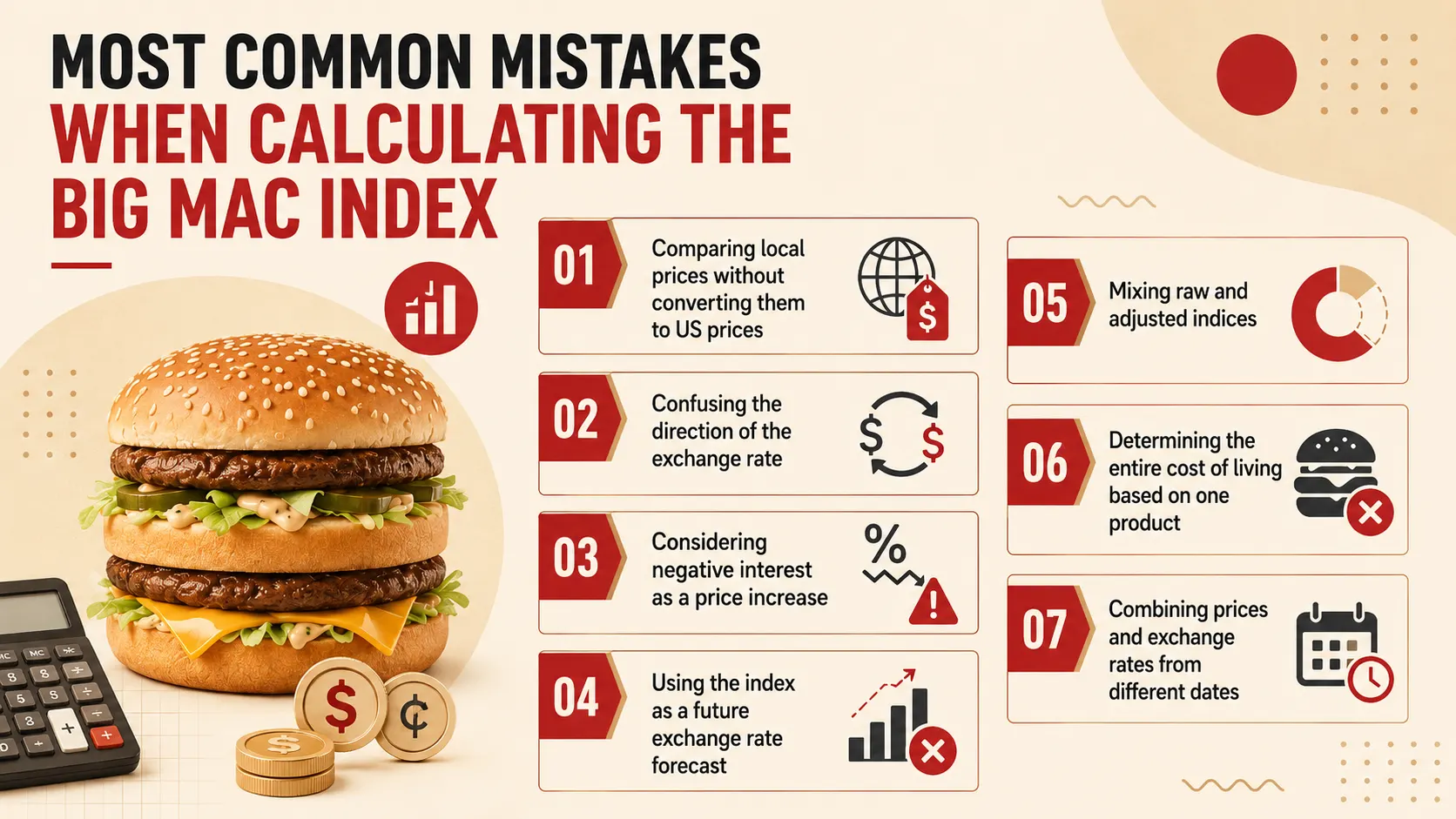
# Frequently asked questions
- What is the Big Mac Index?
The Big Mac Index is an unofficial economic index that compares the prices of Big Macs in different countries to show the theoretical value of currencies relative to each other.
- Who compiles the Big Mac Index?
The index is compiled by The Economist. The index data and calculation methodology are published in an open database.
- What does the Big Mac Index measure?
The index measures purchasing power parity and the relative overvaluation or undervaluation of currencies based on the prices of the same product in different countries.
- How is the Big Mac Index calculated?
First, the local Big Mac price is divided by the US price to find the theoretical exchange rate. The theoretical exchange rate is then compared to the actual exchange rate.
Formula: ((Theoretical Exchange Rate ÷ Actual Exchange Rate) − 1) × 100
- What does a negative Big Mac Index mean?
A negative result indicates that the local currency is undervalued against the base currency based on the price of a Big Mac.
- What does a positive Big Mac Index mean?
A positive result indicates that the local currency is overvalued against the base currency.
- How is the Azerbaijani manat valued in the Big Mac Index?
Based on January 2026 data, the manat appears to be undervalued against the US dollar by approximately 36.2% in the raw index and by approximately 16.1% in the income-adjusted index.
- Does the Big Mac Index determine the official exchange rate?
No. The index does not determine the official exchange rate and is not the primary currency model used by central banks.
- Can currencies be bought or sold based on the index?
The Big Mac Index alone is not sufficient for investment or currency trading decisions. Interest rates, inflation, economic growth, foreign trade, political risks, and monetary policy must also be considered.
- Does the Big Mac Index indicate the cost of living?
It may give a partial idea, but it is not a complete cost of living index. A wider basket of goods and services should be used to calculate the cost of living.
- How do countries without Big Macs compare?
Countries that do not sell McDonald's or Big Macs are not included in the standard Big Mac Index. The PPP indicator for such countries can be calculated using a wider international price survey.




What is the Big Mac Index that determines the pr...

16 Jul