
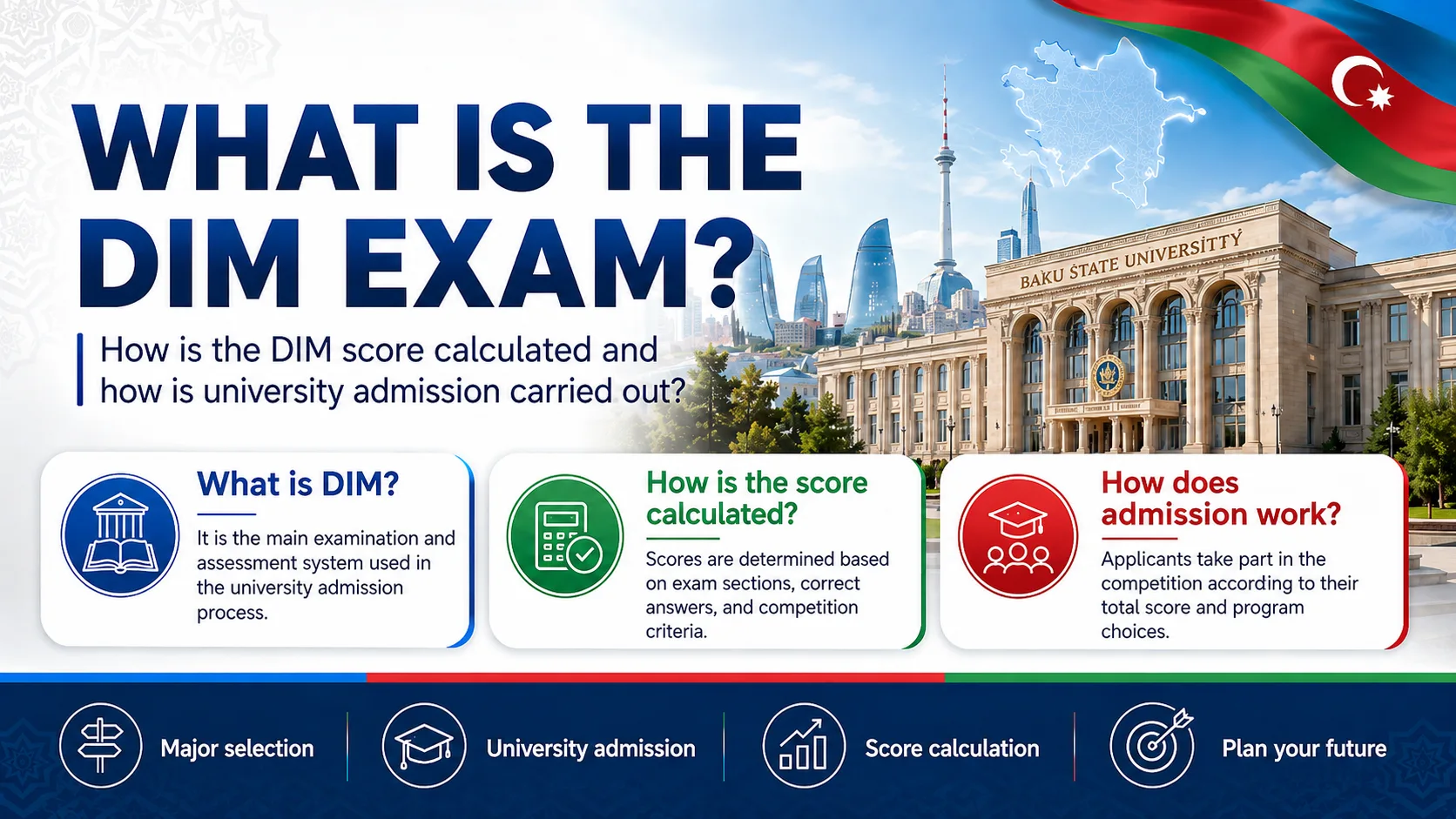
University applicants in Azerbaijan are assessed through admission examinations organized by the State Examination Center (DİM). These examinations are used for graduation assessment and university admission. The admission system for the bachelor’s level of higher education differs depending on the direction chosen by the applicant. The results of applicants who want to be accepted to I, II, III and IV specialized groups are essentially formed in two stages of the admission examination.
It is possible to collect a maximum of 300 points in the first stage and a maximum of 400 points in the second stage. Accordingly, the total result of the applicants for specialized groups I–IV can be a maximum of 700 points.
In this article, as “Hesabla.com”, we explain what the DİM admission exam is, who it is for, the admission stages, specialized groups, how the 700-point system is formed, how university placement is conducted, and what applicants should pay attention to during preparation.
Who is the DIM exam for?
- IX class graduation exam
- XI class graduation exam
- Undergraduate admission
- Admission to colleges
- Master’s degree
- Residency
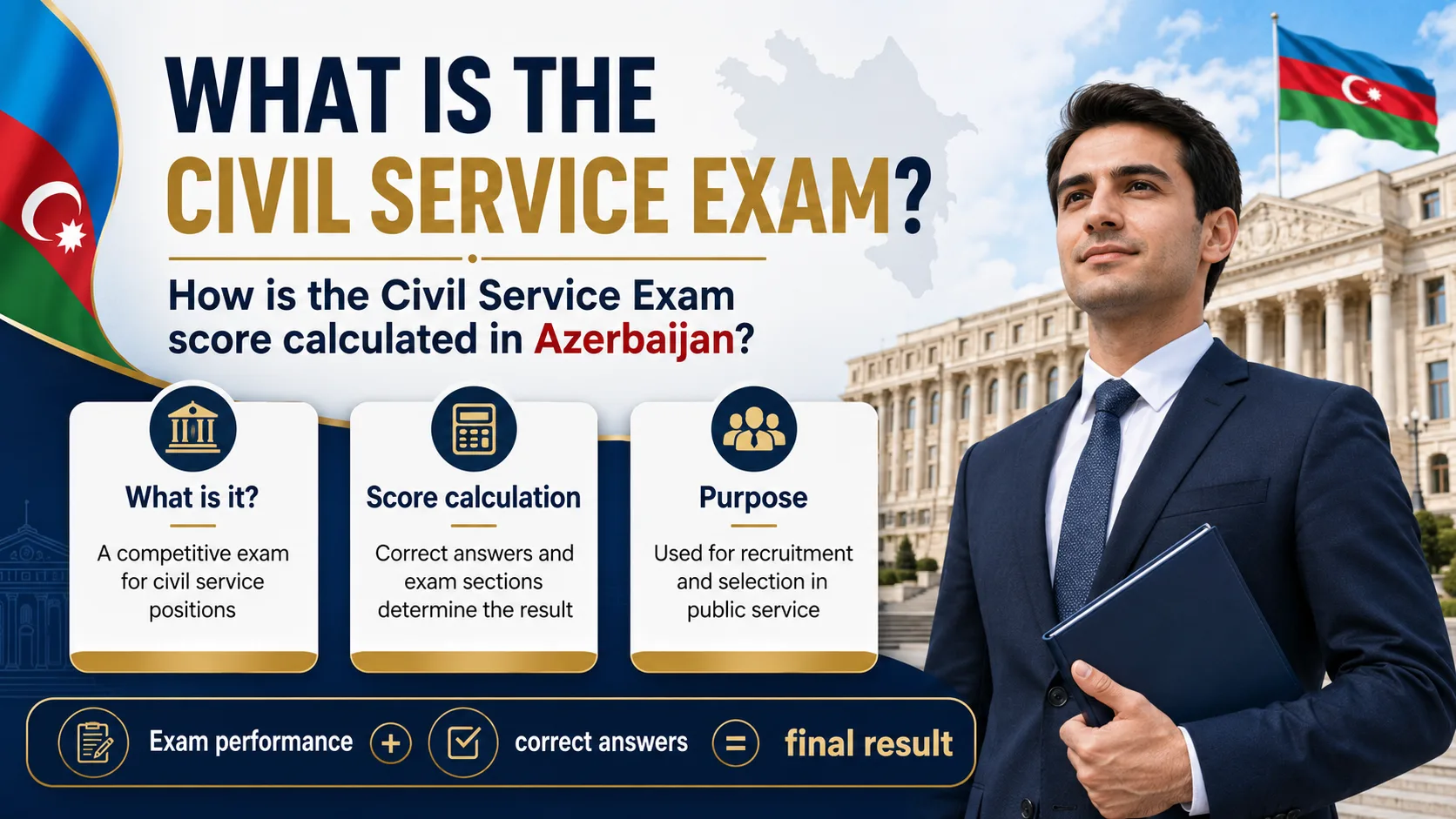
- Civil service
- Aptitude exams
Which examination stage the candidate should take part in may depend on the year in which they graduated, their education document, and the direction in which they wish to be accepted. For 11th-grade graduates of the current year, the graduation exam is considered the first stage of the admission exam. Graduates of previous years can participate in the first-stage examination under the conditions determined for them by DİM.
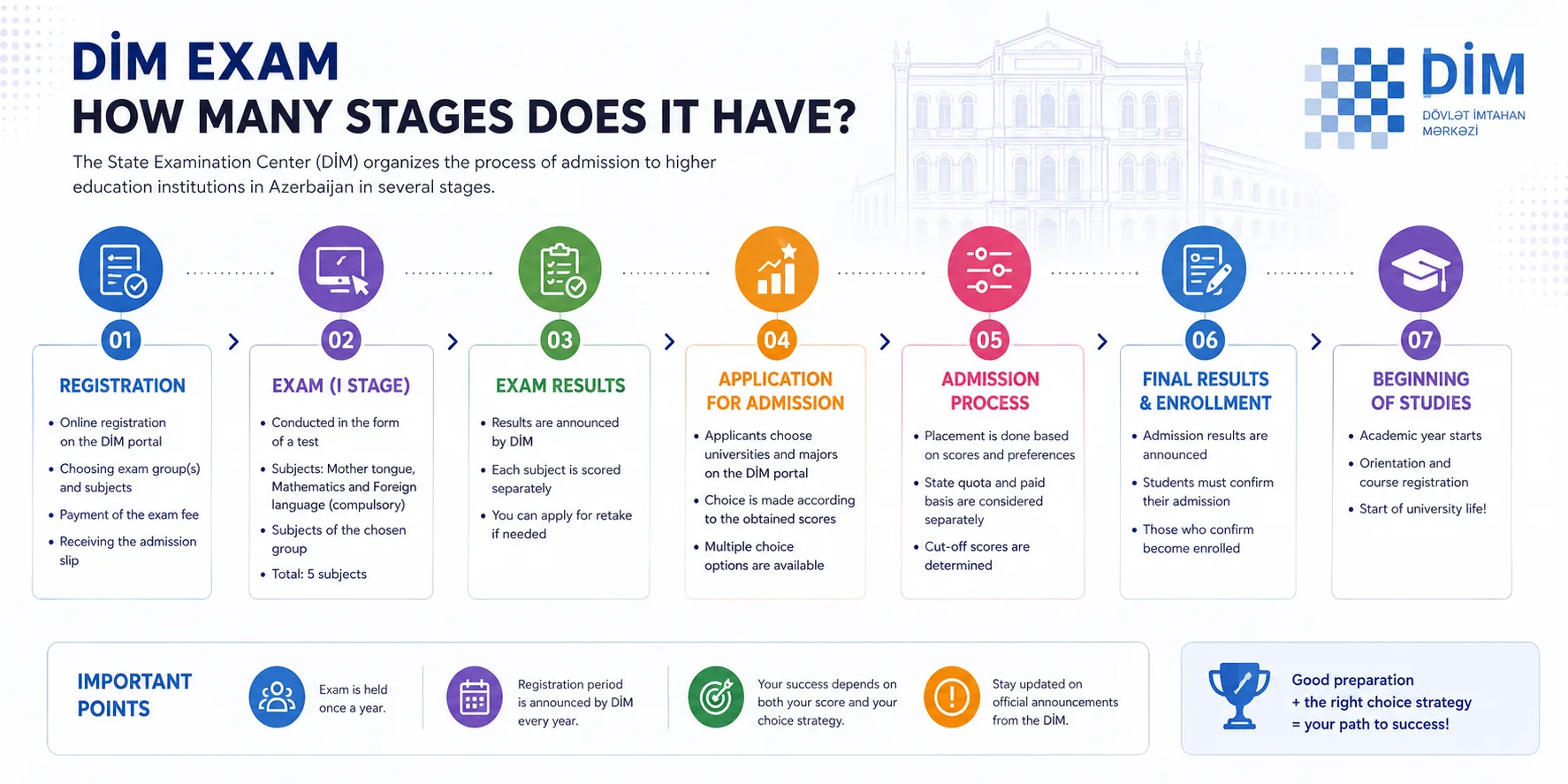
How many stages does the DIM exam consist of?
The admission process to higher education institutions in specialized groups I, II, III and IV essentially consists of two examination stages:
- First stage of the admission exam (300 points) (Evaluating general knowledge of the language of instruction, mathematics and foreign languages)
- Second stage of the admission exam (400 points) (Evaluating knowledge of the main subjects of the selected specialized group)
What is the first stage of the admission exam?
In the first stage of the admission exam, students take the following exams in accordance with the language of education in which they want to study:
- Azerbaijani or Russian language
- Mathematics
- Foreign language
Based on official DİM information for bachelor’s admission, 30 tasks in the language of instruction, 30 in foreign languages, and 25 in mathematics are presented in this stage. Therefore, there are 85 tasks in total in the exam. In addition, in the language of instruction section there are 20 closed and 10 written tasks; in Mathematics there are 13 closed, 5 coded open, and 7 written tasks; and in Foreign Language there are 23 closed and 7 written answer tasks. It is possible to score a maximum of 100 points per subject and a maximum of 300 points for the entire stage.
What is the second stage of the admission exam?
The second stage evaluates knowledge of subjects suitable for the specialized group chosen by the applicant. The maximum possible score at this stage is 400 points.
In specialized groups I–IV, tasks are divided between high-weight subjects and other group subjects. The impact of subjects on the overall result is determined based on the group's official assessment model.
It was announced that the previous year's exam model will be applied in the 2026 admission exams. The test blocks include 22 closed questions, 5 coded open questions, and tasks with written answers. In group I, 3 independent written tasks are presented, and in groups II, III and IV, 3 written tasks are presented based on text, situation or source.
How many specialized groups are there in DIM?
Higher education specializations in Azerbaijan are mainly classified into five specialization groups:
- I specialized group
- II specialized group
- III specialized group
- IV specialized group
- V specialized group
In specialized groups I–IV, the competition score is essentially formed on the basis of the results of the first and second stages. Specialized group V is associated with certain specialties that require special aptitudes, and the admission mechanism may differ here.
What is specialized group I?
The first specialized group covers mainly engineering, information technology, computer science, mathematics, physics, certain aspects of architecture and other technical specialties.
This group is divided into two subgroups:
- RK subgroup
- RI subgroup
The main subject combination differs in the “RK” and “RI” subgroups. Applicants should check in advance which subgroup the specialties they want to choose belong to.
This group may be suitable for applicants interested in the following directions:
- Mathematics and logic, Mathematics, applied mathematics
- Computers and programming, computer science, information technology
- Technical systems, various engineering specializations
- Physics and technology, physics, electronics and technology fields
- Infrastructure, construction and related engineering directions
The list of specific specializations and subgroups for each admission year is published in DİM's “Abituriyent” journal and admission announcements. Accordingly, when choosing a specialization, the official list for that year should be used. As an alternative, we offer the University Admission Assistant on our website completely free of charge. All you have to do is enter your score. The system will present the 15 most suitable specialties and universities for you to choose from.
What is specialized group II?
The II specialized group mainly covers economics, finance, business, administration, marketing, tourism and some socio-economic directions. In order to be successful in the second group, in addition to mathematical thinking, it is also important to have the ability to understand geographical and socio-economic information. This group may be suitable for applicants interested in the following areas:
- Economics
- Finance
- Accounting
- Business administration
- Marketing
- Management
- Organization of the tourism business
- State and municipal administration
- Directions related to international trade and logistics
What is specialized group III?
Specialized group III mainly covers the major part of the fields of humanities, social sciences, law, languages, history, journalism and teaching.
Group III is divided into two subgroups:
- DT subgroup
- TC subgroup
The combination of admission subjects and corresponding specializations may differ in subgroups. In addition, in some specializations such as Journalism, additional aptitude tests or other special requirements may apply. The applicant must check the competition conditions for that year separately.
It is possible to encounter the following directions in group III:
- Law and governance, jurisprudence, state and public relations
- Languages, philology, translation, foreign language teaching
- History and social sciences, history, regional studies and related fields
- Media, journalism and communications
- Education, various humanities teaching specializations
What is specialized group IV?
The IV specialized group covers mainly the fields of medicine, biology, chemistry, pharmacy, certain branches of psychology, ecology and other natural sciences. Many specialties of group IV can be highly competitive. Especially in medical and stomatology fields, high overall results are required for admission. However, the exact cutoff score is not fixed in advance; it is formed depending on the outcome of the competition for that year. This group may be suitable for applicants interested in the following areas:
- Medicine
- Stomatology
- Pharmacy
- Biology
- Chemistry
- Biotechnology
- Ecology
- Veterinary medicine
- Biology and chemistry teaching
What is specialized group V?
The V specialized group includes a number of specialties that require special skills. This may include music, visual arts, design, acting, sports and other creative and aptitude fields.
The admission process for group V differs from groups I–IV. Along with the applicant's graduation or first-stage result, participation in a special aptitude test may also be required.
DİM notes that there are specializations requiring special skills in higher and secondary specialized education institutions, and separate aptitude tests are organized for admission to these specializations.
The aptitude test may take the following forms, and the program, minimum requirements and evaluation vary depending on the specialty:
- Drawing and composition
- Musical performance and theory
- Physical fitness
- Acting and stage skills
- Design and creative tasks
- Other practical evaluations suitable for the selected field
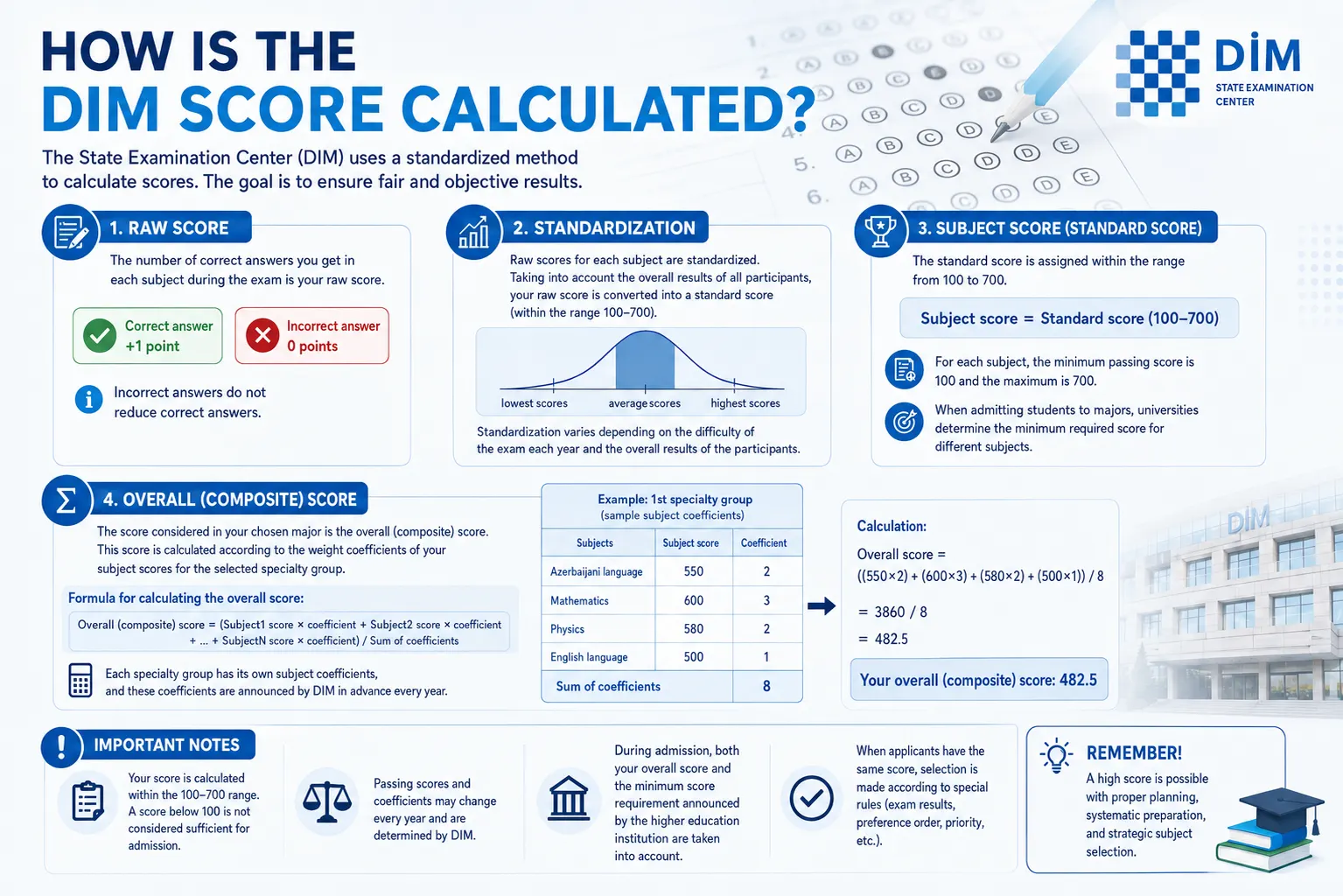
How is the DIM score calculated?
The calculation of the DİM score varies depending on the selected specialization group and examination stage.
The general formula for groups I–IV is as follows: Total competition score = First-stage score + Second-stage score
For example: Language of instruction (78), Mathematics (85) and Foreign language (72). Total first-stage score is 235.
If you score 320 points in the second stage: 235 + 320 = 555 points.
How do universities evaluate DIM results?
In centralized bachelor’s admission in Azerbaijan, universities usually do not evaluate an applicant's document independently or issue a separate score. Placement is conducted by DİM based on the applicant's competition score, order of specialization preferences, available places, and admission rules.
Applicants should prepare a specialization list that matches their score as accurately as possible. Although a high score increases admission chances, an incorrect selection strategy may leave the applicant unadmitted.
What is government order and admission on a paid basis?
Places in university programs can be offered under two main forms of funding:
- On the basis of a government order: Tuition fees are funded by the state.
- On a paid basis: Tuition fees are paid by the student.
The cutoff scores for government-funded and paid places in the same specialization may differ. Places with government orders usually involve higher competition.
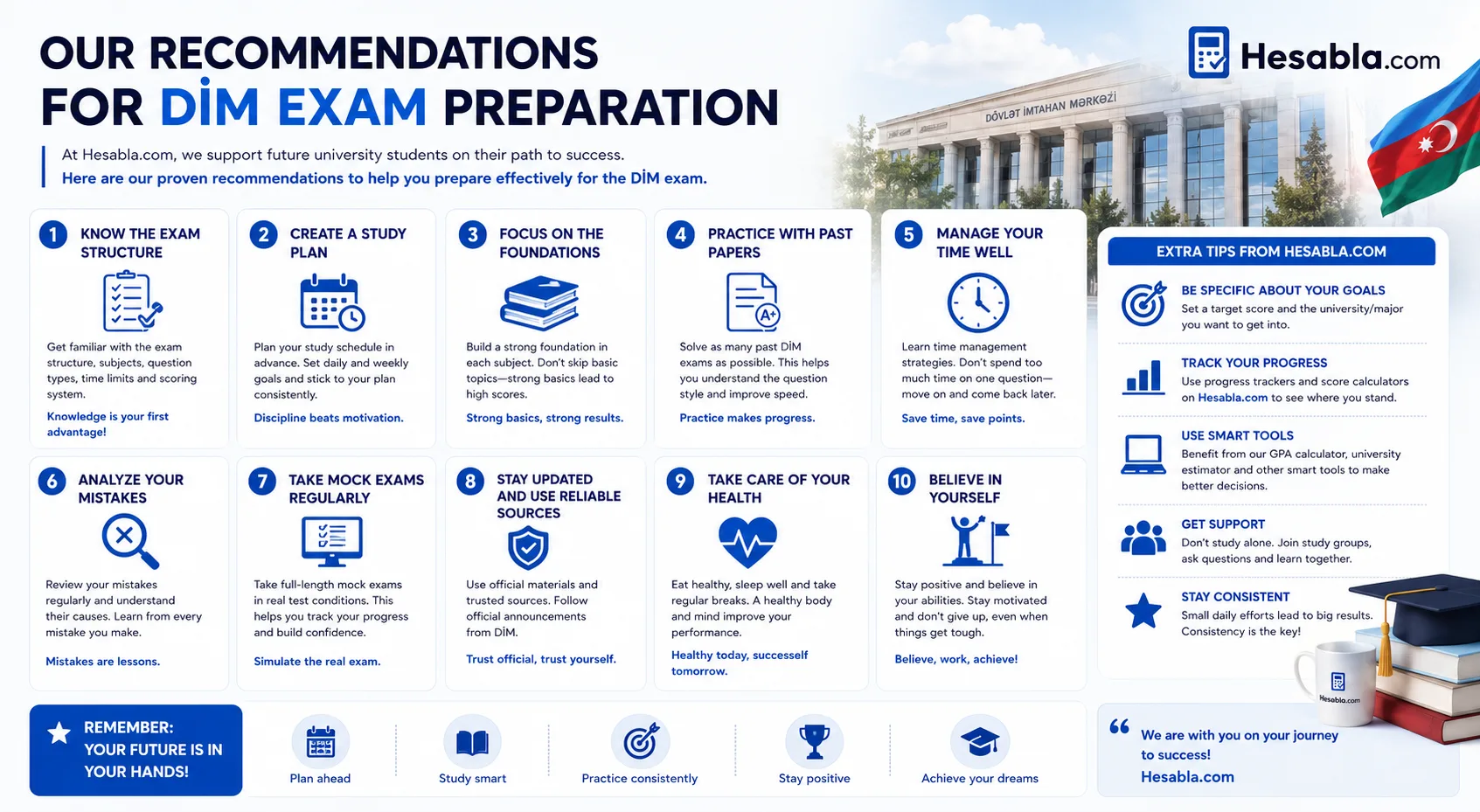
As Hesabla.com, our recommendations for those preparing for the DIM exam
The first step in preparing for the DİM exam is to determine the specialization group and target programs. The applicant must know which subjects affect their result more. A preparation plan can be established as follows:
- Define the specialized group and subgroup
- Select the target university and specializations
- Calculate the estimated required score
- Measure your current level with a practice exam
- Prepare a weekly study program for subjects
- Practice open and written tasks separately
- Take full timed mock exams
- Record errors by topic and cause
- Analyze DİM tasks from recent years
- Prepare safe and ambitious options for specialization selection
Preparation should not consist only of solving tests. Applicants must find the reason for every error and relearn the topic. As for the most common mistakes in the DİM exam, these mainly include simply memorizing tests instead of understanding the subject's logic, treating the first stage as unimportant, failing to practice open tasks, and considering a minimum score as a guarantee of admission.
Frequently asked questions
What is DIM?
DİM — State Examination Center. It organizes exams in Azerbaijan for university and college admission, master’s degree programs, residency, civil service, and other fields.
How many stages does the DIM admission exam consist of?
The admission exam for specialization groups I–IV essentially consists of two stages. For 11th-grade graduates of the current year, the first stage is the graduation exam. The second stage is conducted on the subjects of the selected specialized group.
What is the maximum score in DIM?
The maximum total score for specialization groups I–IV is 700. It is possible to score 300 points in the first stage and 400 in the second stage.
What is the maximum score that can be obtained in the graduation exam?
In the 11th-grade graduation exam, it is possible to score a maximum of 100 points per subject and 300 points in total.
Which subjects are included in the first stage?
In the first stage, the language of instruction — Azerbaijani or Russian — mathematics, and foreign language subjects are presented.
How is the DIM score calculated?
The total score for groups I–IV is calculated by adding the first and second stage scores: Total score = First stage + Second stage.
What is a cutoff score?
A cutoff score is the score of the applicant admitted last as a result of competition for a specific specialization. These score thresholds may change from year to year depending on available places, the number of applicants, and their results.
Does obtaining the minimum score mean admission?
No. Meeting the minimum competition requirement only gives you the right to select certain specializations. For actual admission, your score must meet the competition result formed that year.
Is the 700-point system applied in the fifth specialized group?
The admission mechanism for group V may differ from groups I–IV. In specializations requiring special skills, the result of the aptitude test and other competition conditions are taken into account.
Is it possible to take the second stage of the admission exam twice?
DİM organizes two attempts for the second stage in certain admission years. Separate registration was announced for the second attempt in 2026. Specific rules and dates are announced by DİM every year.
Which attempt’s result is considered?
This matter is determined by the rules announced for the respective admission year. During registration, applicants should check DİM’s official explanation regarding the use of results.
How should programs be ranked when choosing a specialization?
Specializations should be ranked in order of genuine preference. The system admits the applicant to the highest available specialization on their list for which their score qualifies. As Hesabla.com, we provide assistance at this stage — simply navigate to the calculators section and go to the admission assistant.
Is it correct to make choices based on last year’s cutoff score?
Last year’s score provides guidance, but does not guarantee admission. For a more accurate analysis, the cutoff scores of the last 3–5 years should be evaluated together with current available places and interest in the specialization.
Do universities convert the DIM score into GPA?
No. In centralized admission, the DİM score is an independent competition indicator. It is not converted into your high school diploma average or university GPA.