
One of the most common exams for students who want to study abroad, especially at US universities, is the SAT exam. This exam measures the reading, writing, language and math skills that a student has learned in school and presents the result as a score in the range of 400–1600.
In this article, we will explain in detail what the SAT exam is, the Digital SAT structure, the Reading and Writing and Math sections, how the score is calculated, what the adaptive module system means, and how universities approach SAT results.
# What is SAT?
SAT, or Scholastic Aptitude Test, is mainly used for undergraduate applications to US universities. However, SAT can also be used for international universities and scholarship programs in some other countries, not just the US.
SAT is not an exam that tests a student's in-depth knowledge of a specific subject. It rather measures how relevant the basic academic skills learned in the school program are to university-level education. This includes skills such as reading comprehension, finding the main idea in a text, correcting grammatical errors, solving mathematical problems, and analyzing data and graphs.
# Who needs the SAT?
The SAT is mainly useful for those who want to study abroad for undergraduate studies. However, some universities require SAT scores, some accept optional scores, and some may apply a test-blind policy. Therefore, as "Hesabla.com", our recommendation is to check the official admission requirements page of the university you will apply to before preparing. We should also note one more point here that some scholarship programs may also require you to submit your SAT scores.
# What is the Digital SAT?
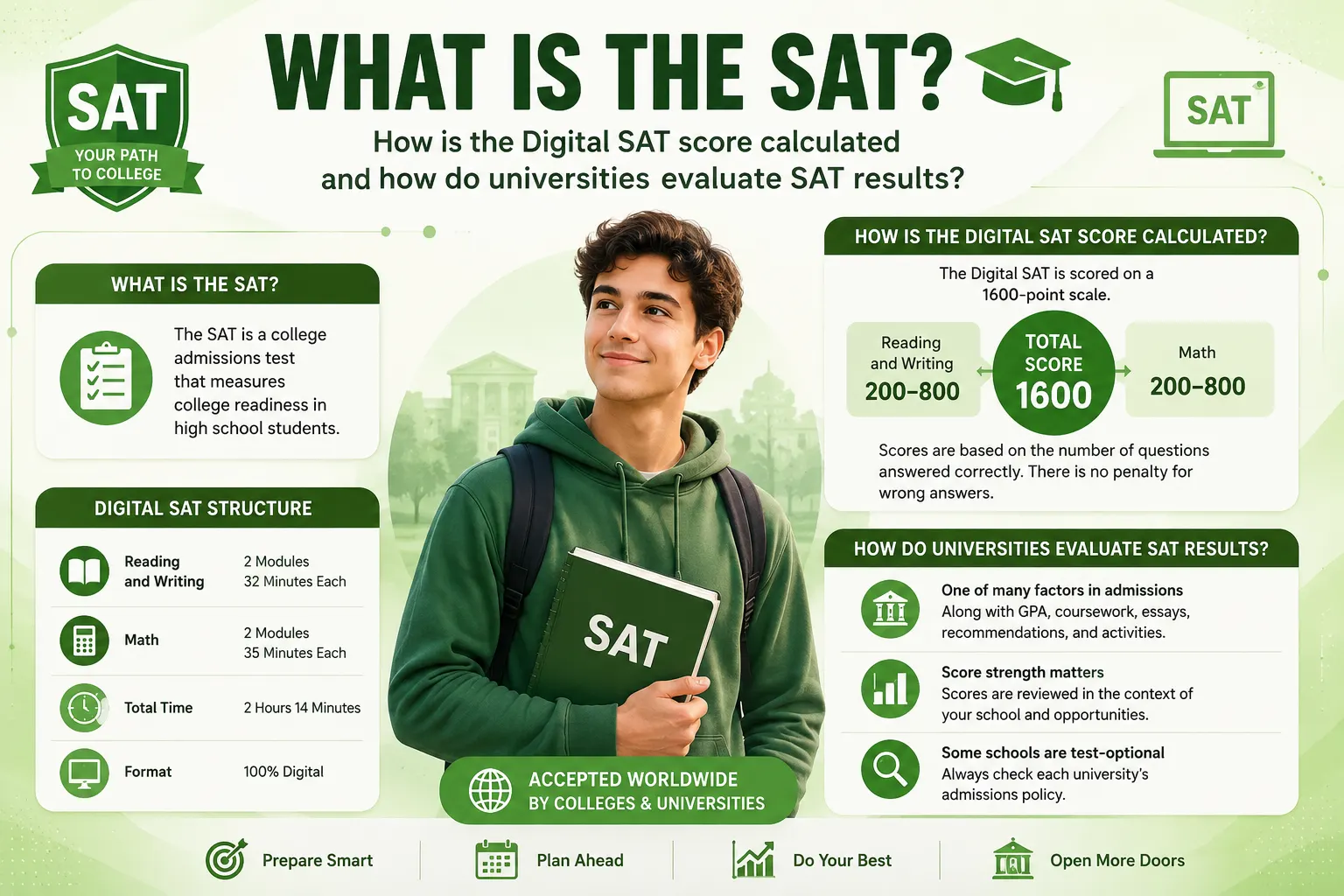
The Digital SAT is a digital format of the SAT exam. This exam is administered on a computer or compatible device through the College Board test application called Bluebook. The Digital SAT uses the same 400–1600 score range as the previous paper-based SAT, but the test format is shorter and more adaptive. The Digital SAT consists of two main sections:
- Reading and Writing (200-800)
- Math (200-800)
# How is the Digital SAT structured?
The Digital SAT is shorter than the previous SAT format. According to the College Board's official test structure, the SAT consists of two sections: Reading and Writing and Math.
In the Reading and Writing section, you are presented with 2 modules, each module has 27 questions. In total, you have 54 questions in this section and 64 minutes for 54 questions.
In the Math section, you are also presented with 2 modules, this time there are 22 questions in each module. That is, in total, you are presented with 44 questions and you have 70 minutes for these 44 questions.
Most of the questions in the Digital SAT are in the multiple-choice format. In the Math section, however, in some questions, the student does not choose the answer from the options, but enters it himself.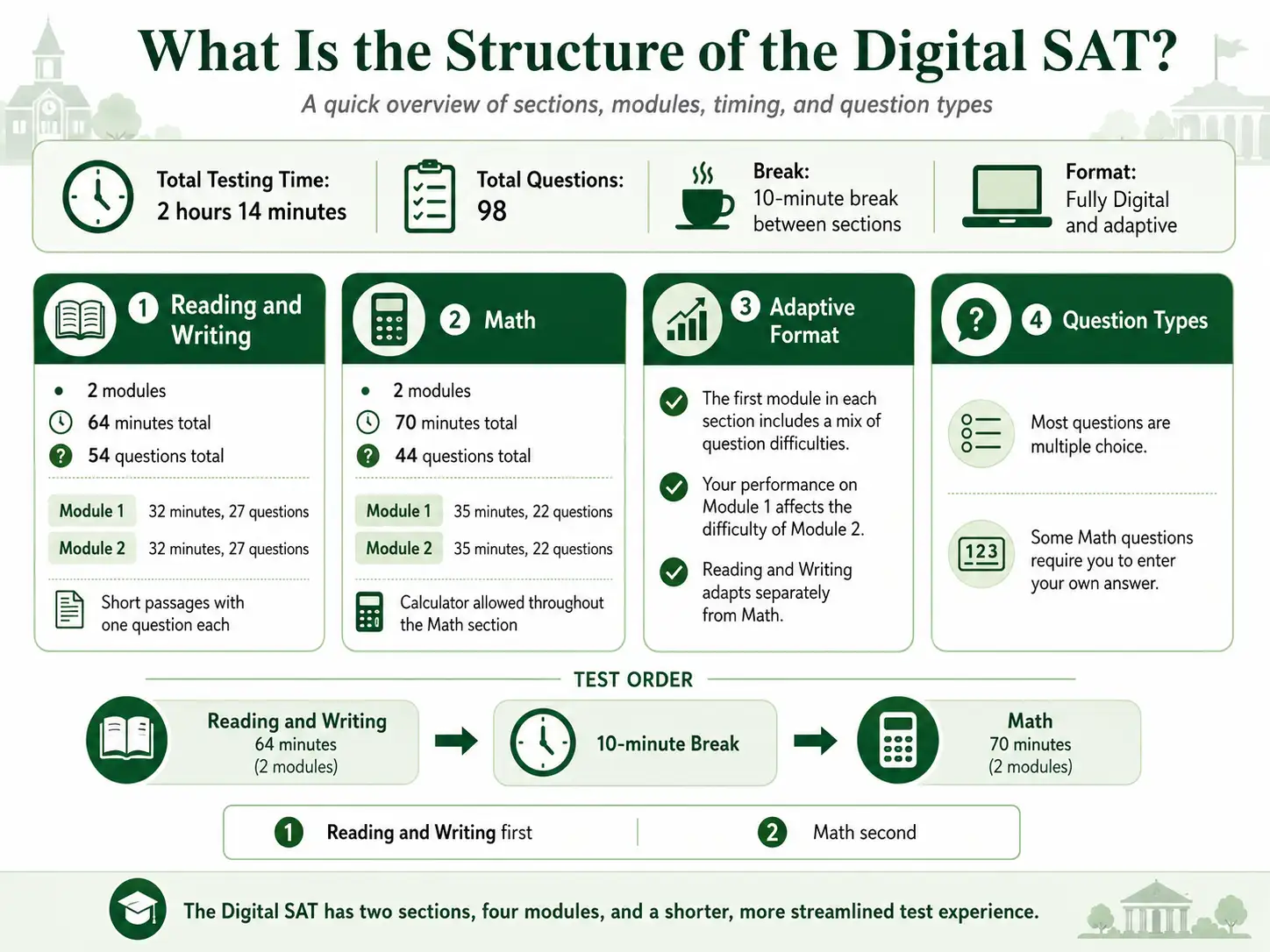
# How does the Digital SAT work with the adaptive system?
One of the most important features of the Digital SAT is the adaptive module system. According to the official explanation of the College Board, the first module of each section consists of a mixture of easy, medium and difficult questions. Depending on the student's performance in the first module, the second module may consist of more difficult or easier questions.
Therefore, in the Digital SAT, the question "how many questions did I answer correctly?" is not enough. The difficulty level of the questions you answered correctly also affects the score.
# How is the Digital SAT score calculated?
The Digital SAT is scored on a scale of 400–1600. The total score is the sum of the two section scores:
Score range for the Reading and Writing section: 200–800
Score range for the Math section: 200–800
In simple terms, our summation formula is: Total Score = "Reading and Writing" score + Math score
For example, let's say we scored 620 in "Reading and Writing", and we scored 680 in the "Math" section. Our total score will ultimately be 1300.
However, the Digital SAT score is not based solely on the number of correct answers. According to the College Board, the "Digital SAT Suite scoring" model takes into account factors such as the number of correct and incorrect answers a student gets, as well as the characteristics of the questions they answer, including the difficulty level.
This means that even if two students answer the same number of questions correctly, their results may be different. Because one may have answered more difficult questions correctly, while the other may have answered easier questions correctly.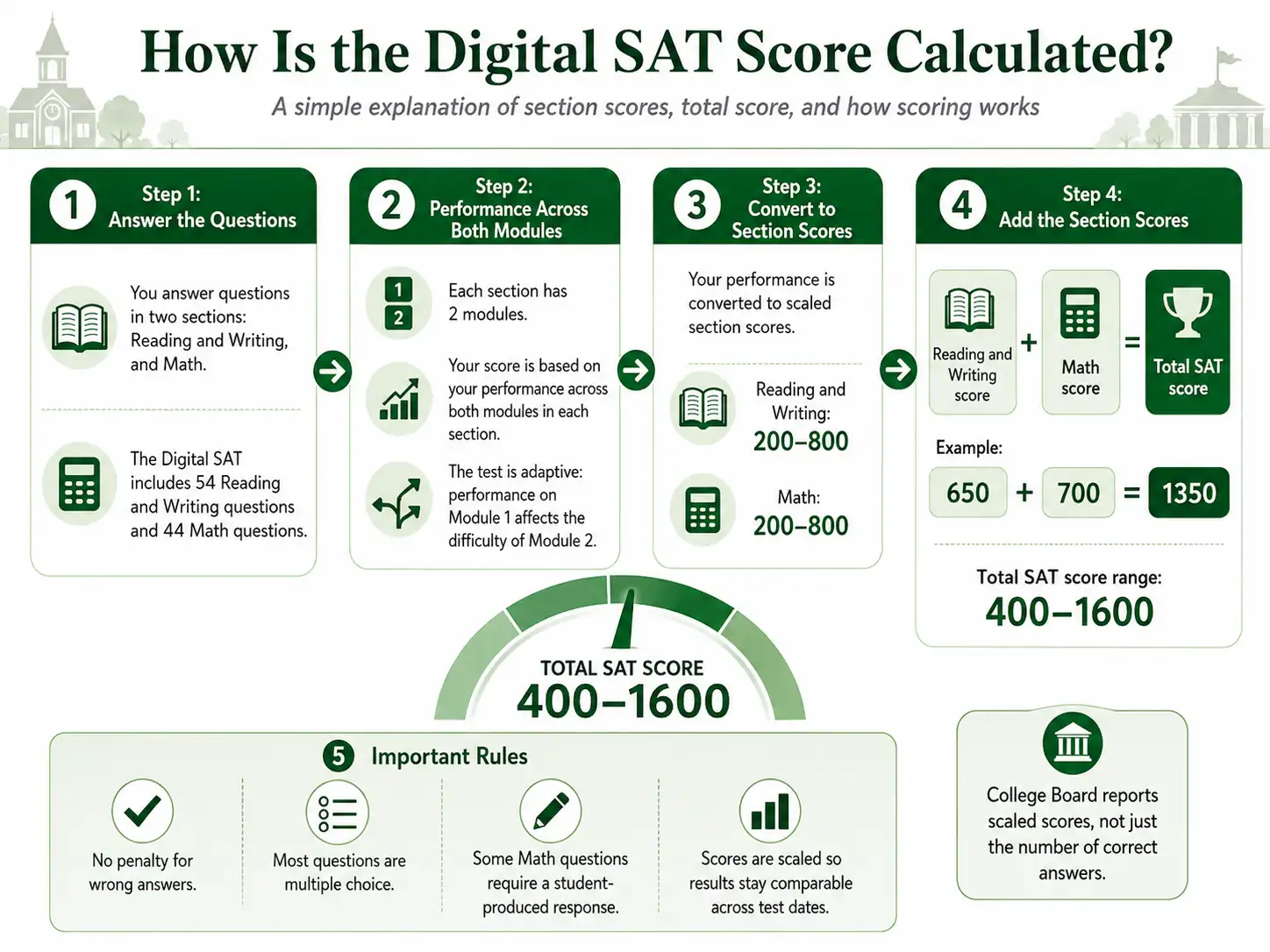
# What does the Reading and Writing section measure?
The Digital SAT Reading and Writing section measures a student's ability to understand what they are reading, understand words in context, analyze information, and apply grammar and spelling rules.
According to the College Board's official information, the Reading and Writing section presents a short passage or passage pair, and each passage is followed by a multiple-choice question. Passages are approximately 25–150 words long and can be taken from literature, history/social studies, humanities, and science.
The Reading and Writing section is structured around four main categories:
- Information and Ideas, Understanding the text, finding information, and analyzing it
- Craft and Structure, The meaning of words in context, the structure of the text, and the author's approach
- Expression of Ideas, The ability to revise writing to express it more effectively
- Standard English Conventions, Grammar, punctuation, and sentence structure
To succeed in this section, knowing only English is not enough. The student must quickly find the main idea in a short text, separate unnecessary information, notice grammatical errors, and carefully compare answer options.
# What does the Math section measure?
The Digital SAT Math section measures a student's ability to understand mathematical concepts, solve problems, work with data, and apply mathematics to real-world situations. According to the College Board, the SAT Math section focuses on four main areas: Algebra, Advanced Math, Problem-Solving and Data Analysis, Geometry and Trigonometry.
- Advanced Math, More complex functions, quadratic equations, nonlinear expressions
- Problem-Solving and Data Analysis, Percentages, ratios, data, graphical and statistical reasoning
- Geometry and Trigonometry, Geometry, angles, figures, and basic trigonometry
The questions in the Math section can be in both multiple-choice and student-produced response formats. Therefore, the student should not be satisfied with just memorizing formulas. Because the Digital SAT Math also tests the ability to think and apply mathematics in real-world situations.
# Is a calculator used in the Digital SAT?
The Digital SAT Math section is more convenient to use a calculator, because the Bluebook application has a built-in Desmos graphing calculator. The College Board's information on the differences between the SAT and ACT also mentions that the SAT Math section has a built-in Desmos graphing calculator.
This is a great advantage for students. Because it is possible to graph functions, check equations, and perform some calculations faster with Desmos. But this does not mean that the calculator will automatically solve all problems. The student must first understand the logic of the question, know what operation to perform, and use the calculator correctly.
Both the ability to use a calculator and basic mathematical reasoning without a calculator are important in SAT Math preparation.
# What are SAT College and Career Readiness Benchmarks?
The concept of benchmark is also important in SAT results. A benchmark is an indicator of how ready a student is to succeed in certain courses at the college level.
According to the official benchmark information of the College Board, the Reading and Writing benchmark for the SAT is 480, and the Math benchmark is 530. A student who meets the benchmark in the Reading and Writing section is said to have a 75% chance of getting at least a C in first-semester college courses in history, literature, social studies, and writing. A student who meets the Math benchmark has a similar 75% chance of getting a C in courses such as algebra, statistics, precalculus, and calculus.
These benchmarks should not be used to limit a student, but to indicate where additional preparation is needed. The College Board also notes that benchmarks should not be used to discourage students.
# How do universities treat SAT scores?
Universities usually evaluate SAT scores as part of an application package. That is, the SAT alone does not mean an admission or rejection decision. Universities may consider SAT scores in conjunction with GPA, transcripts, essays, recommendation letters, extracurricular activities, English proficiency test results, and other documents.
For this reason, students should check the admissions policies of their target universities before starting SAT preparation. Different programs in the same country and even within the same university can have different approaches to the SAT.
# When are SAT scores released?
SAT score release dates vary by test type, date, and region. The College Board shares score release dates by test type on its "score release dates" page.
Students should check their College Board account and official score release page when registering for the test to see when their scores will be released. It is also important to check the last date for submitting documents when applying to a university. If your SAT score is released after the deadline, the university may not accept your score.
# Our recommendations for those who want to prepare for the SAT as Hesabla.com?
The main goal of SAT preparation is not only to solve many questions. The student should know the test format, module system, time management and categories where he is weak.
On the official SAT page of the College Board, Bluebook full-length practice tests, Khan Academy Official SAT Prep and other free practice resources are offered for SAT preparation.
One of the most important points in SAT preparation is to conduct error analysis. The student should not only understand the correct answers, but also why he made a mistake. For example, an error can arise from not knowing the topic, inattention, lack of time or not comparing the answer options correctly.
# Our recommendations for SAT Reading and Writing as Hesabla.com
Since the Reading and Writing section consists of short texts, the student must develop fast and accurate reading skills.
Therefore, since there are short texts in the Digital SAT, learn to work with short texts. Learn not only the meaning of the word in the dictionary, but also its role in the sentence. Review grammar rules, especially Punctuation, subject-verb agreement, modifiers are important.
One of the biggest mistakes in this section is choosing an answer without reading the question completely. Each question on the Digital SAT tests a specific skill. Therefore, the student must first understand what the question wants.
# Our recommendations for SAT Math as Hesabla.com
To succeed in the Math section, subject knowledge, problem-solving skills, and calculator use must be developed together.
Pay special attention to algebra topics. Functions and nonlinear expressions are important. Practice percentages, ratios, graphs, and statistics questions. Review geometry and trigonometry. Learn to use Desmos
The goal of the Math section is not just to find the answer, but to choose the fastest and most correct way. Sometimes it can be more effective to solve the question with algebra, sometimes with graphs, and sometimes by checking the answer options.
# Most common mistakes about the SAT
Students can make some common mistakes in SAT preparation and exam planning.
Common mistakes include failing to check whether a university is test-required, test-optional, or test-blind; focusing only on the total score; and taking the SAT without first completing a practice test. Not analyzing the mistakes. Not learning how to use Desmos. Mistakes such as not using time properly are especially common among those taking this exam.
Avoiding these mistakes helps the student to achieve better results and be calmer and more planned on test day.
# Frequently Asked Questions
- What is the SAT?
The SAT is a standardized test mainly used for undergraduate applications to US universities. This test measures a student's Reading, Writing and Math skills.
- What is the Digital SAT?
The Digital SAT is a digital format of the SAT exam. The test is given through the Bluebook application and consists of two main sections: Reading and Writing and Math.
- How many hours does the Digital SAT last?
The Digital SAT lasts a total of 2 hours and 14 minutes. Reading and Writing is 64 minutes, and Math is 70 minutes.
- How many questions are there in the Digital SAT?
The Digital SAT has a total of 98 questions: 54 questions in the Reading and Writing section and 44 questions in the Math section.
- How is the SAT score calculated?
The SAT total score is the sum of the Reading and Writing section score and the Math section score. Each section ranges from 200–800, and the total score ranges from 400–1600.
- Does the same number of correct answers on the Digital SAT mean the same score?
Not always. The Digital SAT scoring model also takes into account factors such as the difficulty level of the questions and the response pattern. Therefore, two students who answer the same number of questions correctly can receive different section scores.
- What is a good score on the SAT?
According to the College Board, the average SAT score is about 1050. A score of 1350 and above may be in the top 10% of test takers. But a good score depends on the university you are applying to.
- Why do you need an SAT Calculator?
The SAT Calculator helps you calculate your total SAT score by adding up your Reading and Writing and Math section scores. It can also be used to plan your target score and analyze your practice test results.
- Do colleges convert SAT scores to GPA?
Usually, no. SAT scores are not converted to GPA. Colleges evaluate SAT scores as a standardized test score, along with GPA and other documents.
- Where can you practice for the SAT officially?
The College Board officially recommends resources such as Bluebook full-length practice tests and Khan Academy Official SAT Prep.


How the United States calculates taxes for busin...

21 Jul
278