
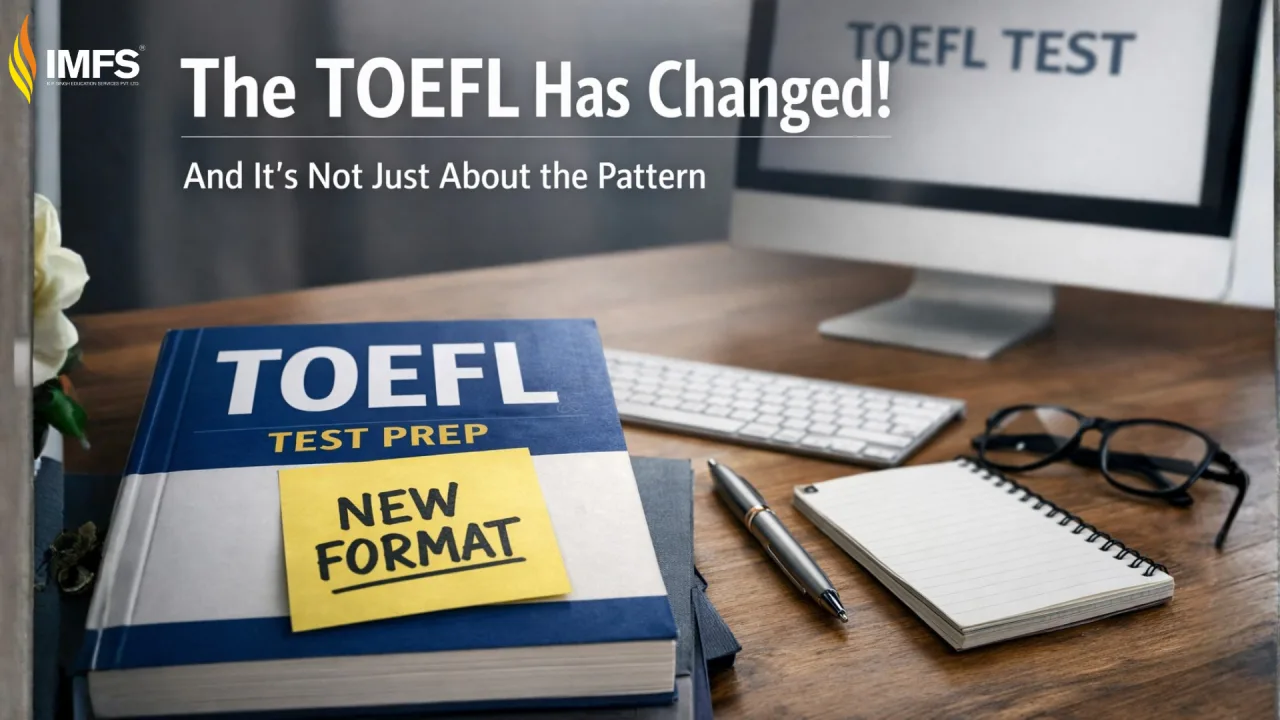
TOEFL, which isone of the best-known English-language proficiency tests for international study, is one of the most well-known exams for studying abroad, applying to international universities, or proving English language proficiency.
This exam not only tests language proficiency, but also evaluates how a student uses their reading, listening, speaking, and writing skills in an academic environment. TOEFL and IELTS use different formats, so candidates may find one more suitable than the other.
In this article, as Hesabla.com, we will explain in detail what the TOEFL exam is, the TOEFL iBT sections, how the TOEFL score is calculated, and how universities approach TOEFL results.
# What is TOEFL?
TOEFL — is an abbreviation for Test of English as a Foreign Language. It is an international exam designed to measure the English language skills of people whose native language is not English. It specifically assesses academic English language skills. Simply put, TOEFL is an exam that measures how you use English in an academic environment.
# Who needs TOEFL?
TOEFL is widely used, especially in the USA, Canada and many international universities. However, TOEFL may also be required for scholarship programs, exchange programs and other programs that require you to prove your English language skills.
As Hesbla.com, our recommendation is to choose your goal before you start preparing and prepare by drawing up a plan according to your goal.
# What is TOEFL iBT?
TOEFL iBT stands for TOEFL Internet-Based Test. This exam is taken on a computer and measures the student's four main academic English language skills: Reading, Listening, Speaking, Writing
This exam is mainly based on situations close to the academic environment. That is, in this exam, the candidate can read an academic text, listen to a lecture, express his opinion orally and prepare a written answer.
You can take this exam in two different ways, via a computer at a test center, which is the right choice for those who have internet problems or are afraid of experiencing any problems, or you can take it from home thanks to the TOEFL iBT Home Edition format.
# TOEFL Reading
The TOEFL Reading section measures the candidate's ability to read and understand texts in English. This section includes task types such as "Complete the Words", "Read in Daily Life" and "Read an Academic Passage". At this stage, you are given 50 questions and you are required to answer these 50 questions within 30 minutes.
Thus, the candidate's skills such as Understanding the Main Idea (understanding the general idea of the text), Finding Details (identifying specific information within the text), Understanding Academic Words (understanding the meaning of words in context), Seeing Logical Relationships (following the relationship between ideas), and Drawing Conclusions (understanding the indirect meaning based on the text) are measured.
If you want to be successful in this section, we recommend that you read a lot of academic texts in addition to your vocabulary.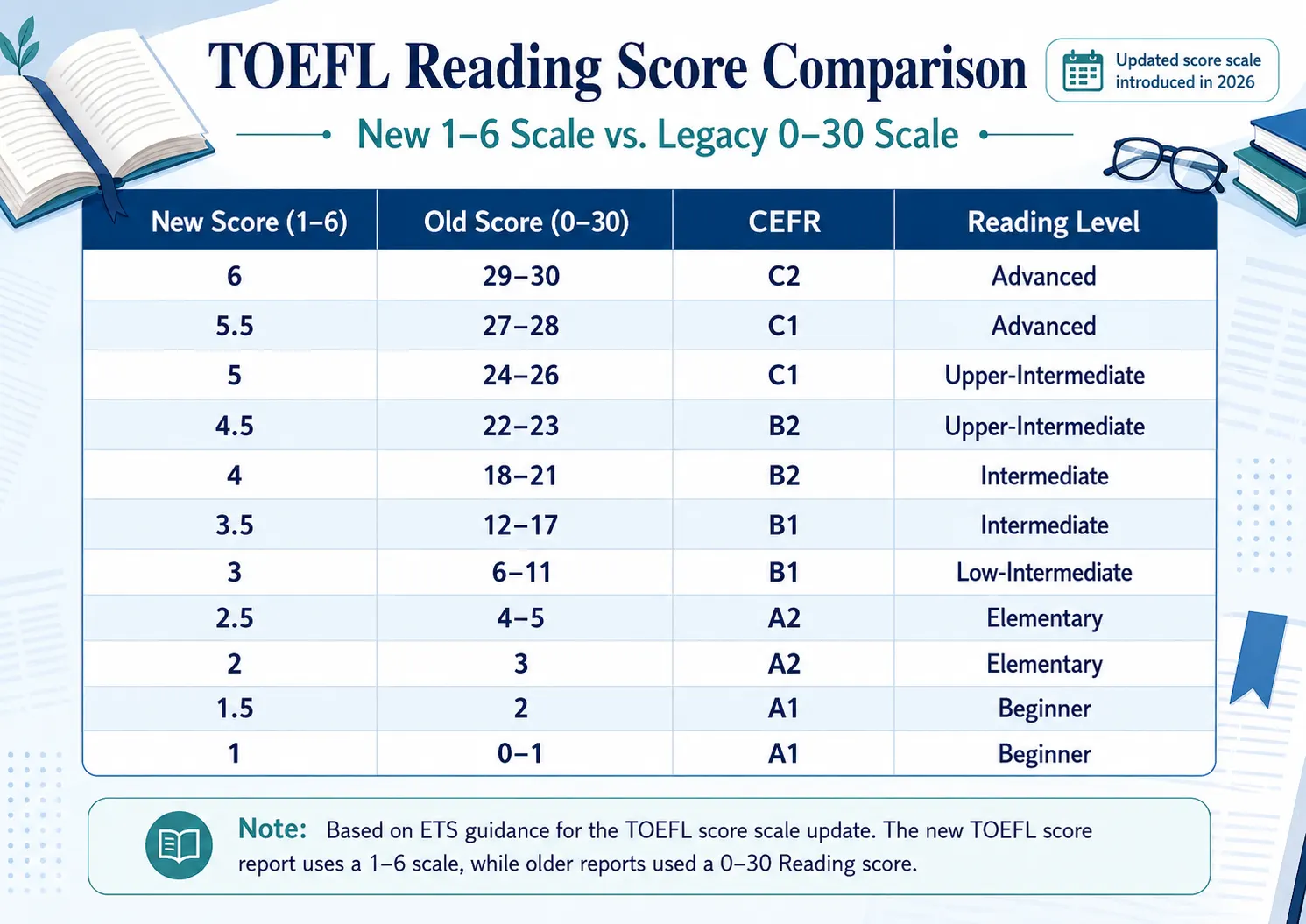
# TOEFL Listening
The TOEFL Listening section measures the candidate's ability to understand spoken English. In this section, the candidate listens to conversations, announcements, academic lectures, and other audio materials and tries to answer 47 questions on the paper in front of him in 29 minutes.
In this section, the candidate has tasks such as “Listen and Choose a Response”, “Listen to a Conversation”, “Listen to an Announcement” and “Listen to an Academic Talk”.
This section answers the questions: Does the candidate understand the main idea of the materials he listens to? Can he choose details? Does he understand the purpose of the conversation? Does he understand while listening to academic lectures? Can he respond according to the information he hears.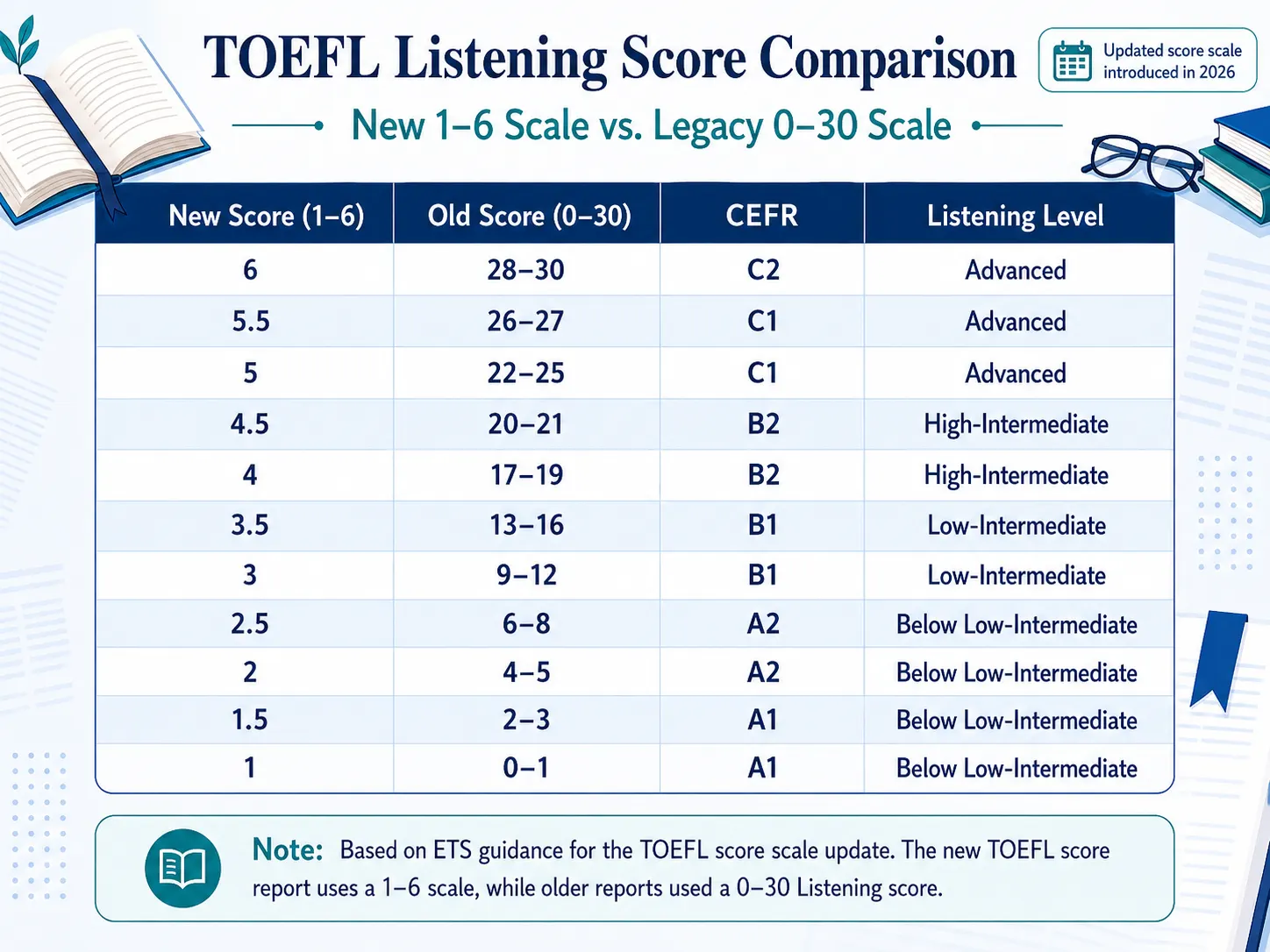
# TOEFL Speaking
The TOEFL Speaking section measures the candidate's ability to express his thoughts orally in English. Unlike IELTS, TOEFL Speaking is usually conducted on a computer and the answers are entered into the system. This section has 11 questions and the candidate has only 8 minutes to answer these 11 questions.
This section usually includes task types such as “Listen and Repeat” and “Take an Interview”. The main goal with these tasks is to find out the answers to questions such as: Can the candidate speak clearly? Can he/she answer fluently? Is his/her pronunciation clear? Are there any grammatical problems? Does he/she understand the question correctly and give a logical answer?
Simply put, the main goal here is not to speak with a perfect accent. The main goal is to express the idea clearly, logically and in an academic context.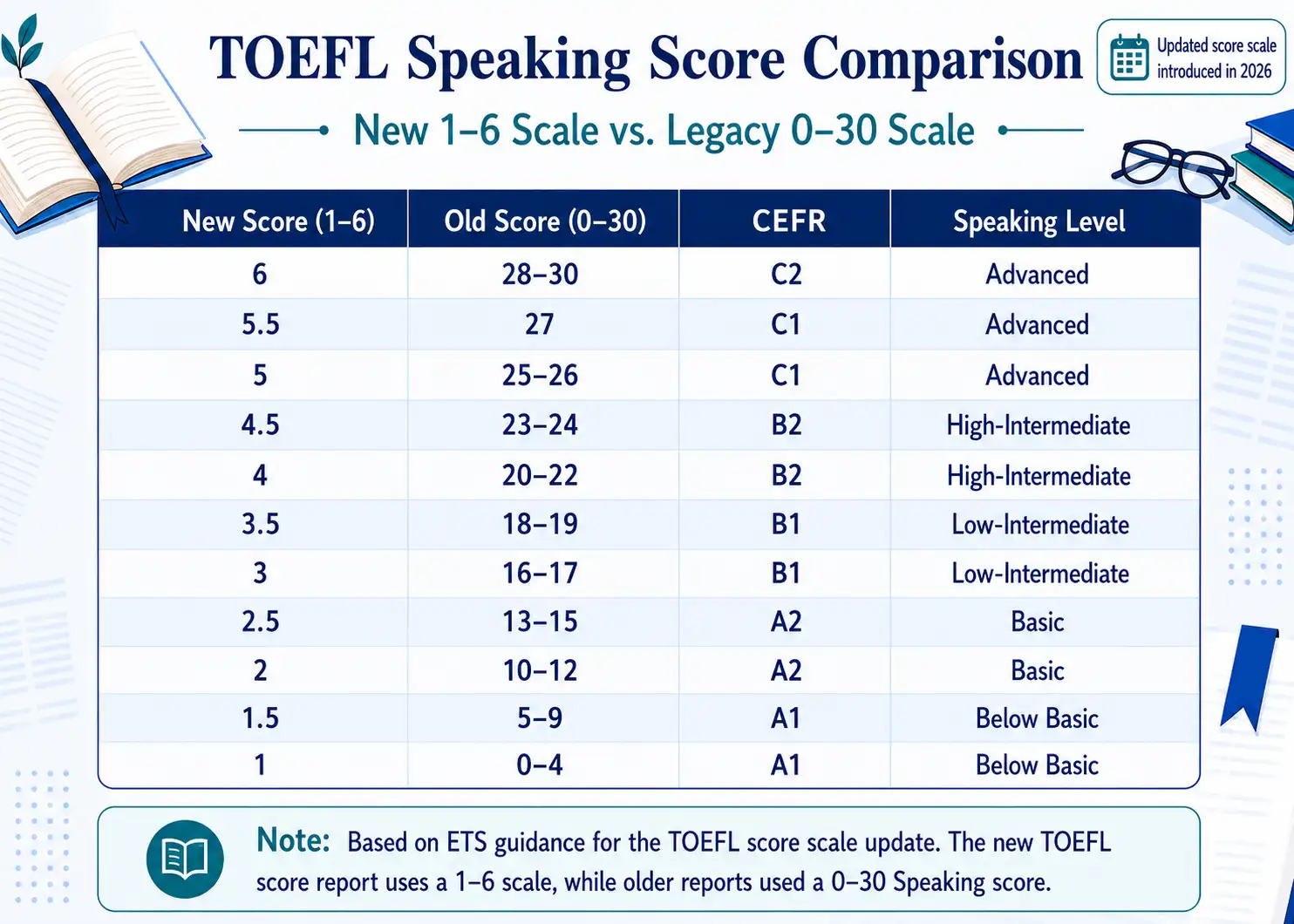
# TOEFL Writing
The TOEFL Writing section measures the candidate's ability to express himself/herself in written English. In this section, the candidate answers tasks such as constructing sentences, writing emails, and responding to academic discussions. This section mainly covers the requirements such as "Build a Sentence", "Write an Email" and "Write for an Academic Discussion". The candidate must answer 23 questions of this type within 12 minutes.
The main goal here is to find answers to questions such as: Can the candidate express his/her thoughts in writing? Can he/she connect sentences and ideas correctly? What is the level of his/her vocabulary? Where is his/her grammatical knowledge? Can he/she answer the required questions in the required format?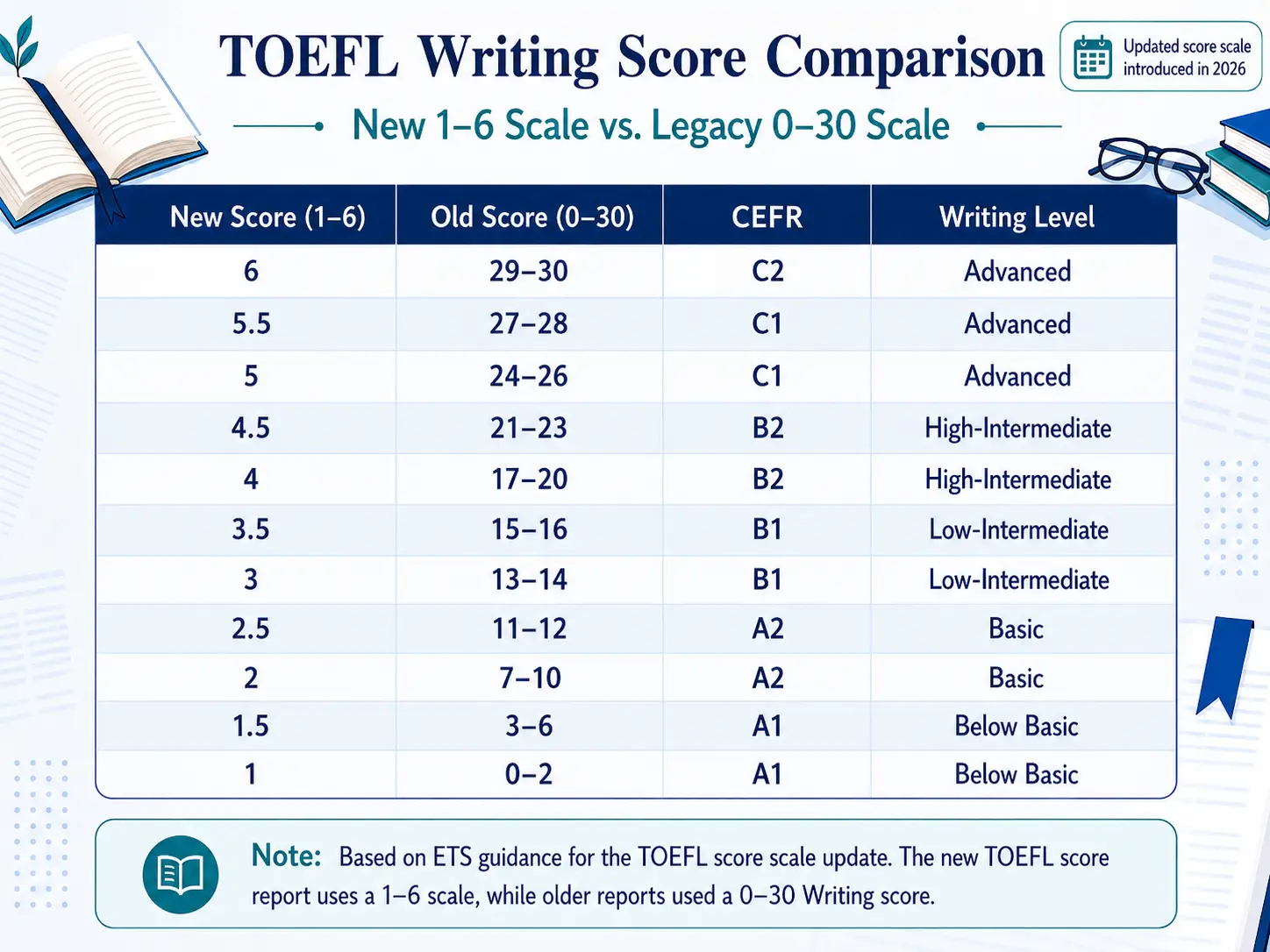
# TOEFL exam scoring system
TOEFL iBT has long been known for its 0–120 scoring system. In this system, each section was evaluated in the range of 0–30 and the results of the four sections were summed to obtain a score in the range of 0–120.
However, this system has changed since January 21, 2026. Now, the score you will get from TOEFL iBT will be in the range of 1–6. According to the official information of ETS, in the new system, the candidate gets a score between 1 and 6 in each of the four sections and then the average of these scores is taken.
TOEFL Overall Score = (Reading + Listening + Speaking + Writing) / 4
The result is then rounded to the nearest half point. According to the official ETS example, if the average of the section scores is 5.25, the overall score is shown as 5.5.
# Example of TOEFL Scoring System
- Reading: 5.0
- Listening: 5.5
- Speaking: 4.5
- Writing: 5.0
TOEFL Overall Score = (5.0 + 5.5 + 4.5 + 5.0) / 4
TOEFL Overall Score = 20.0 / 4
TOEFL Overall Score = 5.0
# How Universities Treat TOEFL Score
Instead of evaluating TOEFL results as “passed” or “failed”, universities evaluate TOEFL results based on whether they meet the requirements for a passing score. That is, the student must meet the minimum score and section score requirements required by the university.
According to ETS, since this system is new to testing, they have announced that they will be able to display scores on both a 0-120 and 1-6 scale to make it easier for candidates. While candidates may think they have to retake the test to get a score between 0-120 on this section, this is not the case. ETS currently provides candidates with scores on both scoring systems so that candidates do not experience any confusion.
# TOEFL Calculator
TOEFL Calculator is a tool that helps calculate a student’s overall score based on their section scores. On the new 1-6 scale, this calculator adds up the Reading, Listening, Speaking, and Writing scores, divides by 4, and displays the result according to the TOEFL rounding rule.
For example, if a student scores 5.0 in Reading, 5.5 in Listening, 4.5 in Speaking, and 4.5 in Writing, the calculator calculates the score as follows:
TOEFL Overall Score = 5.0 + 5.5 + 4.5 + 4.5 = 19.5
TOEFL Overall Score = 19.5 / 4 = 4.875
This score can be rounded to the nearest half-point and is approximately 5.0 overall. That is,
TOEFL Overall Score = 5.0
# Our recommendations for those preparing for the TOEFL exam as Hesabla.com
To improve your TOEFL score, it is not enough to improve your English language skills alone. You also need to be familiar with the test format, question types, and time management. For example,
If your problem is in the "Reading" section, practice reading academic texts quickly and finding the main idea.
If your problem is in the "Listening" section, listen to audio materials specified for Lectures and TOEFL.
If your problem is in the Speaking section, try to give short, clear, and structured answers.
If your problem is in the Writing section, try to write your thoughts in a logical order and clearly by writing multiple essays.
Since each section of the TOEFL affects the overall score, balanced preparation is very important. For example, if Reading and Listening are good, but Speaking and Writing are weak, the overall score may not reach the desired level.
Avoiding these mistakes will make your TOEFL preparation more effective and reduce the risks during university applications.


How the United States calculates taxes for busin...

21 Jul
277