


One of the main standardized tests that students who want to study abroad, especially at US universities, face is the ACT exam. ACT is one of the international tests used to measure the academic skills a student has acquired during his school years. This exam mainly evaluates English, Math and Reading skills. The Science and Writing sections are presented as optional, that is, additional options in the current updated ACT format.
ACT has long been one of the most used tests in the admissions process for US universities, along with SAT. Many universities accept ACT and SAT results as an indicator of academic readiness. However, in recent years, university testing policies have changed: some universities are test-required, some are test-optional, and some are test-blind. Therefore, it is important to check the official admission requirements pages of the universities you will apply to before preparing for the ACT exam.
In this article, we will explain in detail what the ACT exam is, the ACT sections, how the ACT result is calculated, how the Science and Writing sections affect the result, and how universities approach ACT scores.
# What is ACT?
The ACT is a standardized test used in the admissions process for US universities. This test is designed to measure how ready a student is to study at the university level. The ACT focuses mainly on the skills acquired in the school program: understanding texts, correcting written expression, thinking mathematically, analyzing information, and approaching academic problems logically.
The ACT is not just a subject test. That is, this test does not measure only math, only English, or only science knowledge. The ACT tests more on how students use various academic skills together.
# Who needs the ACT?
The ACT is mainly useful for students who want to study for an undergraduate degree abroad. In particular, students applying to US universities can submit the ACT result as part of their application package.
It can be used to demonstrate undergraduate application to US universities, scholarship programs, SAT alternatives, Math and reading skills.
The important point here is that not every university evaluates the ACT result in the same way. Some universities require the ACT or SAT, some accept it optionally, and some do not take the test results into account in their admissions decisions. Therefore, the student should first prepare a list of target universities and check the admission requirements of each university separately.
# What is the Enhanced ACT and what has changed?
The Enhanced ACT is an updated format of this exam. These updates are designed to provide students with a more flexible and shorter test experience. One of the most important changes is that the Science section is optional. That is, a student can add the Science section if they want, but Science is no longer required to get a Composite score.
According to the official higher education information of the ACT, the new Composite score is calculated based on the average of the English, Math and Reading section scores. Students who choose the Science section receive a separate Science score and STEM score. Those who choose the Writing section can see a separate Writing score and ELA score.
In short, Science became optional, the Composite Score changed, the Test was shortened, and Science began to be reported separately
For international students, the official information of the ACT states that starting in September 2025, all students will receive a new ACT Composite Score based on their English, Math and Reading performance. Starting in February 2026, changes are planned to be introduced in the composition of the additional enhanced test for international students.
# How many sections does the ACT have?
The current ACT format consists of core sections and optional sections. The core sections are English, Math, and Reading. Science and Writing are presented as optional.
According to the official ACT information, English consists of 35 minutes and 50 questions, Math consists of 50 minutes and 45 questions, Reading consists of 40 minutes and 36 questions, optional Science consists of 40 minutes and 40 questions, and optional Writing consists of 1 prompt of 40 minutes.
Not every question you encounter on this exam may affect your score. So, according to the official information, 40 questions out of 50 questions in the English section, 41 questions out of 45 questions in the Math section, 27 questions out of 36 questions in the Reading section, and 34 questions out of 40 questions in the optional Science section may affect your score. The remaining questions are used for testing purposes and may not affect your score.
However, since students do not know which questions are intended for testing during the test, they should take all questions seriously.
# What does the ACT English section measure?
The ACT English section measures a student's ability to edit, edit, and express written English more clearly. In this section, students are given short texts and are presented with questions on certain sections. The student must choose the most correct, clearest, and most logical option.
According to the official ACT section structure, the English section measures grammar, usage, and rhetorical skills. This section includes question types such as Production of Writing, Knowledge of Language, and Conventions of Standard English.
The main skills in the English section are: subject-verb agreement, punctuation. Correct use of words and phrases. Choice of phrases appropriate to the purpose of the text, Sequence of ideas and structure of the text, and presentation of sentences in a clearer and more effective form.
To succeed in this section, knowing only the rules of grammar is not enough. The student must also understand the author's purpose, the tone of the text, and the general logic of the sentences.
# What does the ACT Math section measure?
The ACT Math section measures a student's mathematical reasoning and problem-solving skills. This section builds on the basic math knowledge learned in school and requires the student to apply this knowledge to a variety of problem situations.
The ACT score report explanation states that the Math section is divided into the Preparing for Higher Math and Integrating Essential Skills reporting categories. Preparing for Higher Math includes sub-categories such as Number & Quantity, Algebra, Functions, Geometry, Statistics & Probability.
The Math section allows for the use of a calculator within certain guidelines, but not all questions can be answered by a calculator. The student must understand the logic of the question and choose which solution is faster.
# What does the ACT Reading section measure?
The ACT Reading section measures a student's ability to understand, analyze, and compare information in texts. In this section, the student is presented with texts on various topics and asked questions based on those texts.
According to the ACT's official test overview, the Reading section measures how well a student understands and analyzes passages similar to those used in first-year college courses. The questions test for main idea, details, connections, author's purpose, and perspective.
Time management is very important on the Reading section. You have 36 questions to answer in 40 minutes. Therefore, students must be able to read both quickly and accurately.
# What does the ACT Science section measure?
The ACT Science section is an optional section in the current enhanced format. This section measures your ability to understand, analyze, and think scientifically in areas such as biology, chemistry, earth and space sciences, and physics.
According to the ACT's official test overview, the Science section measures interpretation, analysis, reasoning, and problem-solving skills.
Although the Science section is optional, it can be useful for some STEM programs, such as engineering, biology, chemistry, and pre-med. Students who choose Science can receive a separate Science score and a STEM score. According to ACT, students who take the Science section also receive a STEM score in addition to a standalone Science score.
# What does the ACT Writing section measure?
The ACT Writing is an optional essay section. In this section, students are given a prompt about a complex issue and are presented with three different perspectives. Students must develop their position and explain it by linking it to other perspectives.
According to the official ACT section structure page, the Writing section lasts 40 minutes and measures the writing skills a student has learned in high school English and entry-level college composition courses. The Writing score does not affect the Composite score.
# What is the ACT scoring system?
The ACT has basic section scores on a scale of 1–36. There may be separate section scores for each of the English, Math, Reading, and optional Science sections. The composite score is also on a scale of 1–36.
According to the ACT's official scoring explanation, ACT scores are based on the number of questions answered correctly and there is no penalty for incorrect answers. The raw score for each test, i.e. the number of correct answers, is converted to a scale score so that the results have the same meaning across different test formats and test dates.
Since there is no penalty for incorrect answers, students should not leave questions unanswered. If time is short, it is better to choose the most logical option.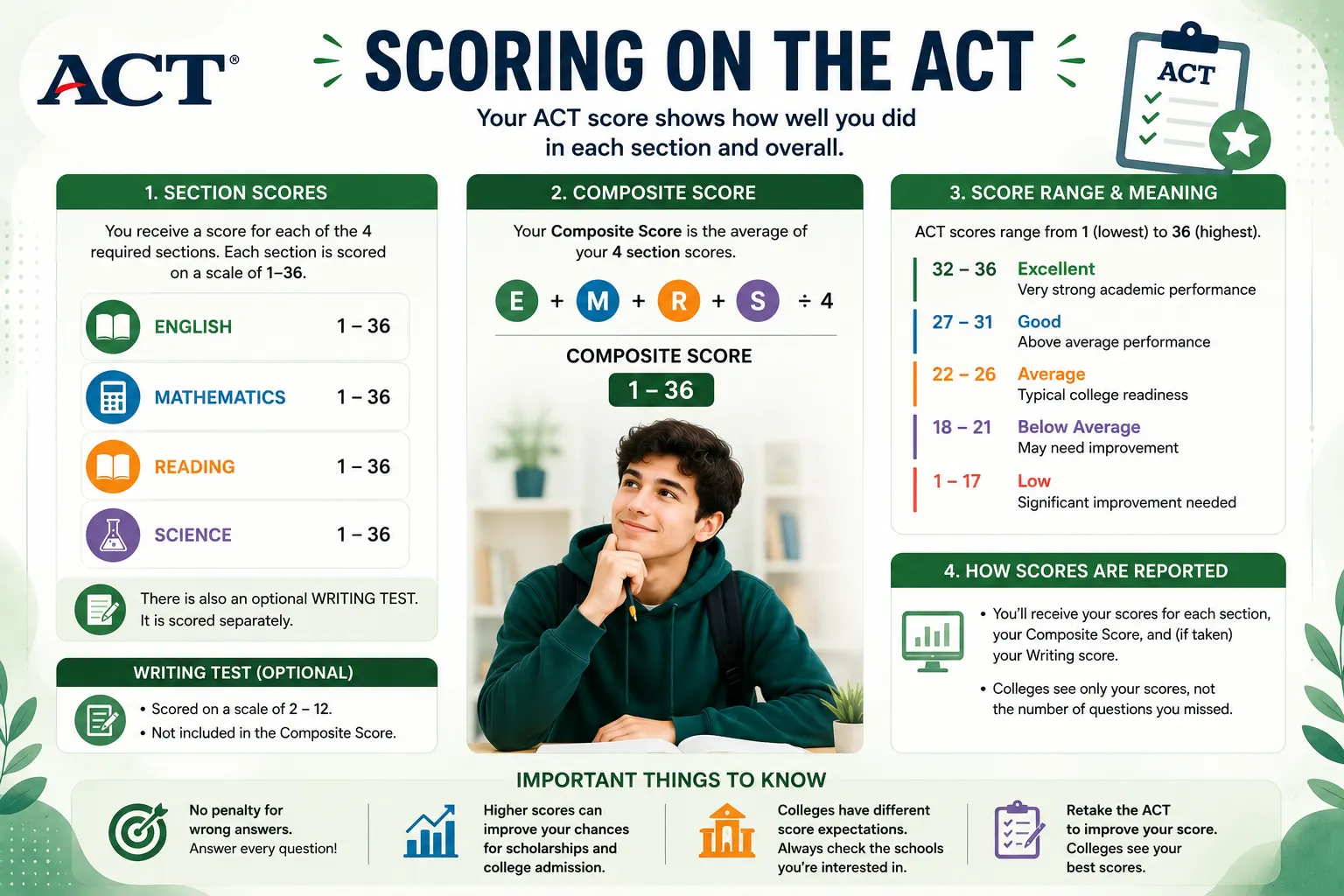
# How is the ACT Composite score calculated?
The ACT's official explanation states that the Composite score is the average of the English, Math, and Reading scores and is rounded to the nearest whole number.
The formula is: ACT Composite Score = (English + Math + Reading) / 3
For example, let's say English(25), Math(27), Reading(26).
Applying our formula, (25 + 27 + 26) / 3 = 26
So, Composite Score: 26
This example shows that each major section of the ACT affects the Composite score. A very poor score in one section can lower the overall score. Therefore, working only on Math or only on English is not enough; English, Math, and Reading should be prepared in a balanced way.
# What is a good ACT score?
A “good ACT score” depends on the student's target university, program, and scholarship goal. According to the official ACT national rankings, the national rank indicates the percentile in which a student's score is compared to other ACT test-takers. For example, a Composite 22 is shown as a national rank of 72, meaning that that score is equal to or higher than 72% of test-takers.
- 18–20, Near average
- 21–24, Good starting level
- 25–28, Strong result
- 29–32, Very strong result
- 33–36, High result for competitive universities
This table is for general information. A score of 25 may be good for a university, but a score of 32 or higher may be required for a very competitive program.
# How do universities view ACT scores?
Universities typically evaluate ACT scores as part of an application package. This means that the ACT score alone is not an admissions or rejection decision. Universities may consider ACT scores in conjunction with GPA, transcripts, recommendation letters, essays, extracurricular activities, English proficiency, and other documents.
If the ACT score is high and the university is test-optional, a student can strengthen their application profile by submitting this score. However, if the score is significantly below the range expected by the target university, it is worth considering whether to submit it.
# How to prepare for the ACT?
The main goal of ACT preparation is to understand the test format, learn time management, and improve weak sections. ACT officially offers free practice resources, PDFs, online quizzes, and full-length practice tests.
Here's how to prepare step by step:
1. Take an official practice test
2. Analyze your English, Math, and Reading scores
3. Identify your weak reporting categories
4. Start practicing with time
5. Record your mistakes separately
6. Check if you need optional Science and Writing
7. Take a full-length test before the test date
Speed is very important on the ACT. Since the number of questions is large, the student must not only know the topics, but also be able to solve them within the time limit.
# Preparation tips for English
To succeed in the English section, text editing skills are also important in addition to grammar rules. Therefore, learn Punctuation rules, practice Sentence structure, know the principle of Conciseness, pay attention to Transition words and understand the purpose of the text.
# Preparation tips for Math
The main goal of the Math section is to apply mathematical knowledge quickly and correctly. To get a good result in this section, focus on Algebra topics, repeat Functions and geometry, practice Statistics and probability, learn Calculator rules and keep an error book.
# Preparation tips for Reading
The main difficulty in the Reading section is time. The student must read the texts in a short time and answer the questions correctly. So, learn Skimming and scanning, understand the author's tone, practice comparing two texts and prove the answer with the text.
# Frequently asked questions
- What is the ACT?
ACT is a standardized test used in undergraduate applications to US universities. This test measures English, Math, and Reading skills. Science and Writing sections may be optional.
- How many sections does the ACT have?
The current ACT consists of English, Math, and Reading sections. Science and Writing can be selected as optional add-ons.
- How is the ACT Composite score calculated?
The Composite score is calculated by averaging the English, Math, and Reading section scores and rounded to the nearest whole number.
- Does the Science score on the ACT affect the Composite?
In the current enhanced ACT format, Science is optional and is not included in the Composite score. If Science is selected, a separate Science score and STEM score can be reported.
- Does the ACT Writing score affect the Composite score?
No. The Writing score does not affect the Composite score. The Writing optional is scored on a 2–12 scale.
- Is there a penalty for incorrect answers on the ACT?
No. ACT scores are based on the number of correct answers and there is no penalty for incorrect answers.
- What is a good ACT score?
This depends on the target university. In general, a score of 25–28 is considered strong, 29–32 is very strong, and 33–36 is highly competitive. The best approach is to look at the university's admitted student ACT range information.
- Why do you need an ACT Calculator?
The ACT Calculator helps you calculate a Composite score by entering your English, Math, and Reading scores. This is useful for planning your target score and analyzing your practice test results.
- Should you take the ACT or the SAT?
This depends on the student's strengths and suitability for the test format. The ACT requires more speed and section variety. The SAT, on the other hand, works with an adaptive module system in a digital format. Both tests are accepted by universities.




How the United States calculates taxes for busin...

21 Jul
277