
IELTS results come as five numbers: a band score from 0 to 9 for each of Listening, Reading, Writing and Speaking, plus an overall band score. Universities, employers and visa authorities usually look at the overall score first — so it is worth knowing exactly how it is worked out.
The overall score: an average, rounded to the nearest half band
According to IELTS, the overall band score is the average of the four section scores, rounded to the nearest whole or half band. Two boundary cases are always rounded up:
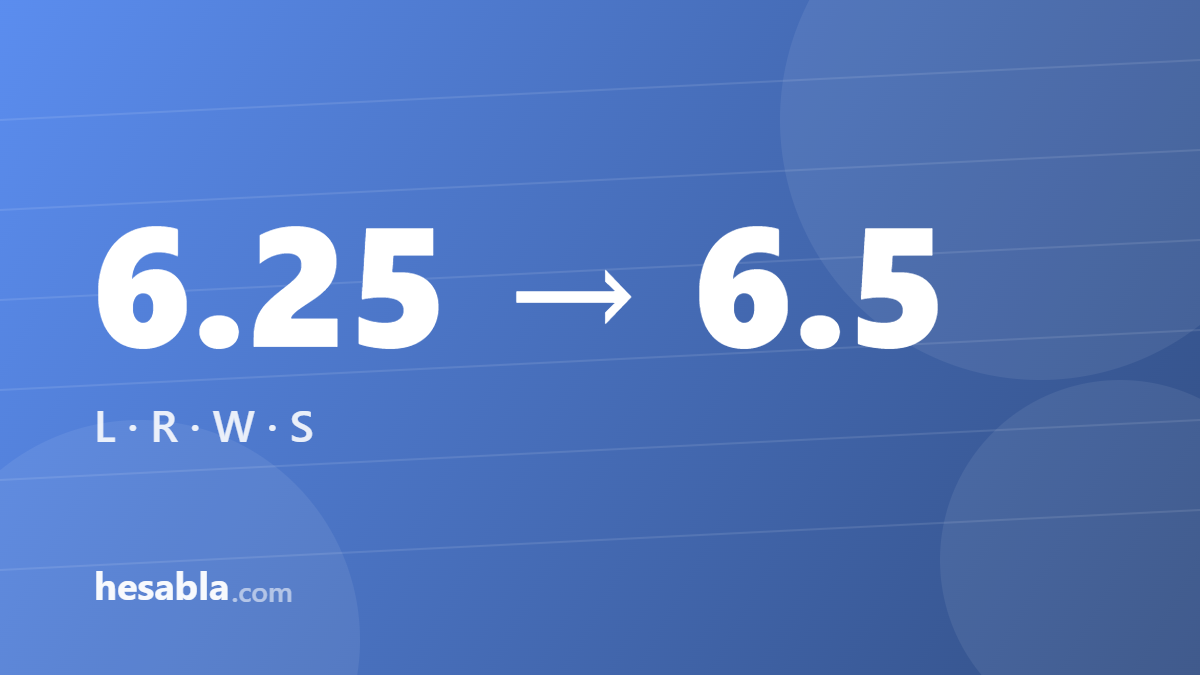
- an average ending in .25 goes up to the next half band (6.25 → 6.5);
- an average ending in .75 goes up to the next whole band (6.75 → 7.0).
Official examples
| Listening | Reading | Writing | Speaking | Average | Overall |
|---|---|---|---|---|---|
| 6.5 | 6.5 | 5.0 | 7.0 | 6.25 | 6.5 |
| 4.0 | 3.5 | 4.0 | 4.0 | 3.875 | 4.0 |
| 6.5 | 6.5 | 5.5 | 6.0 | 6.125 | 6.0 |
Look at the last row: an average of 6.125 is closer to 6.0 than to 6.5, so it rounds down.
Listening and Reading: from correct answers to bands
Each of these tests has 40 questions worth one mark each, and your raw score is converted to the 9-band scale. The exact conversion varies slightly from one test version to another, but IELTS publishes these typical figures:
| Band | Listening | Academic Reading | General Training Reading |
|---|---|---|---|
| 5 | 16 / 40 | 15 / 40 | 23 / 40 |
| 6 | 23 / 40 | 23 / 40 | 30 / 40 |
| 7 | 30 / 40 | 30 / 40 | 35 / 40 |
| 8 | 35 / 40 | 35 / 40 | — |
As the table shows, General Training Reading usually needs more correct answers for the same band than Academic Reading.
Writing and Speaking: four criteria each
Examiners mark Writing on Task Achievement (Task 1) or Task Response (Task 2), Coherence and Cohesion, Lexical Resource, and Grammatical Range and Accuracy. Task 2 carries more weight than Task 1. Speaking is marked on Fluency and Coherence, Lexical Resource, Grammatical Range and Accuracy, and Pronunciation, with all four criteria weighted equally.
What this means for your preparation
- Because the overall score is an average, improving your weakest section is often the quickest way to raise it.
- Rounding works in your favour at .25 and .75 — half a band more in just one section can be enough to lift your overall score.
- Read the requirement carefully: many universities and employers ask for a minimum in each section as well as an overall score.
Want to check a combination quickly? Pick your four scores in our IELTS band score calculator — it applies the official rounding rules and shows the unrounded average too.