
IELTS or International English Language Testing System is an exam that proves English language proficiency for those who want to study abroad, work in international companies, and even apply for migration programs. IELTS is one of the world’s best-known English-language proficiency tests.
The IELTS exam is not a simple English language test, but on the contrary, it is an exam that measures the candidate's English listening, reading, writing, and speaking skills separately and shows the result with a system from 0 to 9.
In this article, as Hesabla.com, we will explain in detail what IELTS is, the differences between IELTS Academic and General Training, how IELTS Band Score is calculated, and how universities approach IELTS results.
# What is IELTS?
IELTS stands for International English Language Testing System. That is, the International English Language Assessment System. This exam is designed for people whose native language is not English, and you can measure your English language proficiency in detail in this exam. Because, this exam is designed according to international standards and shows what level you are at by focusing on each English language skill separately.
IELTS is organized by the British Council, IDP IELTS and Cambridge University Press & Assessment. That is, the test is an international English language exam jointly owned by these three institutions.
# Who needs IELTS?
IELTS candidates may need it for various reasons. For example, IELTS Academic is needed for candidates who want to study abroad for undergraduate studies, and IELTS General Training is needed for Migration Applications and Job Applications.
As you can see, each institution has different requirements. If you want to study abroad, you may be required to take IELTS Academic, but if you are applying for a job, then IELTS General Training is needed.
# What is the difference between IELTS Academic and General Training?
There are two main exams in the IELTS exam: IELTS Academic and IELTS General Training.
IELTS Academic, as we understand from the name, is needed more for academic purposes. These include more academic purposes such as applying to universities abroad, master's and doctoral programs.
IELTS General Training, this type of exam is required more for purposes such as everyday life, work and migration. In this type of exam, you will encounter questions related to everyday life, work environment and social situations, which are closer to the purpose of the exam, rather than academic texts.
# What is IELTS for UKVI?
IELTS for UKVI, as you can guess from the name, is actually intended for candidates with UK purposes. It is similar to the IELTS test, but there is one difference here: it is conducted in accordance with special security requirements for UK Visa and Immigration applications. So, if you are applying to the UK for study, work or migration, a standard IELTS result is not enough for you. It can even differ here at the Test Center, and in some UK Visa applications only and only the IELTS for UKVI result given at a UKVI-approved test center is accepted.
# How many sections does the IELTS exam consist of?
If you are going to apply for the IELTS exam, one of the points you should know is that this exam consists of four sections. These are Listening, Reading, Writing and Speaking.
# IELTS Listening
The IELTS Listening section measures the candidate's listening skills in English. In this section, they are given various listening materials. For example, they listen to a dialogue between several people and then answer the exam questions on the paper given to them. There are 40 questions in this section and each correct answer can be considered as 1 point. These question types include the following:
- Multiple Choice, several options are presented to you and you have to choose the correct one from them.
- Matching, several pieces of information are presented to you and you have to match the correct information from them.
- Form Completion, filling in the blanks.
- Map/Diagram Labelling, recording information on a map or diagram.
- Short Answer, writing a short answer to the question given.
After answering the questions related to the IELTS Listening section, your score is initially evaluated out of 40 and then converted to a 9.0 point system in accordance with IELTS standards.
Although candidates in this section think that they will have difficulty understanding the words mainly when hearing them, this is not one of the main problems here. Because, it is not enough to just understand the words, you also need to understand the content and details of the conversation correctly.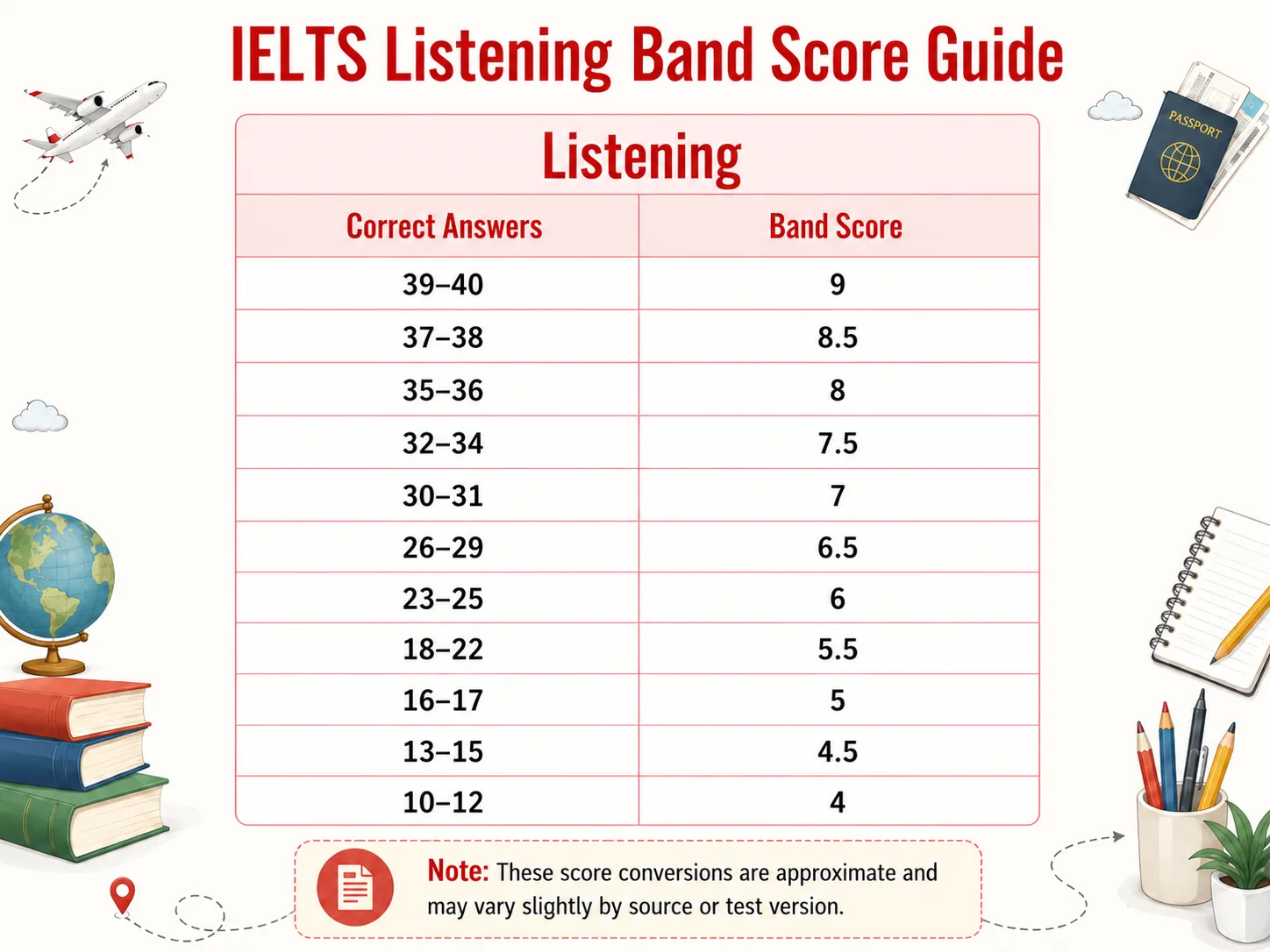
# IELTS Reading
The IELTS Reading section measures how well a candidate can understand written texts. In this section, they take a 60-minute exam and are faced with a test consisting of 40 questions. In this section, they are faced with academic and semi-academic texts. However, if you have entered the IELTS General Training exam, you will be faced with texts related to everyday life, the workplace and general social situations in this section.
In this section, you are mainly required to find the main idea, understand the details, determine the author's position, draw conclusions and find specific information within the text. You may encounter questions like these in this section,
- True/False/Not Given, Check the consistency of the information with the text.
- Matching headings, Choose a suitable heading for the paragraph.
- Sentence Completion, Complete the sentence based on the text.
- Summary Completion, Fill in the gaps in the short summary.
- Multiple Choice, Choose the correct option from several options.
In this section, you also need serious time management skills. Because within 60 minutes, you have to read the text and answer the 40 questions in front of you. Therefore, our advice to you is to set yourself a time limit and practice tests using a timer at least 2 months before the exam as if you were in the exam.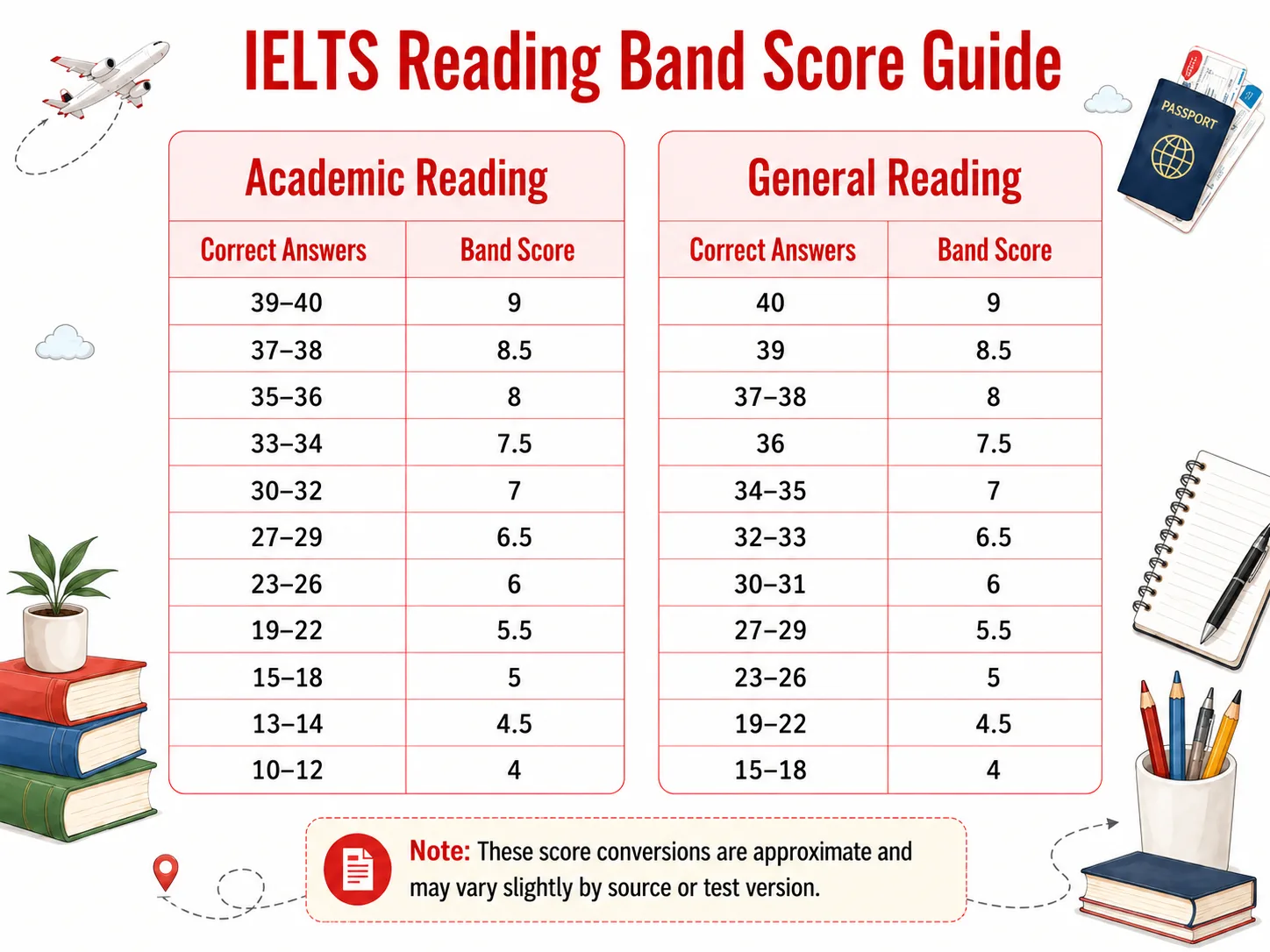
# IELTS Writing
In the IELTS Writing section, you are given the same 60 minutes as Reading, but in this section, instead of working on the text, you are faced with writing questions consisting of two tasks. As in the Reading section, there are different requirements for General Training and Academic candidates.
IELTS Academic Writing Task 1, The candidate must explain visual information such as graphs, tables, maps, process diagrams in his own words. The main goal of this Task is to select and compare information correctly.
IELTS Academic Writing Task 2, The candidate writes an essay on a given topic. Topics can be mainly expressing an opinion, solving a problem, discussing or discussing positive or negative aspects of topic X.
IELTS General Training Writing Task 1, The candidate writes an essay relevant to daily life. This essay should be mainly in a letter format. However, there is no obligation for this essay in a letter format to be formal, it can also be semi-formal or informal.
IELTS General Training Writing Task 2, there is no difference here, you will write an essay as in task 1, but the main difference between this task and the other is that it is more important. Therefore, we recommend that you devote special time to this task.
One of the questions that remain in the minds of candidates while writing the Writing section is, can we still get a low score in this exam even if we write fluently and clearly without grammatical errors and with logical consistency? In fact, we can say yes to the answer to this question. Because, your essay is not only measured on these grounds, but also on the basis of how correctly the task is answered, the structure of the writing and the connection of ideas, vocabulary and grammatical accuracy are evaluated in the essays you write.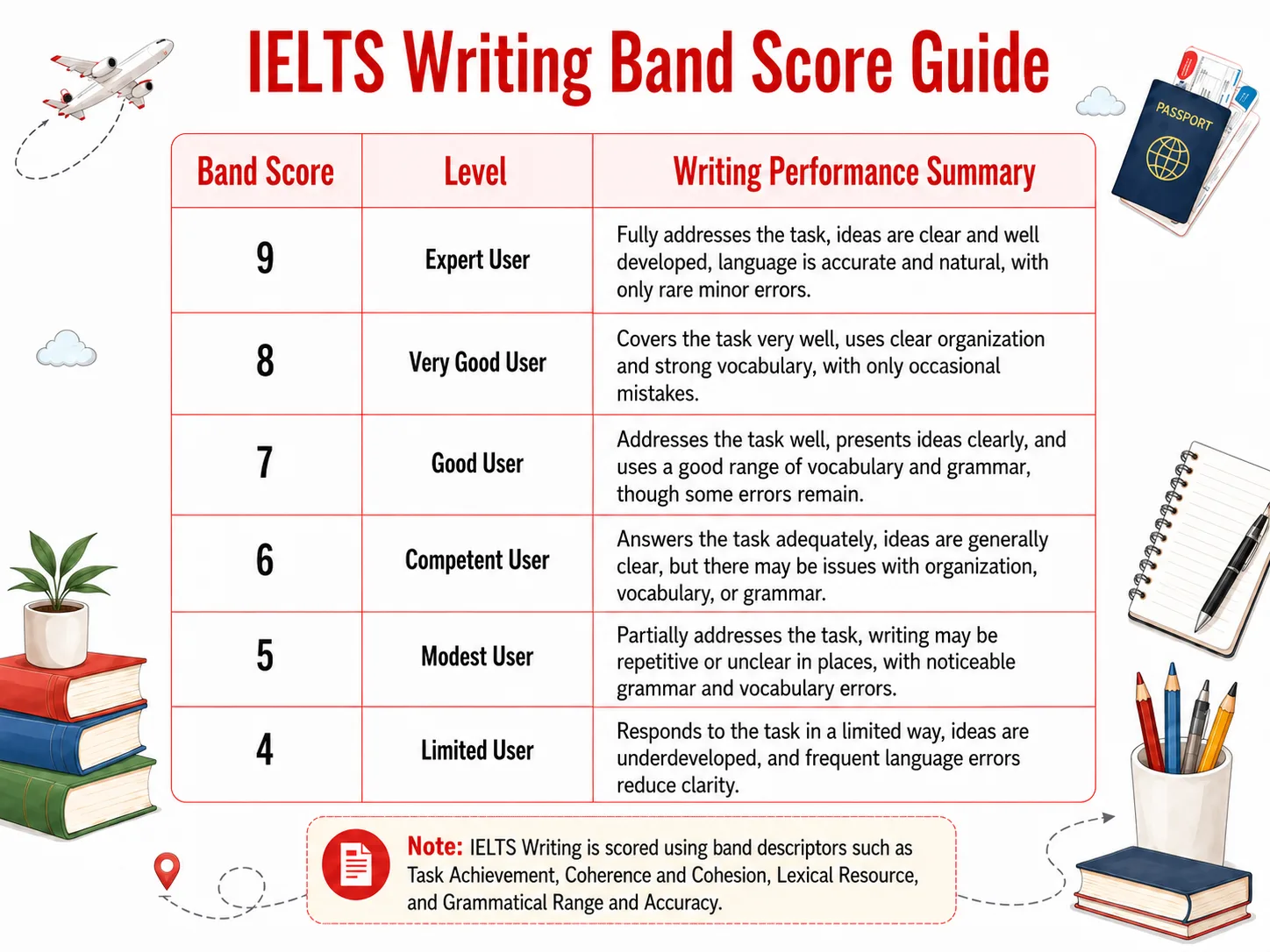
# IELTS Speaking
The IELTS speaking section usually lasts between 11 and 14 minutes. This section is mainly organized on the basis of face-to-face conversation like an interview. You will be greeted by three different parts in this section,
In the first part, you talk about yourself, your family, education, work, where you live, daily habits and personal interests.
In the second part, you are presented with cards with topics and you are given very little time to prepare for those topics.
In the third part, broader, more detailed and more analytical questions related to the topic you are talking about are asked in the second part. The aim here is to check how much the candidate has the ability to explain, justify and speak on more complex topics more clearly.
The most important factors to consider when assessing this section are the connection of ideas, vocabulary, grammatical accuracy and clarity of pronunciation. When you say clarity of pronunciation, you might think that your main goal is to have a perfect accent, but this is not the case. The goal here is to explain the idea in a clear, logical and understandable way.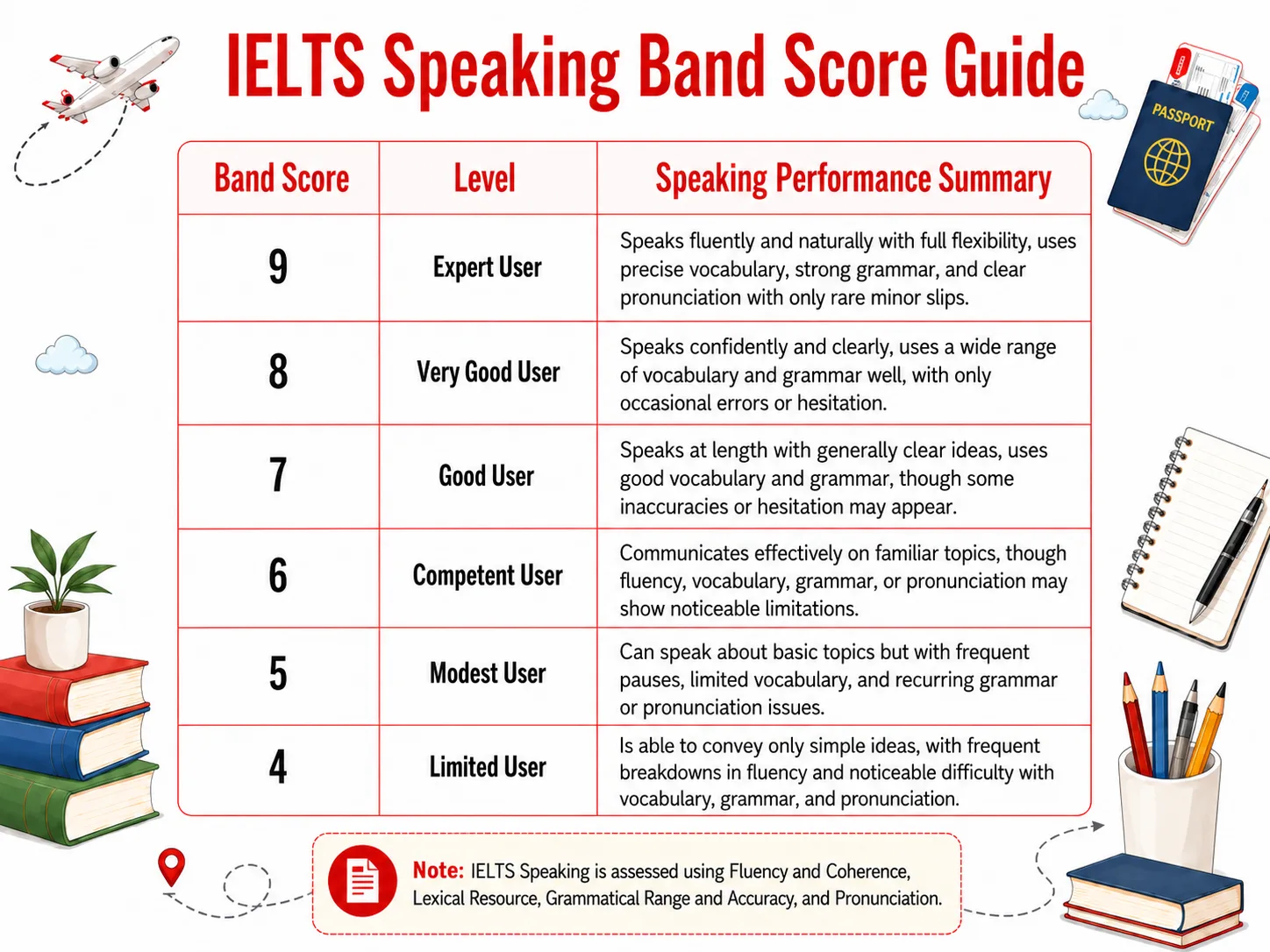
# What is an IELTS Band Score?
In the IELTS exam, each candidate is evaluated on a score system from 0 to 9. The candidate's result is shown both overall and separately for the four sections. So, what score means what?
- 9.0 -> Expert User -> C2
- 8.5 -> Very Good User -> C2
- 8.0 -> Very Good User -> C1
- 7.5 -> Good User -> C1
- 7.0 -> Good User -> C1
- 6.5 -> Competent User -> B2
- 6.0 -> Competent User -> B2
- 5.5 -> Modest User -> B2
- 5.0 -> Modest User -> B1
- 4.5 -> Limited User -> B1
- 4.0 -> Limited User -> B1
- 3.5 -> Extremely Limited User -> A2
- 3.0 -> Extremely Limited User -> A1
- 2.5 -> Intermittent User -> A0
- 2.0 -> Intermittent User -> A0
- 1.5 -> Non-User -> A0
- 1.0 -> Non-User -> A0
- 0.0 -> Test not taken or no answer -> A0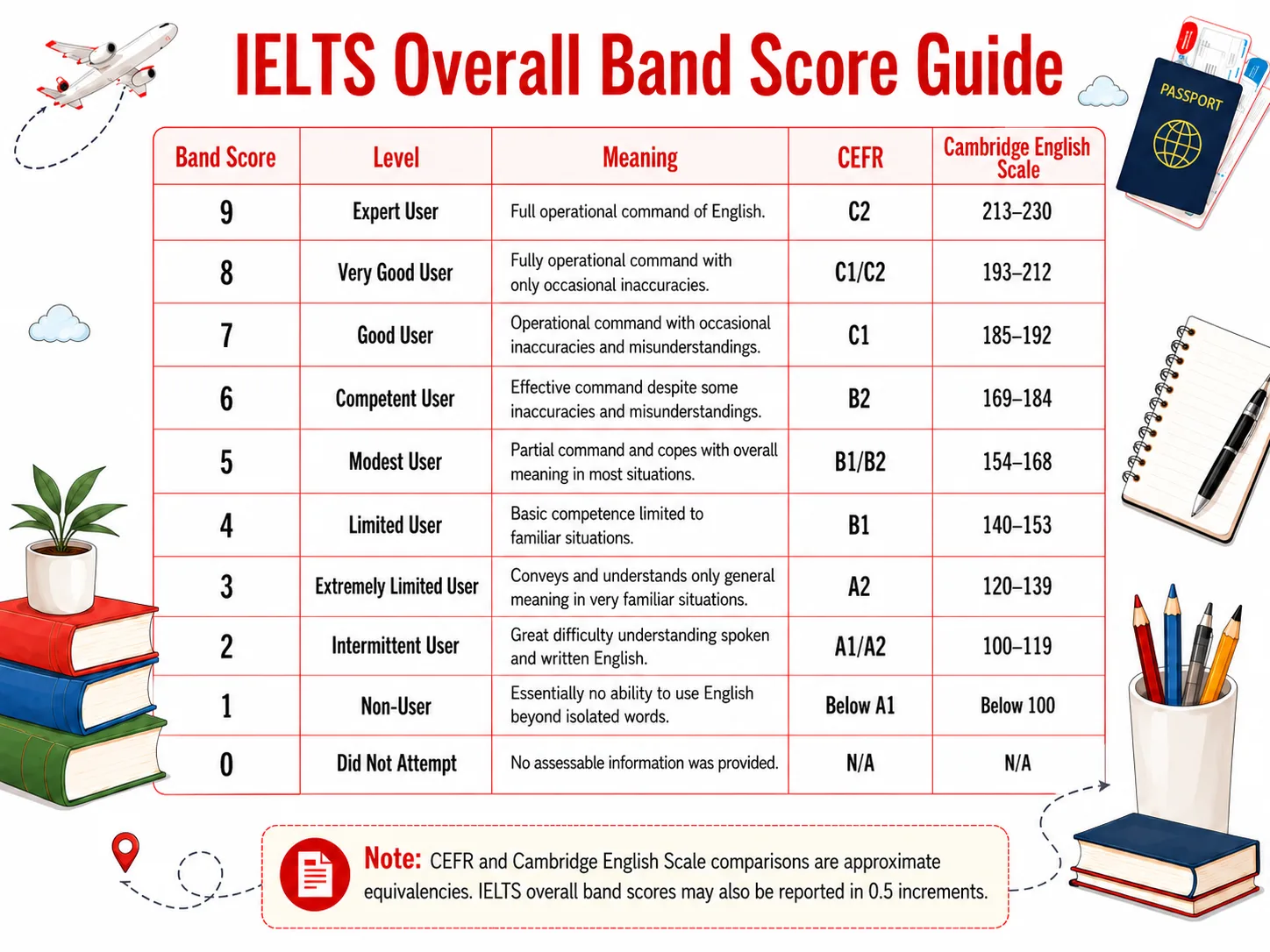
# How is IELTS Band Score calculated?
If you want to know what your overall score is in IELTS, then you add up the results from the four sections and then divide by four to get the average result of the four sections, that is, the overall score. For example,
- Listening -> 6.5
- Reading -> 6.5
- Writing -> 5.0
- Speaking -> 7.0
First we add up: 6.5 + 6.5 + 5.0 + 7.0 = 25.0
Then we divide by four: 25.0 / 4 = 6.25
After rounding the resulting number, our result is: 6.5
# What is IELTS Band Score Calculator and how does it work?
Like our other tools, the IELTS Band Score Calculator helps you estimate section scores and calculate your overall band score. That is why, just like other calculators, our site also has an IELTS Band Score Calculator, through this Calculator, you can see how many correct answers you get for each subject, as well as calculate your overall result for four sections.
# Validity period of IELTS results
Another question that interests IELTS candidates is related to the validity period. Unlike many exams, the validity period of IELTS results is determined as two years. Thus, many applicants, even students, enter the IELTS exams earlier to make the division correct so that they can devote more time to other things, or simply wait another year and try their luck again in the second year instead of entering the exam again because the university they were admitted to that year does not satisfy them. However, sometimes candidates actively keep the test result on their profiles on platforms like LinkedIn even after the validity period has expired, in order to prove that they have improved their language skills even after two years.
# How are IELTS exam dates chosen?
As Hesabla.com, we cannot give you an exact date for the IELTS exam date. Because these dates may vary from country to country, city to city, and even from test center to test center. So, if you want Computer-Delivered IELTS, this exam type is held frequently and you can get faster results. Or, if you want Paper-Based IELTS, this exam type is organized on certain dates depending on the test center.
If you want to get more accurate information, you can definitely visit the British Council website.
# Our advice as Hesabla.com to increase your IELTS Score
If you want to increase your IELTS score, you must definitely identify your weaknesses in each section. If you have a problem with Listening, listen to audio in different accents. If you have a problem with Reading, read books in English and have discussions about the book. If you have a problem with Writing, work on Essay structure, topic sentence and linking words skills. If you have a problem with speaking, try to express your thoughts in your own words in a natural way instead of the same sentences that everyone memorizes about speaking topics.
It is not enough to just work on your skills, but another problem for candidates is to focus on the overall result, which is why we emphasized at the beginning of our article that you need to devote special time to each skill and identify your weaknesses.
These mistakes are not always internal to the exam, but also problems such as not knowing the difference between academic and general training and not being able to prepare for the appropriate test type, candidates who will send documents to the UK turning to other exams instead of the IELTS for UKVI exam, and choosing the exam date late can be seen. Try not to make these mistakes.
The Hesabla.com team wishes you success in the exam!


How the United States calculates taxes for busin...

21 Jul
277