As we know, the last time humanity left Earth was on December 7, 1972, with the Apollo 17 mission. Now we are doing it again with the Artemis 2 mission.
Although some technical problems arose during this mission, they were eventually resolved. The problem was related to a system that had to send a signal to the rocket to choose the right direction if it changed direction. The status of the mission was a mystery for a while, but NASA announced that the problem had been resolved shortly after.
NASA's Artemis II mission, which sent four astronauts to the Moon, began at 01:35 on April 2.
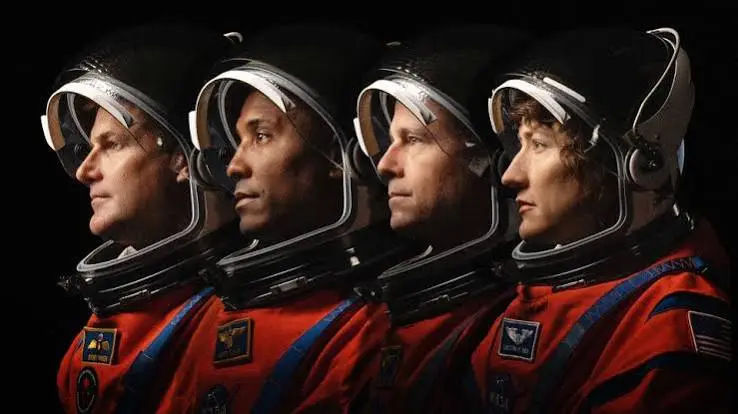
The Orion spacecraft was launched into space from the East Coast of the United States on April 2. NASA astronauts Reed Weissman, Victor Glover, Christina Koch, as well as Canadian Space Agency astronaut Jeremy Hansen were on board. The crew is scheduled to orbit our planet's natural satellite and return to Earth within 10 days. Among other things, the mission participants tested new spacesuits that can breathe autonomously for up to six days. Four astronauts, Reed Weissman, Victor Glover, Christina Koch, and Jeremy Hansen, traveled around the Moon and back.
The spacecraft is expected to travel about 400,000 kilometers, which is the farthest distance from Earth in human history. The journey is expected to take ten days.
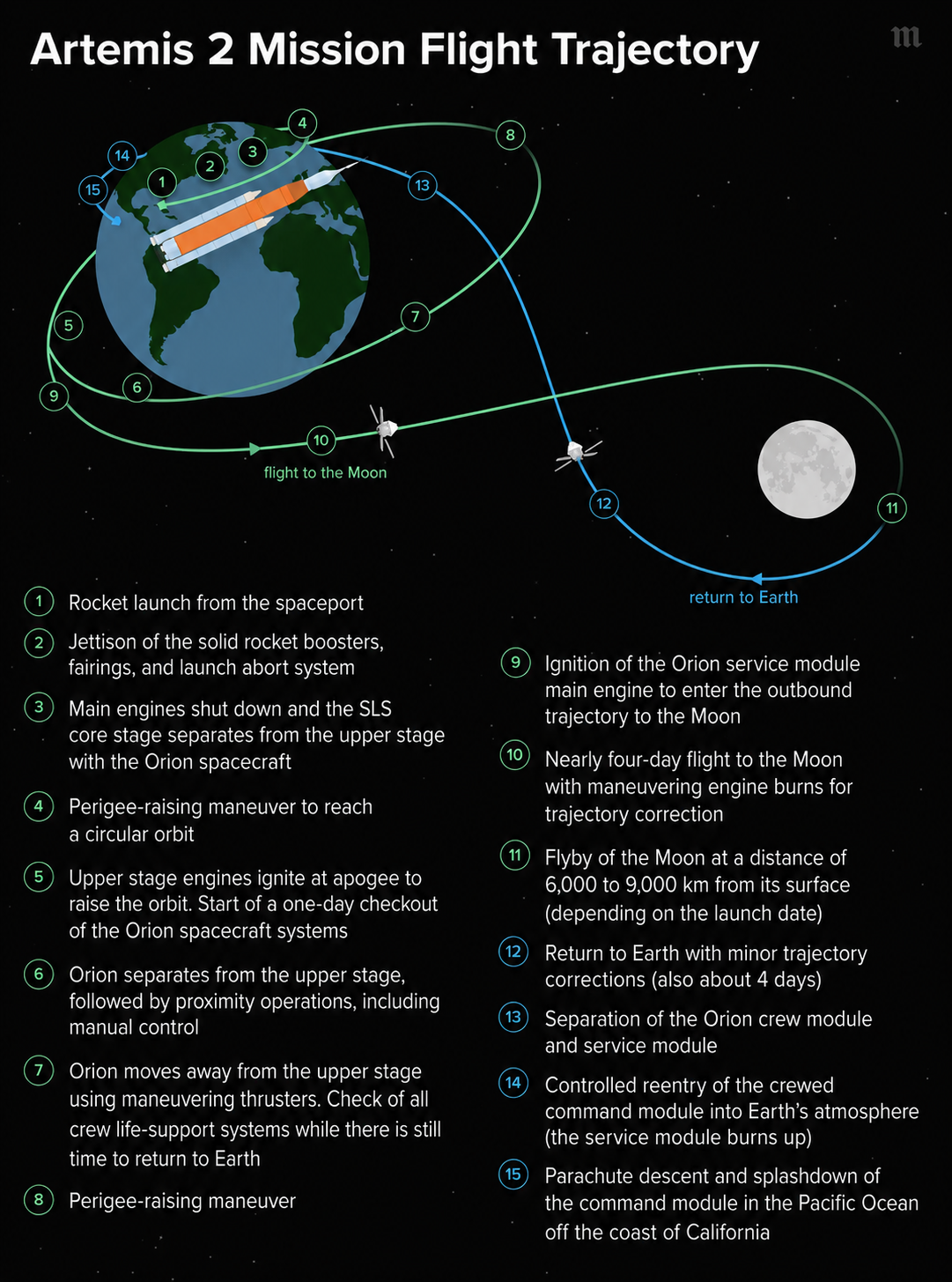
Orion's current position can be viewed at any time in NASA's interactive 3D visualization. If you don't want to deal with 3D visualization in your browser, you can understand the flight path schematically in this image:
The surface of the Moon may appear dry, dusty and quite barren, but that is not true. "The Moon contains the same elements as those found on Earth," says Professor Sarah Russell, planetary scientist at the Natural History Museum. "For example, there are rare earth elements that are very rare on Earth, and in some areas of the Moon there may be high enough concentrations to extract them."
The first significant step was taken on 21 December 1968, when Apollo 8 was launched into lunar orbit and circled the Moon 10 times (the spacecraft returned to Earth a week later and landed in the Pacific Ocean). On 3 March 1969, the module that would be used for the lunar landing was tested by Apollo 9. A small tunnel from the main body of the Apollo was used to access the lunar module, paving the way for a man to transfer from one spacecraft to another without leaving the spacecraft.
The Artemis II mission is a critical test of the Artemis Programme, which will pave the way for a manned lunar landing. With missions planned for the coming years aiming to establish a permanent base on the Moon and even send humans to Mars, we're likely to see more records broken.